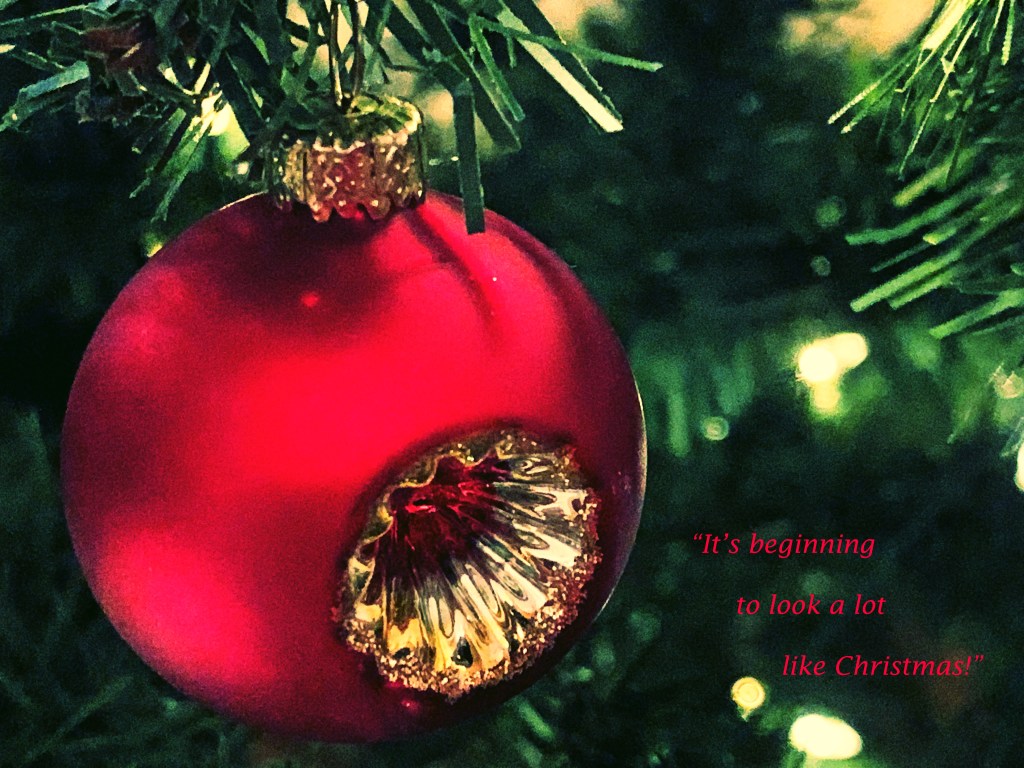
Photo/Text – It’s beginning to look a lot like Christmas
“On the off chance that you’re not going to live forever, why not take a chance on being happy now?”
Further lending support to that thing about the blind hog and the acorn, while aimlessly wandering through The Newsroom clips on YouTube (How did I get here?) I came upon this one in which the Charlie Skinner character (Sam Waterston) is lecturing the Will McAvoy character (Jeff Daniels). Skinner’s wisdom in the series often drips with sarcasm (thus, my affinity for his character), but it delivered the point in that scene — and does for us today.
The series is long gone of course, and Waterston (he would, I think, appreciate the irony) has since passed away, but in this pandemic time where it seems so natural to put off damn near everything but the basics of life “until things get back to normal,” perhaps, just perhaps, there is some room to take Skinner’s advice, throw caution to the wind (but not the mask and social distancing), and, on the “off chance” that we are not immortal, “take a chance on being happy now.”

Photo taken in Galveston last week. Text from the hymn — “Great Is Thy Faithfulness.”
From Anthony DeMello’s One Minute Wisdom:
“Help us find God.”
“No one can help you there.”
“Why not.”
“For the same reason that no one can help the fish find the water.”
Confession time. This took me to an occurrence that seems to be increasing in frequency. I walk around looking for my keys that are in my pocket (or worse yet, my hand), looking for my hat that is on my head, searching for my glasses that are on the top of the hat that is on my head. You may know the feeling. But it occurs to me that “trying to find God” is like that – only worse. Just like my keys, my glasses, my hat – He was and is always right there. Which reminds me of the bumper sticker: “If you are trying to find God, guess who got up and left!” Doh!
From Anthony DeMello in Awareness:
“And so in order to wake up, the one thing you need the most is not energy, or strength, or youthfulness, or even great intelligence. The one thing you need most of all is the readiness to learn something new. The chances that you will wake up are in direct proportion to the amount of truth you can take without running away. How much are you ready to take? How much of everything you’ve held dear are you ready to have shattered, without running away? How ready are you to think of something unfamiliar?”
I love that sentence: “The one thing you need most of all is the readiness to learn something new.” Note that isn’t saying that I actually need to learn something new, only that I need to be ready to learn something new. It occurs to me that in this Information Age, it is increasingly a challenge to “be ready to learn something new.” While I have always had a tendency to hang with people who look, act, and think like I do, now someone much smarter than me has created a magical algorithm that feeds to my devices with information that reaffirms my existing thoughts and beliefs. That algorithm not only shields me from “something new” but also arms me with information that allows me to do battle with those with those who (go figure!) dare to disagree with me. (Of course, as its actual reason to be, that algorithm also offers me opportunities to buy “aligned” goods and services.) Yet in all this, as DeMello puts it, I need to expose myself to “something unfamiliar,” or, in Paulinian terms (Romans 12:2), I need to resist the urge to “conform to the patterns of this world” in order to be “transformed” by the renewing of my mind.
All which points to DeMello’s question: “How much of everything you’ve held dear are you ready to have shattered, without running away?” Yikes!
Happy Thanksgiving — though, per the quote, those may be redundant. Photo taken in California back when travel was a thing.

“Always remember that to argue, and win, is to break down the reality of the person you are arguing against. It is painful to lose your reality, so be kind, even if you are right.” Haruki Murakami
I ran across this quote today and it is yet another pointer to a word that has been much on my mind lately – “kindness.” It has recently occurred to me that “kindness” is a powerful yet underappreciated sibling of “love” that is somehow relegated to a lesser role. Anyway, that’s a whole ‘nother story. What struck me here was the admonition – “be kind, even if you are right.” We could, of course, just put the “.” after “kind” and leave it at that, but the point is a significant one. It is easy to “rub it in” when I am right, and kindness should be part of the celebration ritual. In winning, there is always a related loss, and the opportunity exits to amplify the winning with kindness.
I heard this quote recently on a podcast and it stuck with me:
“We must transcend the places that hold us.” Ruben “Hurricane” Carter
This from a boxer who spent 20 years in prison before being released on a what was deemed to be a wrongful conviction — that is, he knows something about “places that hold us.”
But the quote obviously begs the question — “What are the places that hold me?” And of course, the follow up — “How do I transcend them?”
I have this concept that likely has some long scientific name and explanation but I just call it the yellow car principle. It is fairly simple. You may not really pay attention to the number of cars on the road that are yellow (.2%, or 2 out of 1000 per Google), but you know they are fairly rare. That said, if you buy a yellow car, or even just in reading this yellow cars come to the front of your mind, for some time after that, yellow cars will seem more common. That is, you’ll see them more often. Now obviously, buying a yellow car only puts one more yellow car on the road, and thinking about yellow cars puts no more on the road. So seeing more yellow cars is a mental thing. It is not that there are more yellow cars on the road.
This yellow car principle came to my mind recently when I picked up a cotter pin off the street while running (it was me running, not the cotter pin or the street). Oddly, this occurred while I was listening to Merle Haggard sing Holding Things Together , which is of course what cotter pins do. I see lots of things on the road when I run. Washers, bolts, change — even found a dollar bill last week — but I don’t recall ever seeing a cotter pin. but since then I have seen picked up two more (neither while listening to Merle).
By this time, you’re wondering where the hell this is going. So am I. But I guess the point, if there is one, is this. How might I change my life if I preloaded it with good things instead of bad, good news instead of bad news, stories of accomplishment and success instead of failure? And what’s the harm in engaging in that experiment?
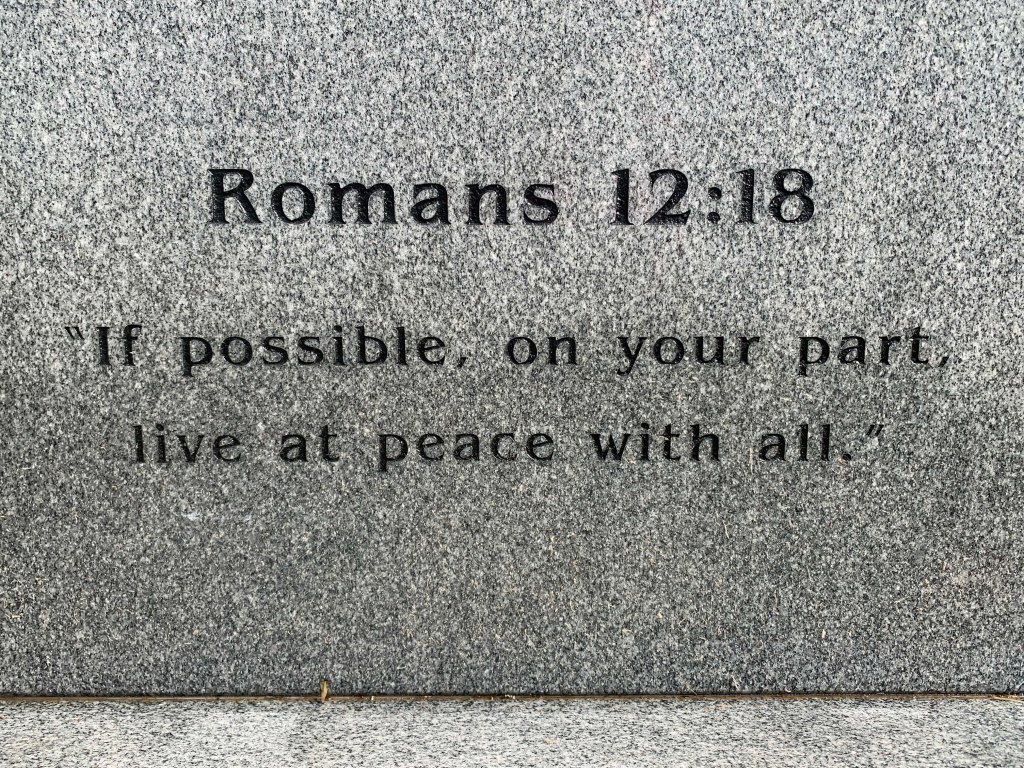
While I felt drawn to take the photo, the irony of this being chiseled on the back of a headstone was lost on me until after the fact, looking at the photo. It somehow conjures up images of Jacob Marley.
 It occurs to me...