Prayer and World Peace

“The efficacy of prayer is often measured by the degree to which the individual is willing to become involved in actually working in the world to meet these needs.  A man may share in his prayer his concern for peace in the world and yet, in his own little world, be unwilling to change his private attitude of antagonism or prejudice toward his fellows.”  Howard Thurman

It’s not like God needs my help on that world peace thing, but still, I suspect he would appreciate me handling some of my own conflicts, or maybe even heading them off before they arise.

Be still and cool

Reading today I came across this written by George Fox (the founder of the Quaker movement) in 1658.  It still  has application some 363 years later, reckon it always will:

“Be still and cool in Thy own mind and spirit, from thy own thoughts, and then thou wilt feel the principle of God to turn thy mind to the Lord God, whereby thou wilt receive God’s strength and power from whence life comes, to allay all blusterings, storms, and tempests.”

Awareness and Appreciation

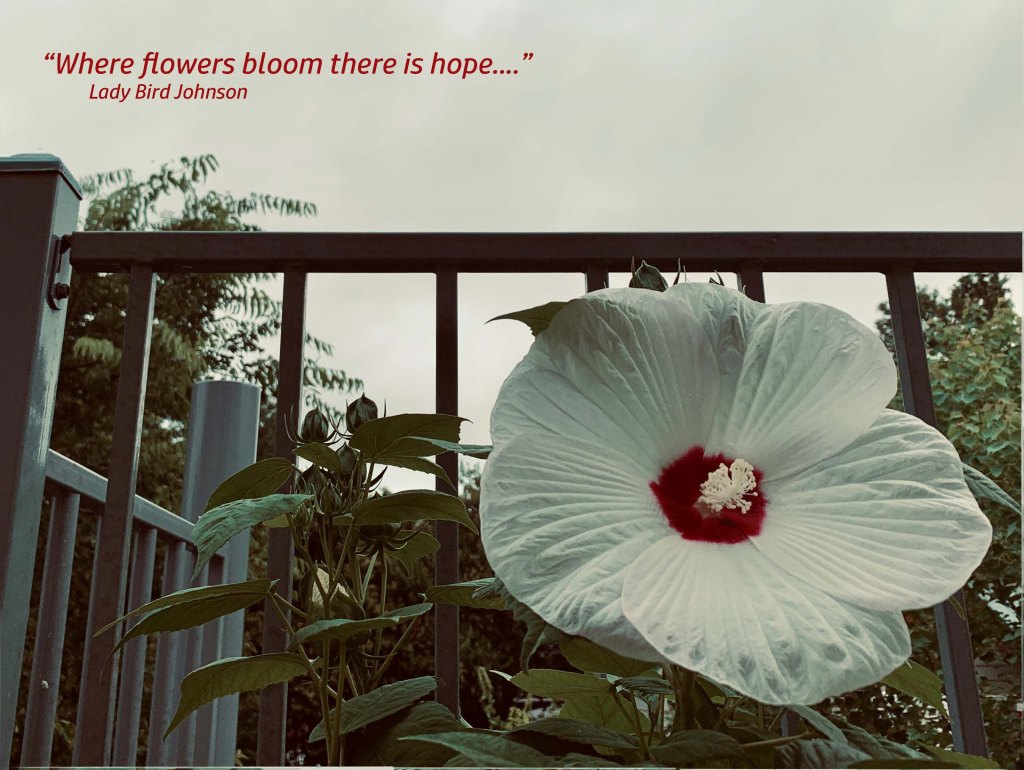
This one has been sitting in my “Ready” box for a bit and seemed ready to “bloom” this week. The photo was taken outside my home office window this summer. This hibiscus (formally the Hibiscus Moscheutos), produces large flowers as shown, but the catch is that each blooms one day and drops the next. Somehow, looking outside my office in the midst of the pandemic, that seemed reassuring. Still does even though winter is upon us.

My Understanding, God’s Understanding

January 13, 2021

“Why dost thou make me see wrongs and look upon trouble?  Destruction and violence are before me; strife and contention arise.  Habakkuk 1:3-5

Sounds like it could have been written today, right?  Nope, about 2,700 years ago.  And still, we are searching for the answer to why God allows bad stuff to occur.  Still!  Howard Thurman, in his book Meditations of the Heart, takes a good swing at an answer, maybe the best I have seen – at least it settled well within me.

He writes: “All events in life take place, somehow, within the divine context.”  The “somehow” there is at the center of the “why bad things happen” question.  That is, I seek to understand why they happen, why God allows them to happen.  I seek to understand.  Thurman notes that we need to develop “the profound confidence that a structure of moral integrity undergirds all of life; that such a structure is basic to the totality of all experience.  Things do not happen merely; they are part of some kind of rationale.  If this can be tracked down and understood, then the living experience, however terrible, makes sense.”

There is the key, in that last sentence, I want to track down and understand things, to know what happened and why it happened.  The problem is, damn it, that I am just not that smart.  I can track down the facts, understand and figure out some things, but only some things.  Here is where Thurman works his magic. 

“Even though one is never able to accomplish this tracking down, one cannot destroy the confidence that the logic of all ills is knowable.  A man traces them down as far as he can, until, at last, he seeks no longer to understand the ills but rather to understand God’s understanding.”  Lacking this, he rests himself in the assurance of God’s Presence in him and in life about him.  He sees the travail of his own would and is satisfied.”

Indeed, satisfied.
Labels and Understanding

Today, this from Anthony DeMelllo:

“The trouble with people is that they’re busy fixing things they don’t even understand.” 

DeMello goes on to explain that our “shortcut” to understanding is often to label.  It occurs to me that this explains a lot about current events.  Rather than try to understand “the other” I slap a label on them/it and move forward under the mistaken belief that because I labelled them/it I now understand them/it.  But, as DeMello notes:

“Understanding has stopped at that moment.  You slapped a label on her, and if the label carries undertones of approval or disapproval [and it usually does], so much the worse.  How are you going to understand what you disapprove of, or what you approve of, for that matter?”

Island of Peace

“The individual lives his life in the midst of a wide variety of stresses and strains.  There are many tasks in which he is engaged that are not meaningful to him even though they are important in secondary ways.  There are many responsibilities that are his by virtue of training, or family, or position.  Again and again, decisions must be made as to small and large matters; each one involves him in devious ways.  No one is ever free from the peculiar pressures of his own life.  Each one has to deal with the evil aspects of life, with injustices inflicted upon him and injustices which he wittingly or unwittingly inflicts upon others.  We are all deeply involved in the throes of our own weaknesses and strengths, expressed often in the profoundest conflicts within our own souls.  The only hope for surcease, the only possibility of stability for the person, is to establish an Island of Peace within one’s own soul.”  Howard Thurman

An ever-needed, beautifully written acknowledgement that while life is tough on the living, though we are tossed about on life’s sea, respite from the storm is available —   “establish an Island of Peace within one’s own soul.”

Different/Same

“We differ in what we do or don’t do … not in what we are.”  Anthony DeMello

It is particularly easy now (though in fact it is easy any time) to be sanctimonious, to elevate myself by comparing myself to others, to raise my opinion of myself (or at least feel that I am) by lowering my opinion of others.  This quote reminds me that I am more like others, they are more like me, than I am comfortable with – and that it is time to get over that.  We are all humans who differ not in what we are, but in what we do, or don’t do.

Right Things and Staircases

“Always do the right thing, even when it’s the hard thing.”  Bryan Stevenson

I heard this listening to a podcast yesterday.  It hung with me through the day and sent me this morning to that complex passage in Romans 7:7-25 which is enough to make anyone’s head twist off.  (“I do not understand what I do.  For what I want to do I do not do.  And if I do what I do not want to do….”)  Heck, that passage even leads Paul to declare: “What a wretched man I am.”  He writes persuasively enough that I want to agree with him! 

Still, the sentiment has some value, even if served with a side of angst.  Martin Luther King Jr. (as he is wont to do) takes some of the angst out of it in his statement (written so many ways I am not sure what the actual quote is) that we don’t have to see the whole staircase to take the first step.  That seems to be the best wisdom to me because in the twists and turns of life, while I certainly lay out the staircase ahead in my mind (and in my mind, it is often filled with loose toys, slippery spots, and lots of perils), the reality is I can’t see all of the steps along the way, much less the landing at the end of the staircase. 

So, I am fairly confident that despite its vagaries the “next right thing” may be the best guide there is, if for no other reason than I am more certain that I need to beware of those folks (myself included) when they claim to have certainty about the staircase.