Photo and Text Sunday

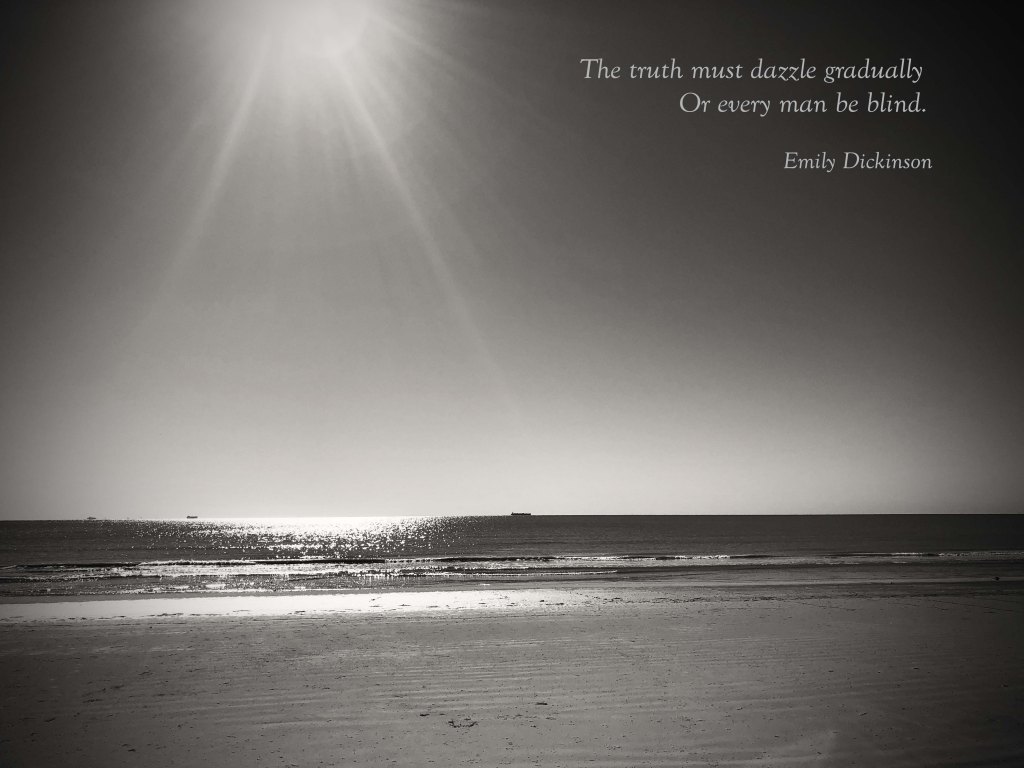
Photo taken recently in Galveston. Emily Dickinson text. It reminded me of another favorite quote of mine from Justice Felix Frankfurter: “Wisdom too often never comes, and so one ought not to reject it merely because it comes late.” I guess the combination of the two is that truth dazzles gradually resulting, if we are lucky, in wisdom.

Emphasis &Treasure

Today, from Howard Thurman:

“A man who depends upon externals for his significance, who must look to others for the nod of the head, is one whose life is constantly at the mercy of whatever it is he is courting in his environment.  He can easily become the victim of envy and jealousy.  Often, he ends up by stretching himself out of shape in trying to be to others what he can never be but what someone else could be without trying.  Where do you place your emphasis.”

Boy, there’s a lot to unwind there: “stretching himself out of shape in trying to be to others what he can never be but what someone else could be without trying.”

That brings to mind the Emerson quote: “Make the most of yourself, for that is all of you there is.”

Darkness and Light

It occurs to me that we are perhaps at our human best when we set aside our hubris and recognize our imperfections, our challenges, our humanity – that is, that we are all just feeling our way through.  This occurred to me today reading an Emily Dickinson poem, untitled as many are.  Never a Dickinson fan, but this one wins me over for her ability to convey much in little space, and to do so with some dry humor mixed in – at least I think she was being humorous.  Oh, and I love her free use of dashes, which I rely on a good deal, always assuming that such is frowned on by those who know.

We grow accustomed to the Dark –

When light is put away –

As when the Neighbor holds the Lamp

To witness her Goodbye –

A Moment – we uncertain step

For newness of the night –

Then – fit our Vision to the Dark –

And meet the Road – erect –

And so of larter – Darkness –

Those Evenings of the Brain –

When not a Moon disclose a sign –

Or Star – come out – within –

The Bravest – grope a little –

And sometimes hit a Tree

Directly in the Forehead –

But as they learn to see –

Either the Darkness alters –

Or something in the sight

Adjusts itself to Midnight –

And Life steps almost straight.

Wow. 

“We uncertain step for the newness of the night – Then – fit our Vision to the Dark –And meet the Road – erect — “

“But as they learn to see – either the Darkness alters – Or something in the sight Adjusts itself to Midnight – And Life steps almost straight.”

Such hope in those last words – “And Life steps almost straight.”

Sometimes

Each time I cycle back around to this poem in Garrison Keillor’s Good Poems collection seems to be the right time to do so – though I am not sure there would ever be a bad time to read Sometimes by Sheenagh Pugh.  In part:

Sometimes things don’t go wrong after all….

Sometimes our best efforts do not go amiss;

Sometimes we do as we meant to.

The sun will sometimes melt a field of sorrow

that seemed hard frozen; may it happen for you.

Only after reading this poem a few times have I come to recognize the hope, the expectation, the faith imbued within that single word – “sometimes.” Hearing it or reading it, I have come to understand the importance of focusing on what follows — which often has a prayer-like quality

Choosing Weapons in the Battle

Great writing and truth (perhaps they are the same thing) have the same effect – to stop me in my tracks and make me fully present in the moment.  Fully present in the world, yes, but somehow, at the same time, transcending that, “fully present” with no need for any other description – FULLY present. 

The moment, the sensation, slips away too quickly, but leaves behind some indelible mark that somehow, when put together with all the others, writes the story.  By way of example, today’s reading from Howard Thurman, Deep Is The Hunger:

“’No one ever wins a fight.’ This suggests that there is always some other way, or does it mean that man can always choose the weapon he shall use?  Not to fight at all is to choose a weapon by which one fights.  Perhaps the authentic moral statute of a man is determined by his choice of weapons which he uses in his fight against the adversary.  Of all weapons, love is the most deadly and devastating, and few there be who date trust their fate in its hands.”

I so love that – “…the authentic moral stature of a man is determined by his choice of weapons which he uses in his fight….”  This at one time acknowledges the “battle,” that we each have a role in it, and that our “choice of weapons” has import.

Stop and Stare

From Leisure, by W. H. Davies, a more poetic version of “stop and smell the roses:”

“A poor life this if, full of care,

We have no time to stand and stare.”

Indeed, I don’t “stand and stare” enough.  I find a camera in hand helps.  Well, in any event, here’s to standing and staring.  And as a bonus, have you ever noticed that if you stand still and stare at something (and especially if you do so with a camera at the ready) people will do the same to see what you are staring at.  It’s as if we are all eager to find something to “stand and stare” at, but perhaps a bit lazy, so we want to take our prompts from others – which, circles back to Davies’ poem.

Knowledge/Wisdom

In Deep Is The Hunger Howard Thurman delves into knowledge and wisdom, causing me, it seems, to really consider for the first time the distinction between the two.  [Okay, I may be a little slow to the class.]

Thurman notes this reality:

“It is a simple but terrible truth that, in most fundamental decisions we make, we must act on the basis of evidence that is not quite conclusive.  We must decide and act on our decision without having complete knowledge even of the facts that are involved.  What we do is postpone decisions as long as we can, getting before us as many relevant facts as possible.  Then there comes the moment of decision and we act.  Our hope is that the future will reveal the rightness of our decision but we are never quite sure.”

What Thurman is talking about there is knowledge, facts.  But he continues:

“Since, at our best, we must act again and again on the basis of inadequate evidence, it is quite unworthy of our responsibility as human beings to use less than our highest wisdom in making up our minds.”

There it is, the subtle shift from knowledge to wisdom.  He continues:

“There is no guarantee that the decision I make will not, in the end, form a mistake, a bad judgment, a movement in error.  But I shall bring to bear upon it the fruits of my cumulative wisdom in living, the light from as many lamps along the way as I can see, and the greatest spiritual resources available to me.”

I love that phrase – “the light from as many lamps along the way as I can see….” 

It occurs to me that the “fruits of my cumulative wisdom,” those lights from the “lamps along the way” come from many sources — our past experience, from other folks, from something we read, some song we have heard, from something in nature….  Sometimes those fruits, those lights just appear without us knowing the source (“the greatest spiritual resources”?).  It is when we mix what we know with those life experiences, that fruit and light from within, from without, and from who knows where, that we start to have some sense of the word “wisdom.”