Photo and Text Sunday

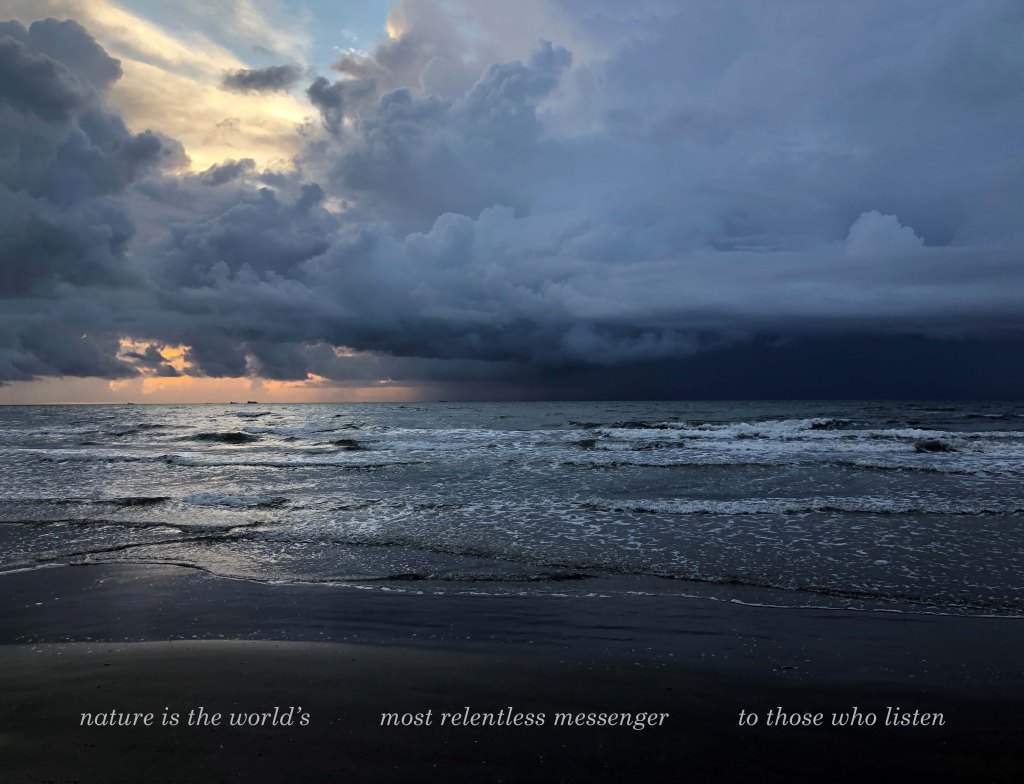
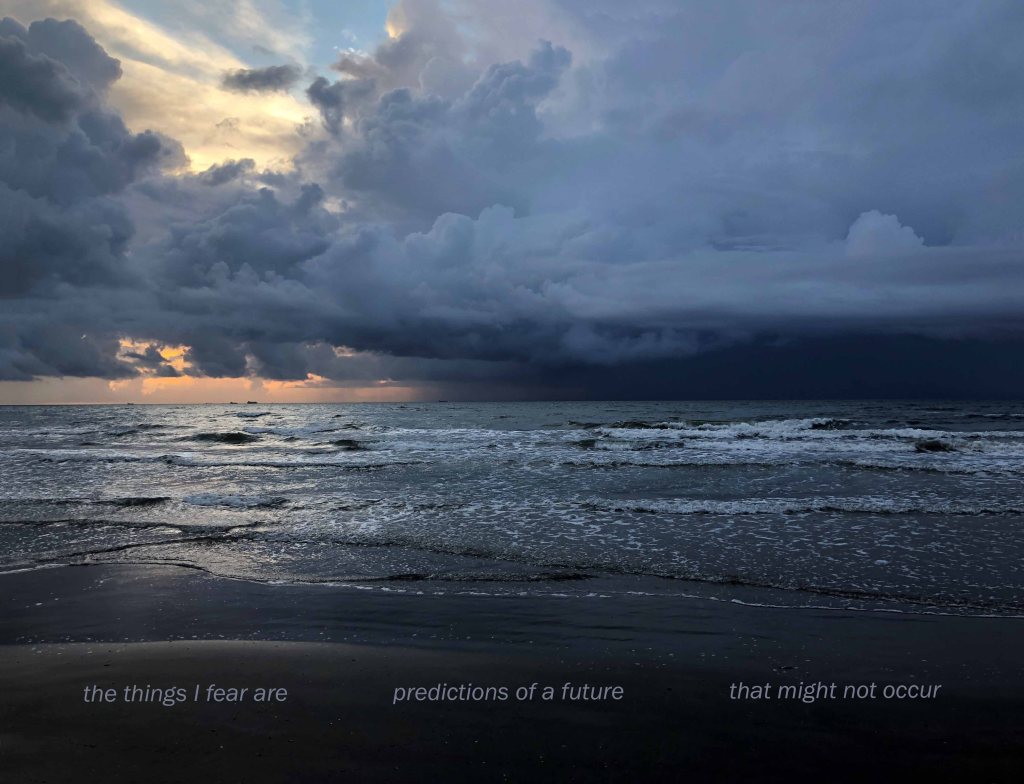
Saw the text on a T-shirt at the airport early this morning and it got a laugh out of me, which, given the setting, was quite an accomplishment. I had the picture (taken in Galveston) already in the can. Christmas time is, as they say, a coming.

Awareness

In reviewing my journaling on my Word of the Year (“Awareness”) this month I came across this quote from Eric Hoffer: “To become different from what we are, we must have some awareness of what we are.”  A few pages over I have this written in quotation marks (though, unfortunately, with no attribution): “…we differ in what we do or don’t do…not in what we are.”

Merging those thoughts, once we “have some awareness of what we are” we recognize that “we differ in what we do or don’t do…not in what we are.” That as we each seek to determine what we are, we come face to face with the reality that we are the same.  In this I am reminded of the line from John McCutcheon’s timeless Christmas classic (though not of the jolly mold), Christmas in the Trenches – “on each end of the rifle, we’re the same.”

The “Radical and Revolutionary Deed

From Howard Thurman’s Deep Is the Hunger:

“[L]ife in any form seems to have a little way of its own, moving with quiet assurance to some special end.  It is of immeasurable comfort to remember that much of the chaos and disorder of our own lies is rooted in causes that are understandable; much of the evil in life is reasonable, in the sense that its roots can be traced and it is not necessary to place the blame upon the devil or some blind senseless process.  The naked responsibility for human misery, you and I and ordinary human beings like us must accept.  In this doomful fact there is the ground of hope, because it means that in the creation of man, God provided for limitless resourcefulness, and because of any situation, however chaotic, can be understood and reconstructed if we have no fear to do, if need be, the radical, the revolutionary deed.”

There is so much there to unwrap.  Life moves “with quiet assurance to some special end” settles in so softly, but Thurman sends along with it the unsettling message that we all share some of “the naked responsibility for human misery.”  But as he notes, within that “doomful fact” there is “grounds for hope” so long as we recall and act upon our innate ability to perform “the radical, revolutionary deed.”

That “radical, revolutionary deed” comes in many forms, shapes and sizes.  We can pause and listen, stop and help, contribute, smile, encourage….  All of course fit under the single most “radical, revolutionary deed” – love.

Random Thoughts

Overheard in an Everything Happens podcast, from the guest, Will Willimon:

“God is always saying: ‘Give me something to work with and I’ll turn it into something interesting.’”

“Something to work with” and “something interesting” are, of course, rather nebulous, a bit uncertain, but of course, that describes life well, doesn’t it?

Longly-Weds

I was taken today by this line in The Longly-Weds Know by Leah Furnas (https://allpoetry.com/poem/3571202-The-Longly-weds-Know-by-XxEmOtiOnjOxX), reminded both that I am of that “longly wed” classification and of the truth of the statement:

The Longly -Weds Know

“That it isn’t about the Golden Anniversary at all,

But about all the unremarkable years

that Hallmark doesn’t even make a card for.”

But perhaps my favorite sequence:

“It’s about the 37th year when she finally

decided she could never change him

And the 38th when he decided

a little change wasn’t that bad.”

And of course, the payoff:

“But most of all its about the end of the 49th year

when they discovered you don’t have to be old

to have your 50th anniversary.”

Learning and Showing Up

Reminded today of the power of just showing up – funerals, weddings, birthdays, various life evvents.  So often I can talk myself out of showing up because of the perceived awkwardness of doing so.  Julia Kasdorf takes that head on in her beautiful poem – What I Learned from My Mother, a good read, which in part goes as follows:

“I learned to attend viewings even if I didn’t know the deceased, to press the moist hands of the living to look in their eyes and offer sympathy, as though I understood loss even then.  I’ve learned that whatever we say means nothing, what anyone will remember is that we came.”

This in turn pointed my memory to a This I Believe essay by Deidre Sullivan, which I pulled up and listened to again.  At age 16, against her wishes, her father drives her to the viewing for a 5th grade math teacher so that she can go inside.

“When the condolence line deposited me in front of Ms. Emerson’s shell-shocked parents, I stammered out, “Sorry about all this,” and stalked away.  But for that deeply weird expression of sympathy delivered 20 years ago, Ms. Emerson’s mother still remembers my name and always says hello with tearing eyes.”

https://www.poetryfoundation.org/poems/48491/what-i-learned-from-my-mother

https://www.npr.org/2005/08/08/4785079/always-go-to-the-funeral#:~:text=Always%20Go%20To%20The%20Funeral%20As%20a%20child%2C%20Deirdre%20Sullivan,important%20as%20the%20grand%20gestures.