Choosing Weapons in the Battle

Great writing and truth (perhaps they are the same thing) have the same effect – to stop me in my tracks and make me fully present in the moment.  Fully present in the world, yes, but somehow, at the same time, transcending that, “fully present” with no need for any other description – FULLY present. 

The moment, the sensation, slips away too quickly, but leaves behind some indelible mark that somehow, when put together with all the others, writes the story.  By way of example, today’s reading from Howard Thurman, Deep Is The Hunger:

“’No one ever wins a fight.’ This suggests that there is always some other way, or does it mean that man can always choose the weapon he shall use?  Not to fight at all is to choose a weapon by which one fights.  Perhaps the authentic moral statute of a man is determined by his choice of weapons which he uses in his fight against the adversary.  Of all weapons, love is the most deadly and devastating, and few there be who date trust their fate in its hands.”

I so love that – “…the authentic moral stature of a man is determined by his choice of weapons which he uses in his fight….”  This at one time acknowledges the “battle,” that we each have a role in it, and that our “choice of weapons” has import.

Stop and Stare

From Leisure, by W. H. Davies, a more poetic version of “stop and smell the roses:”

“A poor life this if, full of care,

We have no time to stand and stare.”

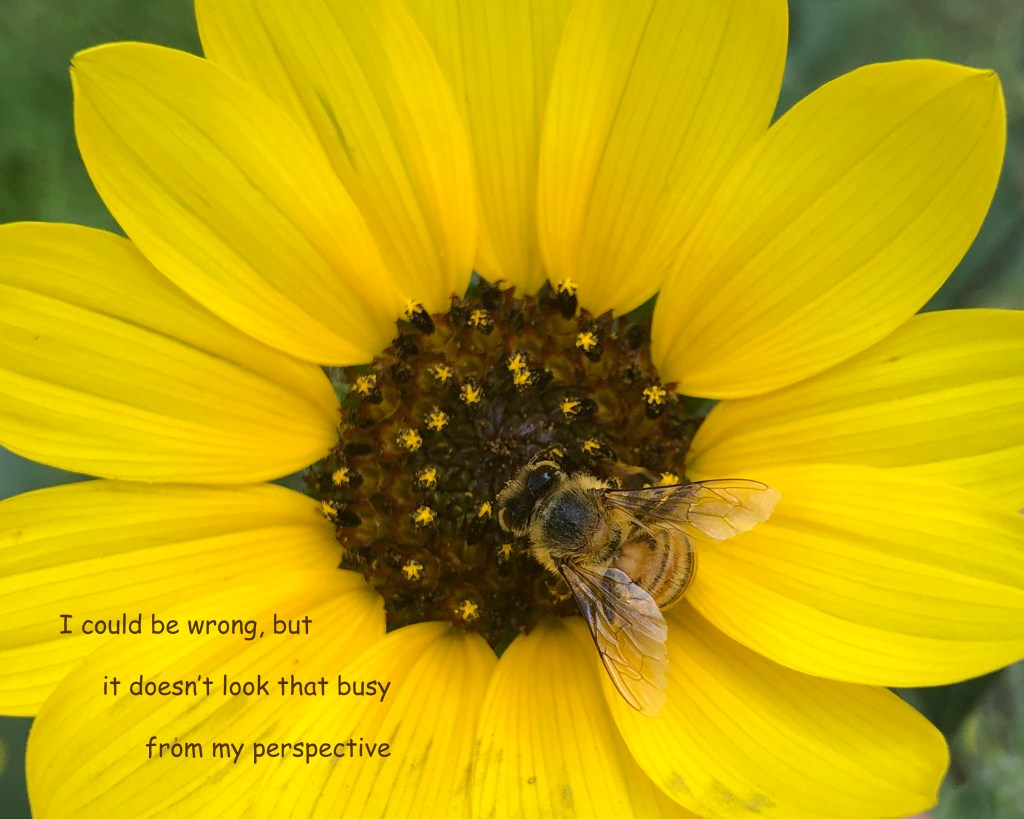
Indeed, I don’t “stand and stare” enough.  I find a camera in hand helps.  Well, in any event, here’s to standing and staring.  And as a bonus, have you ever noticed that if you stand still and stare at something (and especially if you do so with a camera at the ready) people will do the same to see what you are staring at.  It’s as if we are all eager to find something to “stand and stare” at, but perhaps a bit lazy, so we want to take our prompts from others – which, circles back to Davies’ poem.

Knowledge/Wisdom

In Deep Is The Hunger Howard Thurman delves into knowledge and wisdom, causing me, it seems, to really consider for the first time the distinction between the two.  [Okay, I may be a little slow to the class.]

Thurman notes this reality:

“It is a simple but terrible truth that, in most fundamental decisions we make, we must act on the basis of evidence that is not quite conclusive.  We must decide and act on our decision without having complete knowledge even of the facts that are involved.  What we do is postpone decisions as long as we can, getting before us as many relevant facts as possible.  Then there comes the moment of decision and we act.  Our hope is that the future will reveal the rightness of our decision but we are never quite sure.”

What Thurman is talking about there is knowledge, facts.  But he continues:

“Since, at our best, we must act again and again on the basis of inadequate evidence, it is quite unworthy of our responsibility as human beings to use less than our highest wisdom in making up our minds.”

There it is, the subtle shift from knowledge to wisdom.  He continues:

“There is no guarantee that the decision I make will not, in the end, form a mistake, a bad judgment, a movement in error.  But I shall bring to bear upon it the fruits of my cumulative wisdom in living, the light from as many lamps along the way as I can see, and the greatest spiritual resources available to me.”

I love that phrase – “the light from as many lamps along the way as I can see….” 

It occurs to me that the “fruits of my cumulative wisdom,” those lights from the “lamps along the way” come from many sources — our past experience, from other folks, from something we read, some song we have heard, from something in nature….  Sometimes those fruits, those lights just appear without us knowing the source (“the greatest spiritual resources”?).  It is when we mix what we know with those life experiences, that fruit and light from within, from without, and from who knows where, that we start to have some sense of the word “wisdom.”

Carry on and do some good

Going through some things this morning I ran across this sent to me by my late friend, Jim Mulford, and it hung with me as it does each time I read it.  I’ve never really been able to comment on it because it seems that it says everything that need be said on the issue, and while that often doesn’t keep me from commenting on something, here it always has:

“I blinked and I am nearing the end.

Sometimes I just want to shout: ‘Pay attention to now, exercise some discipline in your life, love somebody hard, keep yourself fit.’

It seems we think that way only when it is too late to do anything about it, or maybe that’s too self-revealing.

And yet, we carry on and do some good.”