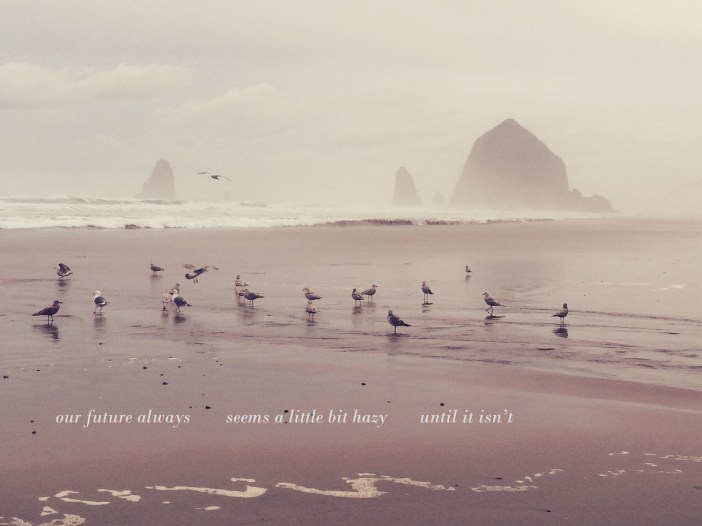
Photo taken at Cannon Beach, Oregon last year.

Photo taken at Cannon Beach, Oregon last year.

Pondering on the Prodigal Son parable this morning, Luke 15:11-32:
We aren’t really told anything about the characters in this parable either before or after the facts recounted. That is, I think, one of the magical things about parables – I get to fill in the details with my own thoughts, and in that way, make the story my story, or at least more meaningful to me. In that regard, it does seem odd, doesn’t it, that the younger son would be so bold as to think he could just take off with his inheritance and make it in the world? Of course, as he leaves we have no evidence to support he is incapable of that, but look at what we have filled in later. We know he is the younger son, so we imply inexperience. We know the older son later talks of his dutiful actions on the return of his younger brother (“Lo, these many years do I serve thee, neither transgressed I at any time thy commandment….”), which at least gives us the opportunity to imply that the younger son was not as dutiful. And of course, we have the reality that the younger son “wasted his substance with riotous living” once he left and was left to “perish with hunger.”
Using my license to fill in details and come to make my own story, it occurs to me that what happened here is that the younger son, having much, came to the erroneous conclusion that what he had was of his own making, and had little to do with the father and brother, or just plain, dumb luck. Being full of himself, prideful, and certain that his good fortune was of his own making, he “gathered it all together, and took his journey into a far country.” That is, becoming full of himself, he distanced himself from those who helped him create his bounty, thinking he didn’t need them and could make it on his own, thank you.
That story, well, it starts to sound a bit too familiar for comfort. Indeed, I have made his story, my story more times than I care to recount. Thankfully, and true to the lesson in the parable, the Father is always there to meet me with open arms on the road home.
“Stay away from negative people. They have a problem for every solution.” Albert Einstein
There are those people in life who seem to have a talent for seeing clouds as clouds – to hell with the silver lining. (Clearing throat sound) I’ve read about these people somewhere.
Reading today from Joan Chittister’s The Rule of Benedict, she caught my attention in her urging to listen not only for the voice of God but also to “listen to one another, to sit silently in the presence of God, to give sober heed, and to ponder….”
It is that last word, “ponder,” that caught my attention. “Ponder” is a favorite word of mine, but it is one that seems out of favor. I come up to the verge of it with some regularity and almost always choose another even though “ponder” is likely the more appropriate word. I think I pull back on using “ponder” because it seems to be one extreme or the other. That is, it either sounds to me like something that Jed Clampett would say on The Beverly Hillbillies Something he would be before going to the “cement pond” or eating “vittles.”, or it brings up the mental image of the gravitas of Rodin’s statue – The Thinker.
I should, however, follow Chittister’s lead and not give up on “ponder” as a respectable word. Webster provides the following in the definition of “ponder” – to “weigh in the mind,” to “think about,” or to “reflect on.” Those are, of course, good things to do, particularly before making decisions and opening one’s mouth to speak. In fact, that may well be a one word solution for much that is wrong in the world right now – ponder. Or perhaps two words. First, ponder!

I stumbled across a new song today – well, an old (1955, older than me) song today. From Let There Be Peace On Earth written by Jill Jackson-Miller and Sy Miller:
Let there be peace on earth
And let it begin with me
Let there be peace on earth
The peace that was meant to be
With God as our father
Brothers all are we
Let me walk with my brother
In perfect harmony
Let peace begin with me
Let this be the moment now
With every step I take
Let this be my solemn vow
To take each moment
And live each moment
In peace eternally
Let there be peace on earth
And let it begin with me
Based on my internet research this is mostly considered a Christmas song. Vince Gill and Harry Connick, Jr. both have it on their Christmas albums. That said, it occurs to me that may be part of the problem. The song, and the sentiment, are (as the song notes) worthy of 365.25 days a year.
“For life to those who have the ears to hear is a symphony; but very, very rare indeed is the human being who hears the music.” The Way of Love – Anthony De Mello
Too often I am listening to, focusing on, just one instrument in the symphony to the exclusion of most if not all others — and those are my good days. On others, it seems, I am listening for the missed note only – I am watching the hockey game for the fight, the auto race for the crash. Rarely, if ever, do I hear the symphony.
De Mello encourages us to “develop a taste for the symphony of life.” That seems particularly poignant in this Christmas season as we seem to all to easily get caught up in the frenetic pace and lose the reason for the season. The street vendor character in Willie Nelson’s Pretty Paper, or even the bell-ringer standing next to the Salvation Army kettle, get lost in the shuffle.
Yes, there is much swirling around us these days, and it is easy to focus on one person, one thing, that upsets. Yet among that there is the good that has always been, and thankfully, always will be, taking place around us.
“For life to those who have ears to hear is a symphony….” Heck, Santa, forget those two front teeth I ordered, all I want for Christmas is a pair of THOSE ears!
Photo taken in Phoenix earlier this year.

“Go placidly amid the noise and haste and remember what peace there may be in silence.”
This opening line from Max Ehrmann’s Desiderata jumped out at me today. As we have turned the corner at Thanksgiving and head to New Years, the “noise and haste” seems to kick up a notch, or two, or three, as the noise level would rise as one approaches the finish line in a race. Lots of things are clamoring for my time, my attention, my efforts, and it is easy, so easy, to lose myself in the process, to just duck my head and make it through focused solely on getting there.
I like the subtlety of Ehrmann’s words. He doesn’t tell us to BE silent. That might be taken as yet another voice amongst the “noise and haste.” Instead, he tells us to “remember what peace there MAY BE in silence.” It is more a suggestion than an order. That remembrance may send me to a quiet corner, or it may just cause me to reflect a moment, to take a deep breath and center myself so that I can take the next step with a bit more awareness of the world around me and realize (again, for the zillionth time) that it ain’t all about me.
From Anthony DeMello in The Way to Love:
“Think of yourself in a concert hall listening to the strains of the sweetest music when you suddenly remember that you forgot to lock your car. You are anxious about the car, you cannot walk out of the hall and you cannot enjoy the music. There you have a perfect image of life as it is lived by most human beings.”
I can see myself sitting there at the concert, anxiously squirming in my seat, wondering whether my car is safe, what I left in my car that could get stolen, whether my insurance is paid up…. Before I know it, the music is over. I walk to my car with trepidation, only to find that all is well – except for the fact that I virtually ignored the music. As Homer Simpson would say – Doh!