Let There Be Peace On Earth
I stumbled across a new song today – well, an old (1955, older than me) song today. From Let There Be Peace On Earth written by Jill Jackson-Miller and Sy Miller:
Let there be peace on earth
And let it begin with me
Let there be peace on earth
The peace that was meant to be
With God as our father
Brothers all are we
Let me walk with my brother
In perfect harmony
Let peace begin with me
Let this be the moment now
With every step I take
Let this be my solemn vow
To take each moment
And live each moment
In peace eternally
Let there be peace on earth
And let it begin with me
Based on my internet research this is mostly considered a Christmas song. Vince Gill and Harry Connick, Jr. both have it on their Christmas albums. That said, it occurs to me that may be part of the problem. The song, and the sentiment, are (as the song notes) worthy of 365.25 days a year.
Hearing the Symphony
“For life to those who have the ears to hear is a symphony; but very, very rare indeed is the human being who hears the music.” The Way of Love – Anthony De Mello
Too often I am listening to, focusing on, just one instrument in the symphony to the exclusion of most if not all others — and those are my good days. On others, it seems, I am listening for the missed note only – I am watching the hockey game for the fight, the auto race for the crash. Rarely, if ever, do I hear the symphony.
De Mello encourages us to “develop a taste for the symphony of life.” That seems particularly poignant in this Christmas season as we seem to all to easily get caught up in the frenetic pace and lose the reason for the season. The street vendor character in Willie Nelson’s Pretty Paper, or even the bell-ringer standing next to the Salvation Army kettle, get lost in the shuffle.
Yes, there is much swirling around us these days, and it is easy to focus on one person, one thing, that upsets. Yet among that there is the good that has always been, and thankfully, always will be, taking place around us.
“For life to those who have ears to hear is a symphony….” Heck, Santa, forget those two front teeth I ordered, all I want for Christmas is a pair of THOSE ears!
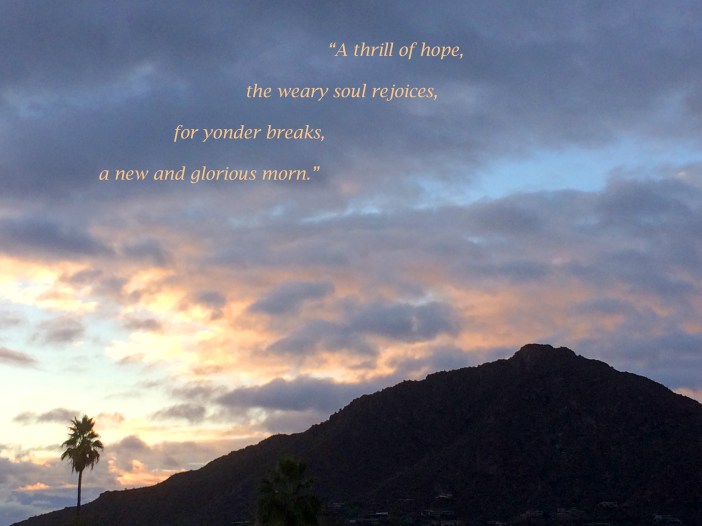
A thrill of hope…
Photo taken in Phoenix earlier this year.
Go Placidly
“Go placidly amid the noise and haste and remember what peace there may be in silence.”
This opening line from Max Ehrmann’s Desiderata jumped out at me today. As we have turned the corner at Thanksgiving and head to New Years, the “noise and haste” seems to kick up a notch, or two, or three, as the noise level would rise as one approaches the finish line in a race. Lots of things are clamoring for my time, my attention, my efforts, and it is easy, so easy, to lose myself in the process, to just duck my head and make it through focused solely on getting there.
I like the subtlety of Ehrmann’s words. He doesn’t tell us to BE silent. That might be taken as yet another voice amongst the “noise and haste.” Instead, he tells us to “remember what peace there MAY BE in silence.” It is more a suggestion than an order. That remembrance may send me to a quiet corner, or it may just cause me to reflect a moment, to take a deep breath and center myself so that I can take the next step with a bit more awareness of the world around me and realize (again, for the zillionth time) that it ain’t all about me.
Enjoy the Music – Doh!
From Anthony DeMello in The Way to Love:
“Think of yourself in a concert hall listening to the strains of the sweetest music when you suddenly remember that you forgot to lock your car. You are anxious about the car, you cannot walk out of the hall and you cannot enjoy the music. There you have a perfect image of life as it is lived by most human beings.”
I can see myself sitting there at the concert, anxiously squirming in my seat, wondering whether my car is safe, what I left in my car that could get stolen, whether my insurance is paid up…. Before I know it, the music is over. I walk to my car with trepidation, only to find that all is well – except for the fact that I virtually ignored the music. As Homer Simpson would say – Doh!
Different
In Uncommon Gratitude, Joan Chittister writes on how “alleluia” can arise out of differences. This is, of course, a tall order. When someone does not act as anticipated, we say he or she is “different.” If we try something new and, when asked to rate the experience, we may say it was “different.” In these contexts, “different” is rarely just an observation. Often, “different” has a judgmental connotation to it, or it is used out of politeness to shroud the potentially hurtful judgment. (To this day, I recall the tone of voice an elementary school teacher had when she commented that my art project was “different.” We’ve all heard the tone, and I will confess to using it.
On “difference” Chittister writes:
“We learn sameness very early in life and find it hard to stray too far from its boundaries, however old we get, however much we think we’ve moved away from such thinking as time goes on. Sameness becomes a kind of security blanket that wraps us up in the warm feeling of being acceptable to the groups with which we identify and whose approval we seek. If we don’t stand out, we can’t be criticized. We are safe because we are just like everybody else…. It is an effective technique, a kind of chameleon approach to life, but it is neither psychologically mature nor spiritually healthy. Somewhere along the line we must become who we are meant to be as individuals. We are persons put on earth to contribute to it as well as take from it…. Most of all, we must allow others to do the same, as much for our sake as for theirs…. It is in our respect for the differences of others that we grow.”
That bears repeating – “It is in our respect for the differences of others that we grow.” This of course, telegraphs her “punchline:”
“But that is the glorious burden of real Christianity: to follow the one who talked to Samaritan women and Roman soldiers, all the time allowing them to be who they were. Clearly, differences were not made to be homogenized; differences were made to be respected, to be honored, to be cherished. Alleluia.”
Nobody Wins
A line from one of my favorite songs/songwriters popped into my mind today. This from Radney Foster’s tune, Half My Mistakes:
“And if I had it all to do over, I’d prob’ly win and lose just as much. But I’d spend less time on the right and wrong, and a lot more time on love.”
It occurs to me that this line seems to sum up a lot of what is going on these days – we spend more time on being/deciding/judging right and wrong at the expense of listening to, thinking about, considering the opinions and viewpoints of others. Hell, they may be wrong, I may be wrong. And, while I don’t want to minimize being right or doing the right thing, the insistence on seeing things in that binary world, particularly when it prevents us from listening to the other perspective, takes us down a path that does not lead to a good place. Which points me to another Radney Foster song/line (Nobody Wins):
“Before another bitter word gets loose
I was hoping we could call a truce
Cause nobody wins, we both lose
Hearts get broken and love get bruised
When we light that same old fuse
Again and again
Nobody wins slamming doors
We’ve both lost this fight before
And I won’t play that game no more
Cause nobody wins”
Doubt
Today, Joan Chittister, in Uncommon Gratitude, sings the praises of Doubt. (I never heard my grade school nuns speak highly of doubt – they only focused on “faith.”)
“Without doubt, life would simply be a series of packaged assumptions, none of them tested, none of them sure, and all of them belonging not to us, but to someone else whose truth we have made our own. The problem with accepting truth as it … becomes a patina of ideas inside of which we live our lives without passion, without care.
Doubt, on the other hand, is the mother of conviction. Once we have pursued our doubts to the dust, we forge a stronger, not a weaker, belief system. These truths are true, we know, because they are now true for us rather than simply for someone else. To suppress doubt, then, to discourage thinking, to try to stop a person from questioning the unquestionable is simply to make them more and more susceptible to the cynical, more unaccepting of naive belief. It is doubt that is the beginning of real faith.”
I like that – “Doubt…is the mother of conviction.” Yes, knowledge and certainty each have their place, but in the end, for whatever reason, there are things I cannot truly know, things of which I cannot be certain. As Chittister puts it: “There is simply a point in life when reason fails to satisfy our awareness of what is clearly unreasonable and clearly real at the same time—like love and self-sacrifice and trust and good. Data does not exist to explain these unexplainable things.”
That some things are unknowable does not, of course, excuse me from the quest for knowledge, and I am too stubborn for that in any event, but it does provide me with some understanding of that which I cannot understand. Onward through the fog.
Rejoice Always

 It occurs to me...