Friendship

From Nobody’s Fool by Richard Russo:

“To Rub’s mind, Sully’s one human flaw was that he didn’t seem to want much more than he had, which seemed unaccountable.  If you were standing outside in the cold and wet, it was only natural to wish you were inside where it was warm and dry, so Rub wished it, and not just selfishly for himself, but for Sully, too.  That was friendship….  And as Rub slid onto the stool, as close as he could get to Sully on the other side of the counter, he’d have liked to explain this whole friendship deal to him, so he’d know.  Instead, he said “Could I borrow a dollar?”

I like that simple concept of friendship – to wish more than they have for someone else.  Not more so they have more, but more in the sense of wishing well being to come upon them, like getting out of the cold and wet, into the warm and dry.  It occurs to me that such is a find definition of friendship.  I also occurs to me that Rub and Sully have a typical male friendship — one left to action, rarely words.
Gift

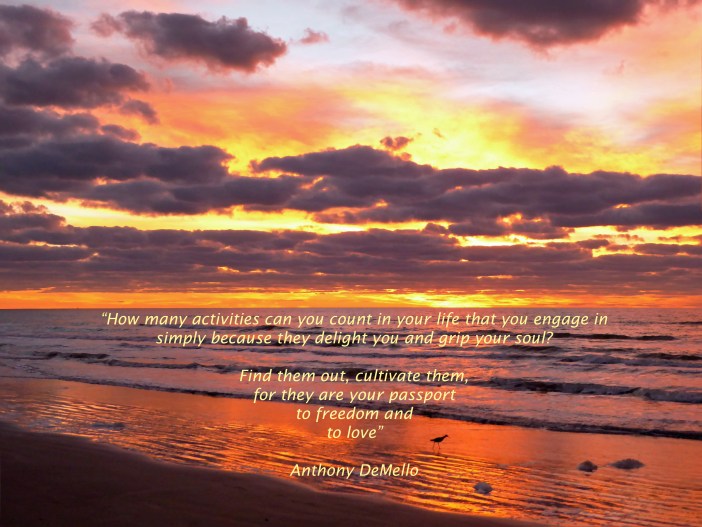
Spending a good deal of time on planes, I followed with particular interest the recent Southwest Airlines incident that resulted in the death of a passenger.  Reading accounts from the passengers and crew feels sort of like gawking at an automobile crash on the opposite lanes of traffic as I pass by, uninjured, car intact.  Having been on a few Southwest planes over thirty plus years of travel, it is sobering.  But the one word that keep bubbling to the top is “fragility,’ as in “the fragility of life.”  Life has its bumps and bruises, its breakups, crashes, and tearing aparts.  As such, it is easy to start to think of life as something other than fragile.  It becomes easy to think of it as a rock, not an egg, a sheet of steel, not a pane of glass.  It becomes easy to start seeing life as an entitlement, not a gift – but a gift it is.  It occurs to me that perhaps the best way to honor those who pass before me is to treat life as the gift that it is.

It is well


“When peace, like a river, attendeth my way

When sorrows like sea billows roll

Whatever my lot, Thou hast taught me to know

It is well, it is well, with my soul”

Horatio Stafford penned that in the 1880s.  It popped into my mind today, as it does with some regularity.  Today, I am struck by the duality of the lyrics.  In two lines, we have “peace like a river” and “sorrows like sea billows” rolling.  Perhaps that is why this song has hung on for so many years – because that is the roller coaster we call life. That sentiment was expressed nearly a hundred years later by John Prine:

“That’s the way that the world goes round

You’re up one day, the next you’re down

It’s a half an inch of water, and you think you’re gonna drown

That’s the way that the world goes round.”

The hard part, of course, it to remember, to see (or see to it) in the midst of those days of ups and downs, while standing in that “half an inch of water,” that “it is well with my soul.”  Today, it seems so.  I’ll take that.

All over the place

From Making All Things New by Henri Nouwen:

“One of the most notable characteristics of worrying is that it fragments our lives.  The many things to do, to think about, to plan for, the many people to remember, to visit, or to talk with, the many causes to attack or defend, all these pull us apart and make us lose our center.  Worrying causes us to be “all over the place,’ but seldom at home.”

Let that settle in a bit – “all over the place, but seldom at home.”  I can’t help but think of the analogy of a merry-go-round.  So long as I am settled into or near the center, the core, the ride is fairly smooth as the rotation (while still 360 degrees) seems much less unsettling than if hang around the periphery.

Snowball

“The entire law is summed up in a single command: ‘Love your neighbor as yourself.’”  That passage from Galatians 5:14 is familiar, and the same things is said throughout the Bible.  While difficult to do, it is easy to let that settle in, at least as a good idea, something to aspire to.  The next verse, however, came across as I read it today as a pretty stern warning, and certainly more unsettling: “If you keep on biting and devouring each other, watch out or you will be destroyed by each other.”  Galatians 5:14-15

There it is – and who can argue with that?  All of the animosity, the bad blood, the “us and them” mentality that is so prevalent today makes me think of the line from one of Merle Haggard’s songs – “Are we rollin’ downhill like a snowball headed for hell?”

So what do we do?  Well, as crazy as it sounds, that answer is in the preceding verse: “Love your neighbor as yourself.”

Cornfields

Today I stumbled across this from poet Billy Collins:

“By the end of a poem, the reader should be in a different place from where he started.  I would like him to be slightly disoriented at the end, like I drove him outside of town at night and dropped him off in a cornfield.”

It occurs to me that many (?most, all?) of the my great experiences in life – friendship, love, travel, accomplishment – all involved that feeling, that slight sense of disorientation.  As much as I bemoan it at the time, that sense of unease is a harbinger of growth, and all growth stretches me a bit, makes me feel a bit uneasy until I grow into/become accustomed to it.

My task is not simply to tolerate the cornfield, but to accept, even enjoy it!

Spring

I don’t know.  This poem just seemed to settle in and fit the day for me:

The First Green of Spring – David Budbill

“Out walking in the swamp picking cowslip, marsh marigold

this sweet first green of spring.  Now sauteed in a pan melting

to a deeper green than they ever were alive, this green, this life,

harbinger of things to come.  Now we sit at the table munching

on this message from the dawn which says we and the world

are alive again today, and this is the world’s birthday, And

even though we know we are growing old, we are dying, we

will never be young again, we also know we’re still right here

now, today, and oh my! don’t these greens taste good.”

Perfection Wasted – John Updike

“An another regrettable thing about death

is the ceasing of your own brand of magic,

which took a whole life to develop and market —

the quips, the witticisms, the slant

adjusted to a few, whose loved ones nearest

the lip of the stage, their soft faces blanched

in the footlight glow, their laughter close to tears,

…The whole act.

Who will do it again?  That’s it: no one;

imitators and descendants aren’t the same.”