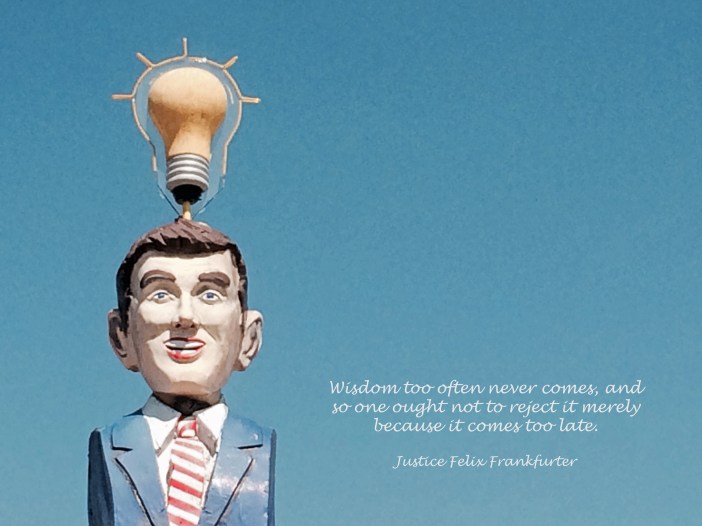
Lighters

“At times, our own light goes out and is rekindled by a spark from another person. Each of us has cause to think with deep gratitude of those who have lighted the flame within us.” – Albert Schweitzer

Indeed, the “light goes out” from time to time no matter how much effort is put into keeping it burning.   There is, it seems, a reluctance to seek help from others.  For some (I’ve read somewhere about people like this) the natural instinct is to try to “rekindle the spark” ourselves, preferably before anyone knows it has even gone out.  But Schweitzer is correct, sometimes, often, the rekindling of the spark must (for whatever reason) come from someone else.  So on this Thanksgiving Day I am thinking, with “deep gratitude of those who have lighted the flame” within me.   It doesn’t take much reflection to understand that there are too many to list, many/much to be grateful for.

Give and Take

“Blessed are those who can give without remembering and take without forgetting.”  Elizabeth Bibesco

There is much to unwrap here.  It is so easy to register giving, to create a mental note that suggests that I am entitled to receive something in return, whether from the recipient of my gift or from the world at large (some form of universal karma).  Similarly, it is easy to take and forget, to translate what I receive as something owed to me.  Those two might even converge.  That is, I might think I deserve to receive something because I gave something.  I might give only that I will receive.

“Blessed are those who can give without remembering and take without forgetting.”

Peace With Your Soul

“…whatever your labors and aspirations, in the noisy confusion of life, keep peace with your soul.”  Desiderata   Max Ehrmann

I like the juxtaposition of those two phrases – “in the noisy confusion of life, keep peace with your soul.”  First, there is the recognition of the “noisy confusion of life.”  Life is rarely played out in an orderly fashion, at least not the orderly fashion as I write (and rewrite, and rewrite…) the script.  Then, the “keep peace with your soul.”  A subtle distinction, but the word choice is “with” not “in,” recognizing, as I think on it, that peace is a relationship between the mind and the soul.  In that context I can keep peace with my soul even if there is not peace in my soul.  That is, a shitstorm may be swirling around me, but I can still have peace.

Now, the challenge is in the execution of that lofty goal!

Success & Humility

“Let us be thankful for the fools.  But for them the rest of us could not succeed.”

Mark Twain

Typical of Twain, there is a great deal of insight in this humor.  Interesting how critical observations seem so much more palatable if they are conveyed disguised in humor!  The message of course assumes one is capable of effectively distinguishing between the fools and the non-fools.  If I am honest I have to profess the limits to my proficiency at that task.  Also, it recognizes that the grading is on a curve.  In a given setting it may not be that I am so good so much as the others are not.   All of which points to yet more reasons to embrace humility, to (tongue in cheek) strive to be the most humble person in the universe.

Worry and Bubble Gum

“Do not distress yourself with imaginings.”  Desiderata – Max Ehrmann

Of all the advice Ehrmann provides in the Desiderata, this is perhaps the one that gives me the most difficulty.  There is not the wiggle room in Baz Luhrmann’s Sunscreen

“Don’t worry about the future; or worry, but know that worrying is as effective as trying to solve an algebra equation by chewing bubble gum.”

I chew a lot of gum.

Silent Gratitude

“Silent gratitude isn’t very much use to anyone.”     Gertrude Stein

My first reaction on reading this quote was a simple “duh!”  But then, I thought more about it.  There is plenty of value to silent gratitude —  worlds of value in a smile, a hug, in silently taking someone’s hand.  I am reminded of the Keith Whitley song line – “You say it best when you say nothing at all.”  That said, a  well-placed “thank you” or other verbal expression of gratitude is always a good call.

Accentuating the Negative

“Our minds are Velcro for negative information but Teflon for positive.”  Rick Hanson

Reading a book, Gratitude Works by Robert Emmons, I came across this quote attributed to neuroscientist Rick Hanson.  It seems there is a scientific basis for the ease with which I slip into and stick with the practice of negativity, what Emmons calls a “built in bias” toward negativity.  This is an example of what is generally known in psychology as a “knowledge to performance gap” and is exemplified in Paul’s familiar conflict as stated in Romans 7:15-19:

“For I do not understand what I do.  For what I want to do I do not do, but what I hate I do….”

Nothing in this, of course, makes “normal” feel good, but it does identify a commonality in the inclination to accentuate the negative, and a place from which to start cultivate a more grateful disposition.