Photo taken a few years back; recently came upon the poem.

Photo taken a few years back; recently came upon the poem.
Wandering through a book of quotations I came across these two:
“A huge percentage of the stuff that I tend to be automatically certain of is, it turns out, totally wrong and deluded.” David Foster Wallace
“It is the customary fate of new truths to begin as heresies and end up as superstitions.” T.H. Huxley
It occurs to me that those help explain our (presumptuous, I know) collective anxiety in these pandemic times as we are being shown with glaring clarity how “wrong and deluded” we have been on some of our “certainties,” (e.g. I have to hop on a plane and fly cross country to be at that meeting), how easily “heresies” (e.g. working from home) can become “normal” on their way to becoming (?) superstitions. Did we ever really “need” the handshake? Spectator sports? Music concerts?….
Interesting times, for sure.
A good first step in the direction of humility, and, well, toward many things:
“Everyone you will ever meet knows something you don’t.” Bill Nye, the science guy
It occurs to me that this is just further proof that we all have something to add to the conversation, but of course that requires listening. (Damn, there’s always a catch!)
I read this today from Pema Chodron, When Things Fall Apart:
“We habitually erect a barrier called blame that keeps us from communicating genuinely with others, and we fortify it with our concepts of who’s right and who’s wrong…. It is a very common, ancient, well-perfected device for trying to make us feel better. Blame others. Blaming is a way to protect our hearts, to try to protect what is soft and open and tender in ourselves Rather than own pain we scramble to find some comfortable ground.”
In the pinball machine that is my mind, this sent me immediately to a song I had not listened to in a while – Jesus Was a Capricorn, by Kris Kristofferson, which includes this unfortunately timely rendition (though the song is nearly fifty years old) of (at least in my mind) this same concept Chodron was discussing.
“Some folks hate the whites, who hate the blacks, who hate the klan
Most of us hate anything that we don’t understand
“Cause everybody’s got have something to look down on
Who they can feel better than at anything they please
Someone doing something dirty decent folks can frown on
If you can find nobody else, then help yourself to me.”
There they are, blame and looking down on others – two tried and true, imperfect, even hideous methods to make myself feel better. UGH!
Always sound advice from Max Ehrmann’s Desiderata that seems to fit every day:
“Go placidly amid the noise and haste and remember what peace there may be in silence.”
Dusting off this piece of writing by John Donne, contemplating how fresh and relevant it is 400+ years later:
No man is an island, entire of itself;
Every man is a piece of the continent, a part of the main.
If a clod be washed away by the sea, Europe is the less, as well as if a promontory were,
as well as if a manor of they friend’s or thine own were:
Any man’s death diminishes me, because I am involved in mankind,
and therefore never send to know for whom the bell tolls;
it tolls for thee.”
In these times, what bell am I hearing in the distance, in my community, in my inner circle? What does it have to do with me? How do I respond?
“This world is a great sculptor’s shop. We are statues and there is a rumour going round the shop that some of us are some day going to come to life.”
Mere Christianity, C. S. Lewis
Now that throws a wrench into the works. Here I’ve been going around, hammer and chisel in hand, thinking I was the sculptor in the shop!
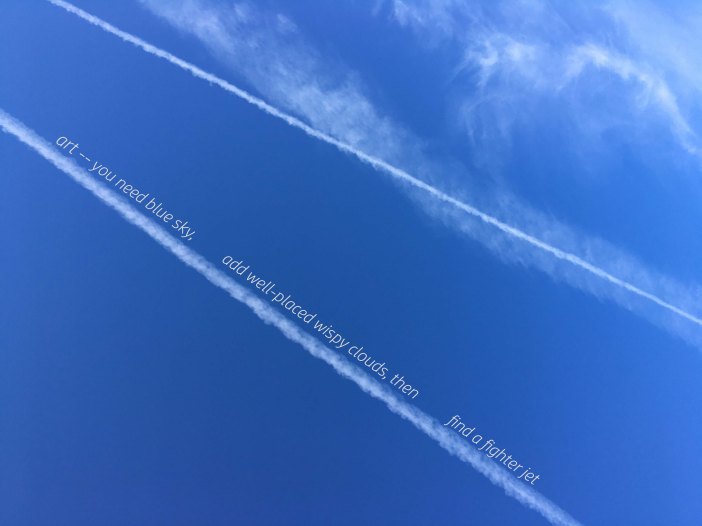
Photo taken in Malibu last year.

Steve Goodman’s song Videotape came up on my playlist and I fell for it again; found out the words had mostly stuck with me:
If your life was on videotape, wouldn’t everything be alright
When your head hurt the morning after, you could roll it back to late last night
You could replay all of the good parts, and cut out what you don’t like
Wouldn’t you be in great shape, if your life was on video tape
Goodman notes in later verses that this is fantasy. He doesn’t have ESP, a crystal ball, or even a video recorder. He can’t predict the future or change the past. None of us can. (That is, we never had the other things, and in 2020, don’t have video recorders.)
All the more reason, it occurs to me, to be mindful and live in the present.
 It occurs to me...