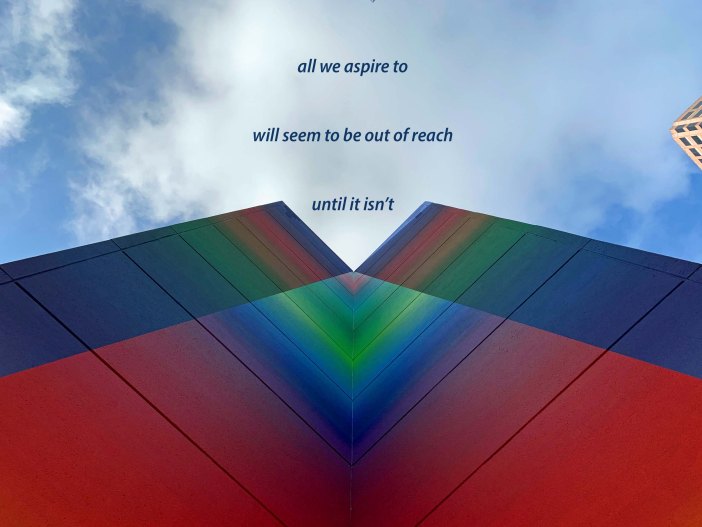
Photo taken on the Congress Street bridge on a recent run.

Photo taken on the Congress Street bridge on a recent run.

“And he arose, and came to his father. But when he was a great way off, his father saw him, and had compassion for him, and ran, and fell on his neck, and kissed him.” Luke 15:20
You probably know the setup in the preceding verses of Luke 15. The younger son has come to his senses and decided to return to his father, rehearsing along the way a speech where he says that due to his sin, he is no longer worthy to be a son, but is offering himself as a “hired servant” that he might not starve to death. You can almost hear him as he practices the speech on the way home: “I am no more worthy to be called thy son: make me as one of thy hired servants.” Luke 15:19 But it is a speech the younger son never gets to deliver because, as noted in the opening passage, the father has a different plan. On the younger son’s return, before he can utter a word, the father runs out to meet the errant son, welcomes him back, and orders the servants (which the younger son was prepared to become) to bring the younger son a robe, shoes, and a ring.
All that to say that the son is not made perfect through anything he has done. The son is (can only be) made perfect through the father. So he/it is. Truth be told, human imperfection is a given, and perfection (grace) only comes through the father.
“Honor one another above yourselves.” Romans 12:10
This is tucked away in Romans 12, almost hidden among a group of seemingly stronger sentences such that it can go unnoticed. “Hate what is evil, cling to what is good.” (v. 9) “Be joyful in hope, patient in affliction, faithful in prayer.” (v. 12) “Practice hospitality.” (v. 13) They all seem to overpower it. Or does it just conveniently seem that way because it is such a tall order? The passage noted above is from the New International Version, but other translations use even more direct language like “practice playing second fiddle,” (The Message), “be eager to show respect for one another,” (Good News Translation) and show “a willingness to let the other man have credit.” (J. B. Phillips New Testament).
Try as I might, I couldn’t find a single translation rendering Paul’s suggestion to be otherwise. Damn!
“Do not think of yourself more highly than you ought to, but rather think of yourself with sober judgment, in accordance with the measure of faith God has given you.” Romans 12:3
I guess in part because they follow my favorite Bible verse, Romans 12:2, I have tended to gloss over this verse and the remainder of Chapter 12. But the sequence here from Paul is pretty exceptional, and I love that understated phrase he starts with, “sober judgment.” First, Paul tells me to be transformed by the renewing of my mind (12:2), but then warns me that the transformation might just trigger ego and pride, that is, I might get the big head (has he been reading my mail) as a result of the transformation, so I should use “sober judgment” when considering the results of that renewing. And to bring the point home in case I didn’t get it the first time, Paul then reminds me that however I have been transformed, and whatever I think of myself in light of the renewal, I am still but one piece of the puzzle – “we who are many form one body.” (12:5) Then, in what might seem like a bit of a non-sequitur if I am not paying attention, Paul jumps into love, evil, and good (12:9-21).
An exceptional sequence indeeed.
I have plenty of time to read yard signs as I pass them by on my runs. Hell, at my pace I even have time to think about them and develop thoughts surrounding them – and of course I can process them in the remainder of the run and beyond. Such is the case with the sign seen yesterday:
“Do we really want a return to NORMAL? Isn’t it time to build something BETTER?”
In this era of COVID there is this burning desire to return back to “normal,” to reset the calendar back to late 2019 or early 2020. Of course, in our reminiscing we have totally forgotten the issues that existed back then in our “normal” lives. That is, nostalgia has kicked. I have always loved the definition of “nostalgia” in a column written by Mary Schmich and made more widely known by Baz Luhrmann in the “Sunscreen Song” – nostalgia is “a way of fishing the past from the disposal, wiping it off, painting over the ugly parts, and recycling it for more than it’s worth.”
Like it or not (I vote for the “not” here) what the past six months have made clear (if we choose to see it) is that there was plenty of opportunity for improvement in our pre-pandemic “normal.” Plenty. Which takes us back to the sign.
Unless we seize that opportunity here and “build something better” we become one of the “most people” walking away from Socrates’ “common heap.”
“If all our misfortunes were laid in one common heap whence everyone must take an equal portion, most people would be content to take their own and depart.” Socrates
Internet hopping in financial news and commentary recently I came across both a “buy” and a “sell” recommendation for a given stock recently issued by two different experts on the same day. It caused me to chuckle, but only briefly, as it was followed by the thought, well, the reality, that like these guys, 1) no matter how much I think I know about something, there are and will always be differing takes, and 2) no matter how much I think I know about something there’s a WHOLE LOT MORE I don’t know. Songwriter/musicians, in this sense, seem to be much wiser (or at least less sure of things) than financial experts:
The Avett Brothers’, in Smithsonian, admit: “Turns out we don’t get to know everything.”
And then there’s Iris Dement’s Let the Mystery Be:
“Everybody is wondering why and where they all came from
Everybody is worried ‘bout where they’re gonna go when the whole thing’s done
But no one knows for certain, and so it’s all the same to me
I think I’ll just, let the mystery be.”
When in doubt, stick with the songwriter/musicians, at least the good ones.
Photo taken recently in downtown Austin

Revisiting the prodigal son parable (Luke 15:11-32) always reminds me of the richness of the story and the underlying lessons that it holds. What comes to mind on this reading is the phrase “what have you done for me lately?” If asked of the younger son by the father, the honest answer would seemingly be: “While causing you angst I have taken half of your hard-earned belongings, sold, lost, or thrown them around in ‘riotous living.’” If asked of the younger brother by the older brother, the honest answer would seemingly be: “Not a damn thing. I’ve been out having fun running through my inheritance.” Yet those responses draw wildly dissimilar reactions. One gets the sense that the father will never hold the younger son’s transgressions against him, while the older brother always will.
All of which goes to show just how important perspective and attitude are.
Photo taken recently on the back porch

“Pay attention to your enemies, for they are the first to discover your mistakes.” Antisthenes
So, doesn’t that in some odd way make your enemies your friends? That is, I guess, the sentiment from another quote, one of my favorites, from Oscar Wilde: “True friends stab you in the front.”
All that to say what I guess is generally known – separating friends from enemies is tricky business, and requires occasional reconsideration.