Photo taken on a recent run.

Photo taken on a recent run.
Howard Thurman writes in Meditations of the Heart about two kinds of ideals. These days I instinctively recoil at anything that suggests that things are binary, but given that it is Howard Thurman, I allowed him some leeway. (I am sure he appreciates that.) Thurman notes that the first type of ideals are “like far-off lighthouses whose glow is far away in the distance. They belong to the realm of the absolute and are never marred by the sordidness of the surroundings in which men work and struggle.” Then there are the “ideals that seem to be created out of the stubborn realities I the midst of which men work and live. They belong essentially to the stuff of life, the vary raw materials of experience.”
The sentences I loved, both for their understated nature and for the hope they create:
“It is well within the range of possibility that these two kinds of ideals will in time prove to be one piece. The present ever-achieving ideal is seen as the nearer end of the far reaching and ultimate ideal. When this happens, a man experiences the integration of his life.”
While I do not always perceive those two sets of ideals in the same universe, it occurs to me that Thurman has it right that while it is not often seen as such, living in the “present-ever achieving ideal” places me in “the nearer end of the far reaching and ultimate ideal.” That is, the two sets of ideals can co-exist; they are in different zip codes, not in different universes. The separation is more the result of problems in my own vision and my own mind, not with the ideals. Or as Thurman puts it, it is possible that at some point a person becomes “deeply assured that what he is striving for in his little world is suddenly a part of the larger whole.”
It occurs to me that such might be the definition of peace – when a person becomes “deeply assured that what he is striving for in his little world is suddenly a part of the larger whole.” This moment, when “I” and “we” are seen as co-existing, may be exactly what Amanda Gorman was getting at in her recent inauguration poem, The Hill We Climb:
“The new dawn blooms as we free it.
For there is always light if only we are brave enough to see it.
If only we’re brave enough to be it.”
Text from Amanda Gorman’s awesome inaugural poem, The Hills We Climb. Galveston Photo.

I got a laugh out of reading C. S. Lewis today:
“Besides being complicated, reality, in my experience, is usually odd. It is not neat, not obvious, not what you expect…. Reality, in fact, is usually something that you could not have guessed…. It just has that queer twist about it….”
I am not sure why that makes me laugh, unless it is a laugh of relief that my reality and Lewis’, while not the same, seem to have similar characteristics. Reality — you just can’t make this #%&! up.
Seems to me that if I take that as a basic premise of life, the stochastic nature of reality, it somehow lightens the load. Perhaps that is the source of the laugh.
Hank Aaron
That he did as a baseball player is an accomplishment.
That he did what he did under the circumstances he faced was nothing short of heroic.
The he did what he did, under the circumstances he faced, with the grace he exhibited speaks to his greatness not only as a baseball player, but also as a human being and a role model.
Rest in peace, Hank.
In what ultimately becomes a roadmap to a life of prayer, Howard Thurman, in Meditations of the Heart, notes:
“The streets of our minds seethe with endless traffic;
Our spirits resound with clashings, with noisy silences,
While something deep within hungers and thirsts for the still moment and the resting lull.”
Thurman penned this at least 70 years ago, and I think it is fair to say that the “endless traffic, the “clashings” and “noisy silences” of life have only intensified in that time. As such, his suggestion for respite remains appropriate. He calls for “a lull in the rhythm of daily doing.” I am drawn to that phrase – “a lull in the rhythm of daily doing.” First, it suggests that there is in fact a “rhythm of daily doing.” My daily doings seem (at least at times) to more appropriately be classified as a “cacophonous din,” so the suggestion that they are or might be something else is encouraging. His use of “daily doing” seems so much nicer a term than the four letter expletive I might suggest/often use in its place. Finally, I appreciate the practicality in “lull” as opposed to the more absolute “cessation.” Sometimes, cessation does seem like too big of an ask, whereas seeking a “lull” seems more attainable. All that to say that “a lull in the rhythm of daily doing” sounds so much nicer than a frustrated “Can’t we just stop all this #%&*” — and is probably more effective.
Text from yesterday’s inauguration poem by Amanda Gorman – The Hills We Climb. Do yourself a favor and read/watch/listen to the whole thing. Galveston Photo
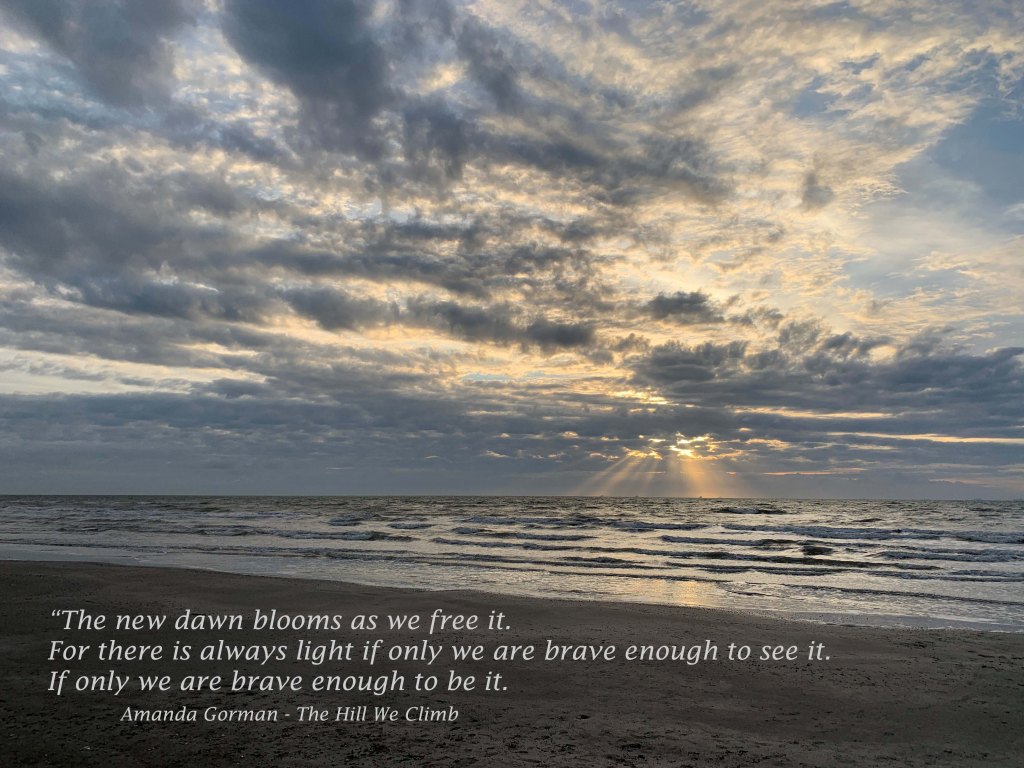
Photo taken this weekend while working in the yard.

“The efficacy of prayer is often measured by the degree to which the individual is willing to become involved in actually working in the world to meet these needs. A man may share in his prayer his concern for peace in the world and yet, in his own little world, be unwilling to change his private attitude of antagonism or prejudice toward his fellows.” Howard Thurman
It’s not like God needs my help on that world peace thing, but still, I suspect he would appreciate me handling some of my own conflicts, or maybe even heading them off before they arise.
“Be still and cool in Thy own mind and spirit, from thy own thoughts, and then thou wilt feel the principle of God to turn thy mind to the Lord God, whereby thou wilt receive God’s strength and power from whence life comes, to allay all blusterings, storms, and tempests.”
 It occurs to me...