Haiku Wednesday – NOT

I sat down to write a haiku and put a photo with it, but this song kept coming out, so I am sharing it.  You all know the song from the Charlie Brown 1965 Christmas special — even if you weren’t born before 1965.  Many people don’t know there are real words to the song as it is difficult to understand the children singing in the cartoon.  So here’s one of my favorite versions, by Sarah McLachlan – or pull it up on iTunes.  Diana Krall also sings a good version. 


Merry Christmas!


https://www.youtube.com/watch?v=FBAJoF_ndbY

Works In Progress

“Human beings are works in progress that mistakenly believe they are finished.”  Dan Gilbert

Can’t argue with this one, though I might add as an editorial note that it is so easy to overestimate my own level of completeness, and underestimate that of others.

The Hard Work of Understanding Other People

Today from Howard Thurman’s Deep Is the Hunger, this on the hard work of understanding other people:

“The will to understand other people is a most important part of the personal equipment of those who would share in the unfolding idea of human fellowship.  It is not enough merely to be sincere, to be conscientious.  This is not to underestimate the profound necessity for sincerity in human relations, but it is to point out the fact that sincerity is no substitute for intelligent understanding.”

I hear him saying, politely, that one can’t merely feel your way into understanding others, it takes effort, and fighting the inclination to take the easy route.  Thurman continues:

“A healthy skepticism with reference to rumors, gossip, what we read and observe about others must be ever present, causing all these things to be evaluated by our highly developed sense of fact.”

Absent these meaningful efforts, “we are apt to substitute sentimentality for understanding, softness for tenderness, and weakness for strength in human relations.”  

Photo and Text Sunday

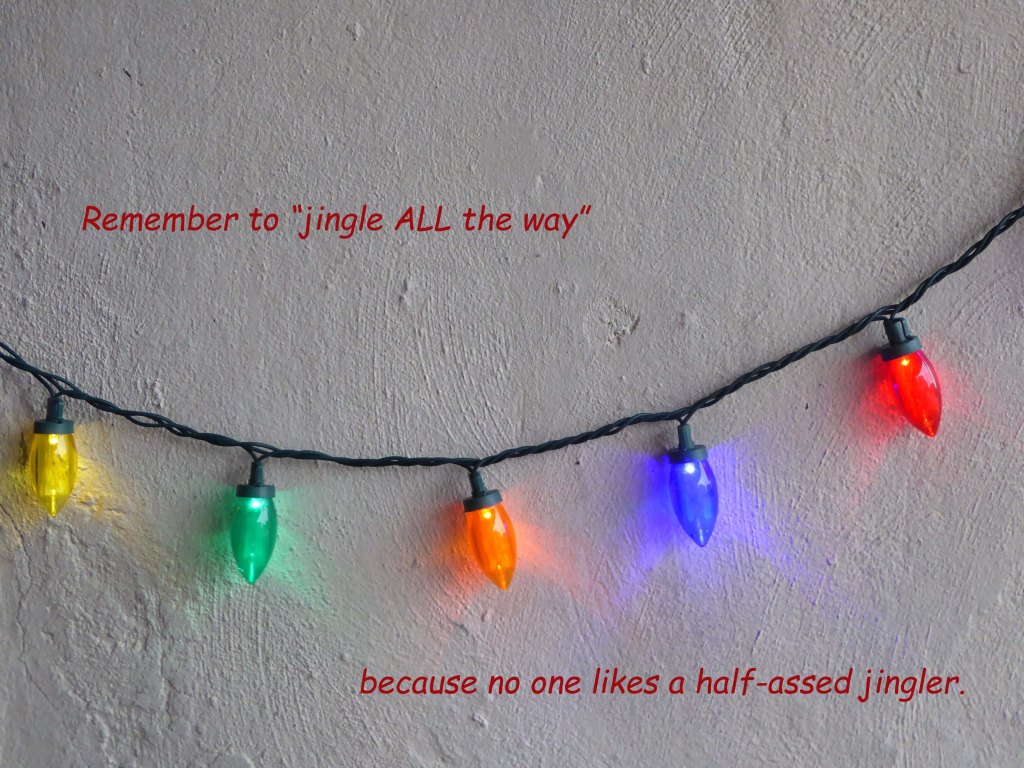
Saw the text on a T-shirt at the airport early this morning and it got a laugh out of me, which, given the setting, was quite an accomplishment. I had the picture (taken in Galveston) already in the can. Christmas time is, as they say, a coming.

Awareness

In reviewing my journaling on my Word of the Year (“Awareness”) this month I came across this quote from Eric Hoffer: “To become different from what we are, we must have some awareness of what we are.”  A few pages over I have this written in quotation marks (though, unfortunately, with no attribution): “…we differ in what we do or don’t do…not in what we are.”

Merging those thoughts, once we “have some awareness of what we are” we recognize that “we differ in what we do or don’t do…not in what we are.” That as we each seek to determine what we are, we come face to face with the reality that we are the same.  In this I am reminded of the line from John McCutcheon’s timeless Christmas classic (though not of the jolly mold), Christmas in the Trenches – “on each end of the rifle, we’re the same.”

The “Radical and Revolutionary Deed

From Howard Thurman’s Deep Is the Hunger:

“[L]ife in any form seems to have a little way of its own, moving with quiet assurance to some special end.  It is of immeasurable comfort to remember that much of the chaos and disorder of our own lies is rooted in causes that are understandable; much of the evil in life is reasonable, in the sense that its roots can be traced and it is not necessary to place the blame upon the devil or some blind senseless process.  The naked responsibility for human misery, you and I and ordinary human beings like us must accept.  In this doomful fact there is the ground of hope, because it means that in the creation of man, God provided for limitless resourcefulness, and because of any situation, however chaotic, can be understood and reconstructed if we have no fear to do, if need be, the radical, the revolutionary deed.”

There is so much there to unwrap.  Life moves “with quiet assurance to some special end” settles in so softly, but Thurman sends along with it the unsettling message that we all share some of “the naked responsibility for human misery.”  But as he notes, within that “doomful fact” there is “grounds for hope” so long as we recall and act upon our innate ability to perform “the radical, revolutionary deed.”

That “radical, revolutionary deed” comes in many forms, shapes and sizes.  We can pause and listen, stop and help, contribute, smile, encourage….  All of course fit under the single most “radical, revolutionary deed” – love.