Photo and Text Sunday

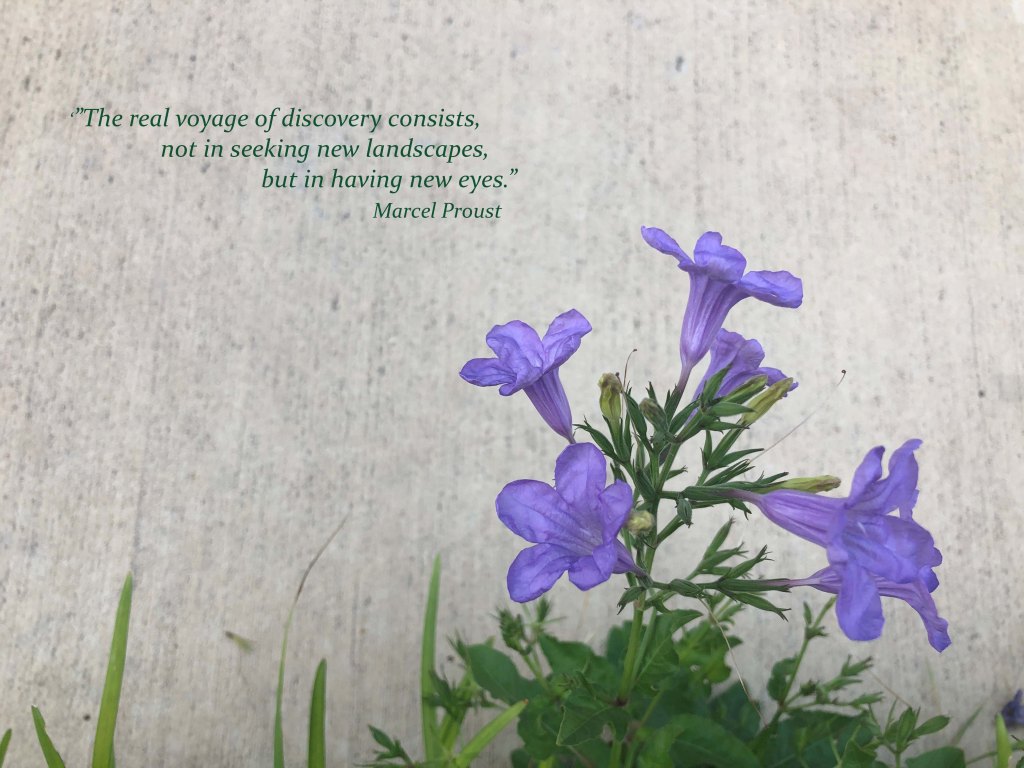
Today’s photo was taken of these purple flowers that grow wild around Austin, and l assume elsewhere. I generally don’t really notice them as they are plentiful and, well, I consider them to be weeds (a whole ‘nother lesson there), but on this day this bunch caught my eye on a run as it extended out over the sidewalk, giving me the opportunity of “having new eyes” as I looked at them — and to the point, gave me a photo for this quote I have had sitting on a post-it note on my desk.

Dingy Sleeves

Howard Thurman points out a paradox today, that as children we often strive to be more like grown ups, and grown ups we often strive to be more like children.  He notes that as adults we can easily feel we have seen it all and can arrive at a point in which we have “no response for surprises, for that which is breathlessly beautiful.” That is, we are at high risk for becoming world-weary (the German “weltschmerz”), or as Thurman puts it, “incapable of the tremor of sheer delight or the thill of intense awe and wonder.” Thurman’s encouragement is “to recapture the wonder of little children, to know once again the fresh feel of the unknown as we stand on the threshold of new adventure, this saves life from boredom and keeps it from growing dingy on our sleeve.”

And who wants life to become “dingy on our sleeve?

Quiet Faith of Man

This song, written by Bill Staines, song by Jerry Jeff Walked, bubbled up on my playlist today and hung around in m head. Songrwiting at its best, particularly the chorus:

You can trust the moon to move the mighty ocean

You can trust the sun to shine upon the land

You take the little that you know, and you do the best you can

And you see the rest as the quiet faith of man

Walker

https://www.google.com/search?gs_ssp=eJzj4tFP1zcsNjCtKClMKjFg9BIqLM1MLVFIS8wsyVDIT1PITcwDAL6cC0o&q=quiet+faith+of+man&rlz=1C1GCEA_enUS928US930&oq=quiet+faith+of+mman&aqs=chrome.1.69i57j46i13l2j0i13i30l2j0i5i13i30j0i390l3.6757j0j15&sourceid=chrome&ie=UTF-8

Staines

Hope and Despair

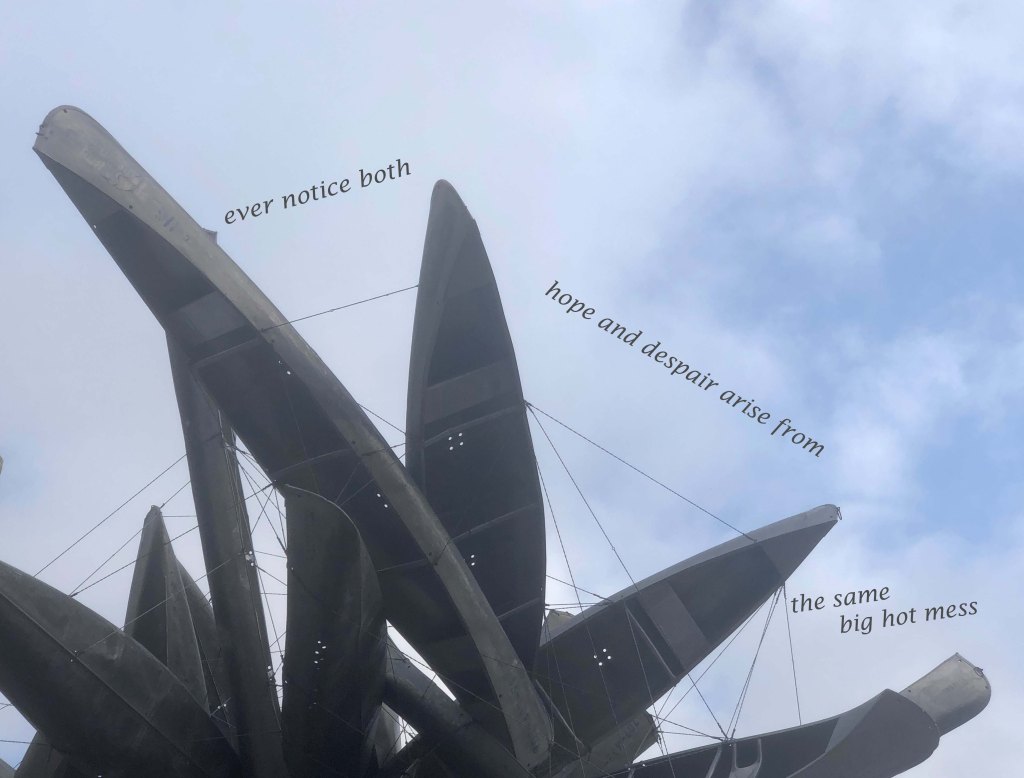
I often pass by this artwork (I call it “Canoe Mess”) on Saturday morning runs through the UT campus. It is along the main mall, and I run slow, so I have plenty of opportunity to view and ponder it as I amble along. This thought hit me recently.

Whence Good Fortune?

Buried in the midst of Mary Oliver’s I Am Not Among The Early Risers is this line:

“Have I ever taken good fortune for granted?”

It is a line to stumble over were the answer (“Of Course!”) not so quick to the mind. And, I might sheepishly add, sometimes not only have I taken good fortune for granted, but I have even claimed it as my own work.

Monday, Monday

From Black Oaks, Mary Oliver — Well, it semed like an appropriate verse for this Monday morning:

“…And to tell the truth I don’t want to let go of the wrists

of idleness.  I don’t want to sell my life for money,

I don’t even want to come in out of the rain.”

The years we have lived

Wisdom from Howard Thurman:

“All of us must accommodate ourselves to the simple fact that we are not so young as we once were, and thus take life in the stride belonging to the years we have lived.”

I love that.  So much subtlety to explore there.  We must “accommodate ourselves” to aging.  Not fight it, not resist it, not ignore it, but “accommodate ourselves” to it.  It is, after all, part of us, and we part of it.  And it is accommodation, not giving in, not resigning ourselves to it, but accommodate ourselves” to the years we have lived, and how they have been lived.  But it gets better.  We are, of course, as old as we numerically are.  We have been around that many years, but Thurman is not telling us to “act our age.”  No.  Age aside, we each have a “stride belonging to the years we have lived,” and that defines how we are to live, to age.

Of course, those may just be the wistful ramblings of an old fart.