Victor Frankl refers to the choosing of attitude as “the last of human freedoms.” When all other freedoms are gone, that one remains. Thankfully, though, we are allowed to exercise that choice at any point, not only when it is all that remains.
You Don’t Never Know
Howard Thurman introduced me to a new (well, old, but new to me) phrase today, Quod Erat Demonstrandum. That is of course Latin, abbreviated as Q.E.D. It means “what was to be demonstrated” or “what was to be shown,” and the abbreviation is typically placed at the end of an equation or a philosophical argument to emphasize completeness – sort of like a smug exclamation point, or in modern terms, a “mike drop” or perhaps even a Forest Gump “and that’s all I have to say about that.”
Without stating it expressly, Thurman points to the absurdity of this phrase/abbreviation: “Life is essentially dynamic and alive…. All judgments concerning experience are limited and partial.”
That is or can be a bit of a tough pill to swallow – all our judgments “are limited and partial.” Which takes me to a colloquialism my wife and I repeat often, usually in wonderment at some surprise – “You don’t never know.” This is, for emphasis, typically followed by – “You think you do, but you don’t.”
All that to say Thurman is correct. We really don’t never know. We think we do, but we don’t.
Questions and Answers
Reading today from Mary Oliver’s Roses, Late Summer:
If I had another life
I would want to spend it all on some
Unstinting happiness.
I would be a fox, or a tree
Full of waving branches.
I wouldn’t mind being a rose
In a field full of roses.
Fear has not yet occurred to then, nor ambition.
Reason they have not yet thought of.
Neither do they ask how long they must be roses, and then what.
Or any other foolish question.
It occurs to me in reading this and letting it settle in that the nature of a life is in large part determined by the questions one asks – the questions, not the answers. Not to suggest that the answers lack significance, but the answers are frequently not within our control, and correct or not, seem to do little to provide understanding. The questions, on the other hand, are ours to be asked and explored — or not. Which points me to Albert Einstein: “I have no special talents. I am only passionately curious.”
Photto and Words Sunday
Another of those accidental photos that sit in my camera a while until they meet some text. The text is a jotted down line from a Kate Bowler podcast (Everything Happens).

Always On Our Way To The Red X
Today from Howard Thurman, this deceptively simple sentence of eight short words:
“We seem always to be on our way.”
This sent me back to one of my favorite quotes from Barbara Brown Taylor’s An Altar To The World:
“No one longs for what he or she already has, and yet the accumulated insight of those wise about the spiritual life suggests that the reason so many of us cannot see the red X that marks the spot is because we are standing on it. The treasure we seek requires no lengthy expedition, no expensive equipment, no superior aptitude or special company. All we lack is the willingness to imagine that we already have everything we need. The only thing missing is our consent to be where we are.”
Let’s string two of those sentences together:
“We always seem to be on our way.” “The only thing missing is our consent to be where we are”
Haiku Wednesday
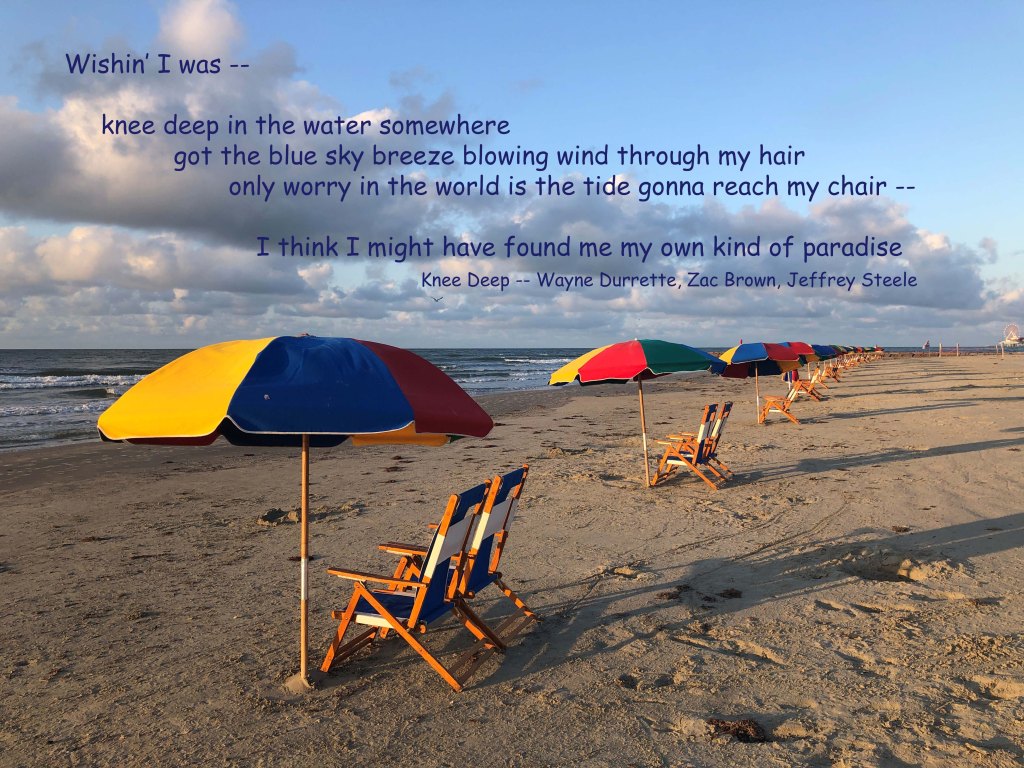
Photo recently taken in Galveston. Text lifted from Psalm 118.

Not Needed, Yet Of Inexplicable Value
Buried within the lines of Mary Oliver’s The Buddha’s Last Instruction, there three lines I hung on to:
“clearly I’m not needed
yet I feel myself turning
into something of inexplicable value.”
It occurs to me that one begets the other, that we first need to understand we are “not needed” (humility) before we can attain “inexplicable value.” No new thought here, this recurring theme in all great philosophies and religions — to win you have to lose, to attain you have to give up, to reap you have to sow, to hold on to you have to let go. You’d think I’d/we’d understand this a bit better by now.
Hard Language
Just a random thought today on language, or since I only know one, perhaps I should limit it to English. Like many things, we take something simple and make it complicated. Take the simple four-letter word – “hard.” Simple? As an adjective, it has, in Webster’s, fourteen definitions, depending on whether you are referring to hard liquor, hard money, hard evidence, hard detergent, hard eyes, hard water, or even hard language. And that doesn’t even get you to the adjectives. No wonder it is so hard (as in “difficult”) to say what we mean and mean what we say.
Photo and Text Sunday
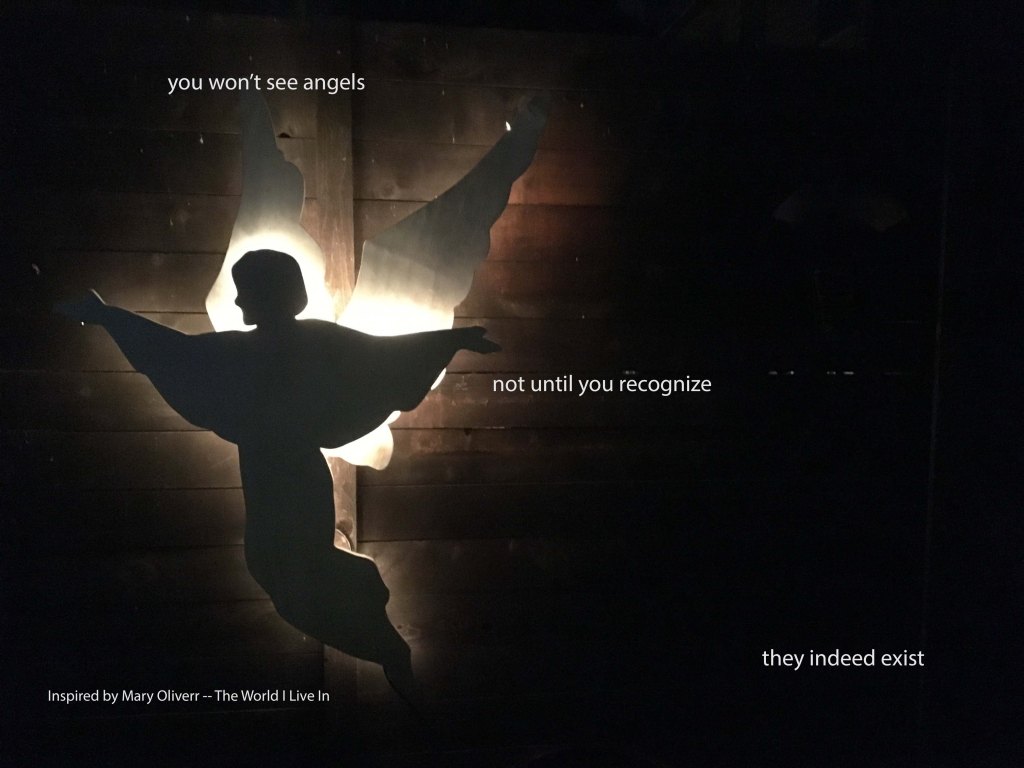
More from Mary Oliver’s The Sun:

Haiku Wednesday
Riding my bike along Seawall in Galveston today I heard an exasperated parent use this line with one of his kids. I am sure I used it long ago with my kids, but the absurdity of the line (its hubris and illogic, among other points) hit me today as I heard it.
Photo is just a filtered black background.