Photo taken recently in Galveston. Don’t know the couple in the photo, but was grateful for their presennce.

Photo taken recently in Galveston. Don’t know the couple in the photo, but was grateful for their presennce.
Okay, I’ve never really cared for Leonard Cohen, or for this song (I find The Neville Brothers version of it better), but apparently a lot of people do like the song and the song (and a flashback to Hitchcock’s The Birds) is what made me take the photo — so here it is.

Because we need a laugh now and again.
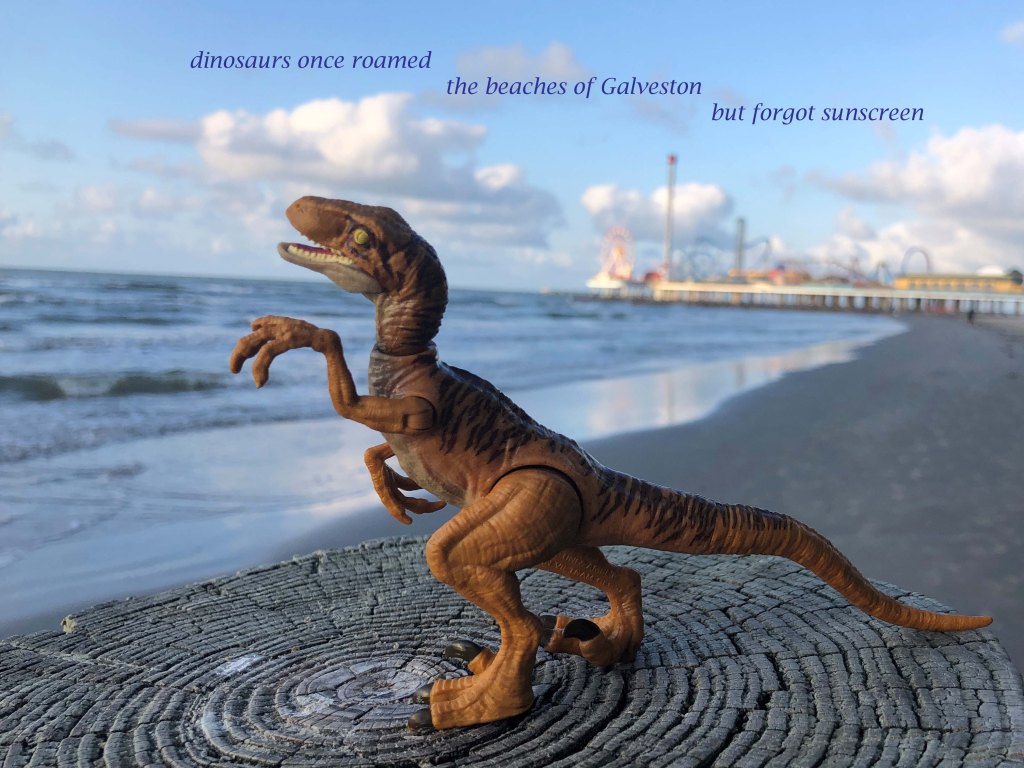
Today, one of my favorite passages from C. S. Lewis’ Mere Christianity:
“…hate the sin but not the sinner. For a long time I used to think this a silly straw-splitting distinction: how could you have what a man did and not hate the man? But years later it occurred to me that there was one man to whom I had been doing this all my life – namely myself.”
Indeed it is so. The lesson here seems pretty straightforward. If I can reconcile the sin/sinner conundrum with myself, well then, resolving it with that guy ought to be achievable.
Galveston early morning photo. No white sand beaches, no blue water, but still…
Zac Brown Band Song – https://www.youtube.com/watch?v=TJSUQQdEKSk
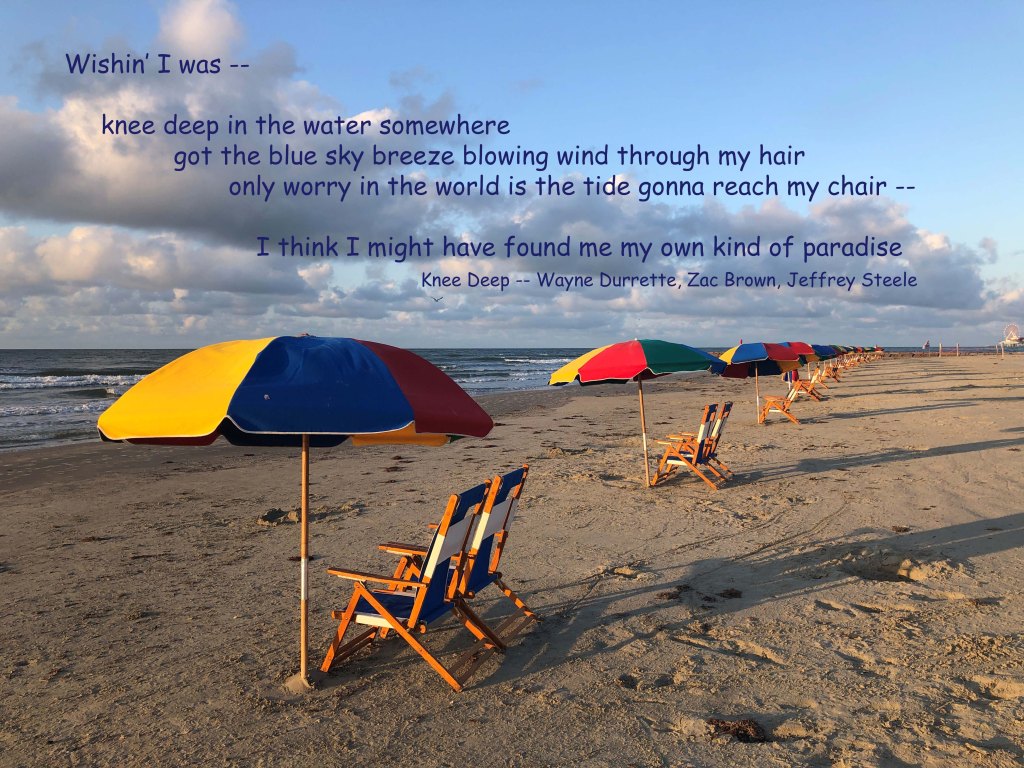
Today, from Mary Oliver’s The Swan:
“Of course! The path to heaven doesn’t lie down in flat miles.”
Of course it doesn’t — though not for my lack of trying to make it, wishing it were, so.
A little Christmas in July. Photo taken around Christmas a few years back. Mary Oliver’s poem The World I Live In provides the haiku inspiration. Whole poem below.
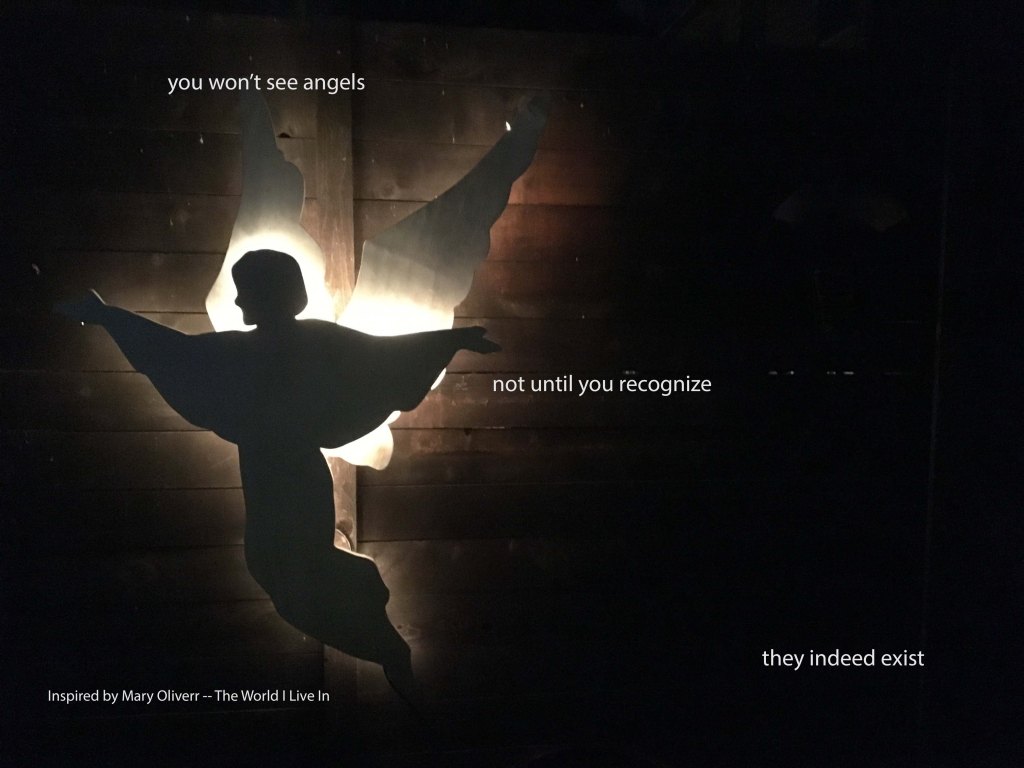

Victor Frankl refers to the choosing of attitude as “the last of human freedoms.” When all other freedoms are gone, that one remains. Thankfully, though, we are allowed to exercise that choice at any point, not only when it is all that remains.
Howard Thurman introduced me to a new (well, old, but new to me) phrase today, Quod Erat Demonstrandum. That is of course Latin, abbreviated as Q.E.D. It means “what was to be demonstrated” or “what was to be shown,” and the abbreviation is typically placed at the end of an equation or a philosophical argument to emphasize completeness – sort of like a smug exclamation point, or in modern terms, a “mike drop” or perhaps even a Forest Gump “and that’s all I have to say about that.”
Without stating it expressly, Thurman points to the absurdity of this phrase/abbreviation: “Life is essentially dynamic and alive…. All judgments concerning experience are limited and partial.”
That is or can be a bit of a tough pill to swallow – all our judgments “are limited and partial.” Which takes me to a colloquialism my wife and I repeat often, usually in wonderment at some surprise – “You don’t never know.” This is, for emphasis, typically followed by – “You think you do, but you don’t.”
All that to say Thurman is correct. We really don’t never know. We think we do, but we don’t.
Reading today from Mary Oliver’s Roses, Late Summer:
If I had another life
I would want to spend it all on some
Unstinting happiness.
I would be a fox, or a tree
Full of waving branches.
I wouldn’t mind being a rose
In a field full of roses.
Fear has not yet occurred to then, nor ambition.
Reason they have not yet thought of.
Neither do they ask how long they must be roses, and then what.
Or any other foolish question.
It occurs to me in reading this and letting it settle in that the nature of a life is in large part determined by the questions one asks – the questions, not the answers. Not to suggest that the answers lack significance, but the answers are frequently not within our control, and correct or not, seem to do little to provide understanding. The questions, on the other hand, are ours to be asked and explored — or not. Which points me to Albert Einstein: “I have no special talents. I am only passionately curious.”
 It occurs to me...