Listening to a podcast recently I heard this from Eboo Patel. “You see the light on the path. You walk the path. You don’t become particularly impressed with yourself.” That seems like a pretty good rule of life, one that calls up Psalm 119:105: “Thy word is a lamp unto my feet, and a light unto my path.” But it occurs to me that Patel’s admonition — “don’t become particularly impressed with yourself”– is a critical addition to the equation. When things are going well, it is easy to believe that in my walk I am responsible for not just putting one foot in front of the other, but also for creating the path and the light. Conversely, when things aren’t going so well, someone else is responsible for the darkness and the boulders in my path.
Trying Better
I just finished a book by Alan Light titled The Holy or the Broken. It is a book solely about the Leonard Cohen song Hallelujah. I suppose one has to be somewhat of a music junkie to really like such a book, which makes sense, because I really liked it. In short, Cohen wrote the song over several years and it frustrated the heck out of him. Reportedly he wrote more than fifty verses. The version he originally selected to put on an album had five verses – and his record label refused to release the song, indeed, entire album. When Hallelujah was later ultimately released in 1984 it was essentially unnoticed. Ultimately, Cohen’s original was covered by John Cale. Cale contacted Cohen and asked him for the lyrics and came home to a a floor full of pages spewed from the fax machine. Cale picked a handful of verses, only two of which were on Cohen’s original release. Cale’s version received no great response. However, a then unknown singer named Jeff Buckley, while house sitting for someone, pulled an album from a stack and listened to Cale’s cover of Cohen’s Hallelujah. Buckley’s version, arguably the most famous (though it did not become popular until after Buckley’s tragic death) is then, a cover of Cale’s cover of Cohen’s original. Many versions we hear are then, covers three-times over. Most bear little in common with Cohen’s version other than the title and the fact that they use some of Cohen’s many verses. Prior to his death, Cohen generally played in concert some version of Cale’s or Buckley’s covers.
In reading the book I kept thinking of the quote from Samuel Beckett: “Ever tried. Ever failed. No matter. Try Again. Fail again. Fail better.”
There, that’s a long way to get to the punchline. It occurs to me that life is full of failure. The failure is a given, and not the end of the story unless we allow it to be. The trick is to, as Beckett wrote – “Try again. Fail again. Fail better.”
Break Out the Christmas Music
Having entered into December, it is, by all accounts, time for Christmas music. I know that because I have been hearing it for weeks now. The stores have long ago been playing it and put up their Christmas decorations and displays, airports and hotels have too. Heck, they lit the trees at the Capital and at Rockefeller Center. Yep, its Christmas music time. I’ll wear out my play list and add some new songs.
There is, of course, a plethora of Christmas music. So, where do I start? Ignoring those early adopters who have been blasting me with “jingle sells” music for weeks now, what is the first official listen that opens my Christmas music season? It is a close call, but for me, the first Christmas song played is the last one I play each year before I retire my Christmas play list — A Christmas Wish, performed by Asleep At The Wheel. My understanding is that it was written by the late Johnny Gimble, a legendary fiddle player. I like it because it openly recognizes and embraces the bridge between secular and religious Christmas, between Santa Claus and the birth of Jesus. It allows both to exist, both to be celebrated, with the agreed end being the desire for the season to be giving and receiving, yes, but giving and receiving of more than packages with ribbons and bows.
“May Santa fill your stocking, and Jesus fill your heart
With peace and joy this season, and when the new year starts
May his love lead and guide you, every step of the way
And every day, of every year, become thanksgiving day
May friends and family gather, to celebrate his birth
With songs of praise and glory, and prayers for peace on earth
His grace and love will keep us, if we’ll only believe
So trust in him throughout the year, as well as Christmas Eve
So every day, of every year, becomes thanksgiving day.”
Happy Holidays. Merry Christmas. Let the music begin – even that horrid “Grandma Got Run Over by a Reindeer!”
Doing Good, Not Great
As I drive and fly I am becoming more and more grateful for podcasts. Yesterday, I listened to a TED Talk on gratitude. One of the speakers was Mark Davis, a volunteer firefighter, who described his first call out to a fire on a cold rainy night. The second story of the house was in flames, and on arrival Davis asked his Captain what he could do. He was sent in to retrieve a pair of shoes for the homeowner, who was standing outside shoeless. Another firefighter was sent in to rescue the homeowner’s dog. The latter was obviously a more “heroic” effort and Davis reports feeling some envy, some thought as to the relative smallness of his assigned task. Both tasks were accomplished. Later the homeowner wrote the fire department thanking the firefighters for saving her house. She specifically mentioned the recovery of the pet, and also noted that the firefighters were even so kind as to get her a pair of shoes as she stood outside.
All that is background for the quote that resounded with me as I was driving through east Texas yesterday:
“It is so easy to miss the opportunity to do something good while looking for the opportunity to do something great…. Not every day offers us the opportunity to save a life, but each day offers the opportunity to effect one.”
Davis is of course correct. Abundant opportunities to do good are right there if I pay attention. They come in all sizes and shapes, and pop up in even the most unexpected places. I may miss most of them on a given day, but that’s okay. Good is good, even if there is a “better” or “best.” Do some good.
Haiku of the Week
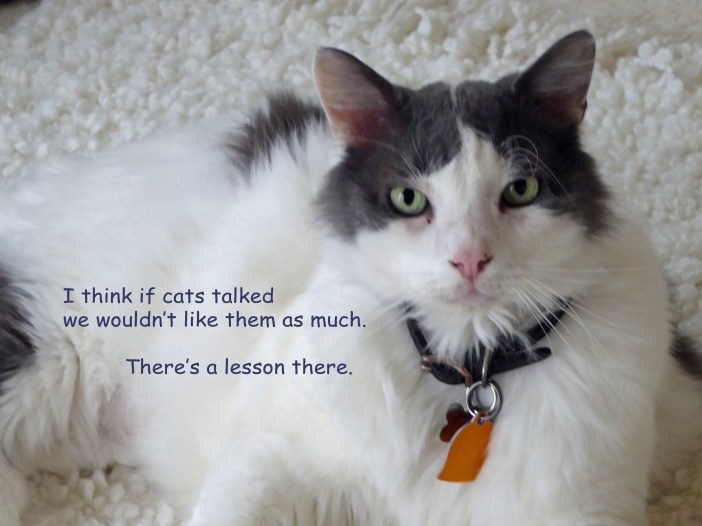
Photo of our cat on his bed he allows us to use.
Emotions
“The smallest act of kindness is worth more than the grandest intention.” Oscar Wilde
As I watched the Macy’s Thanksgiving Parade and the debut of a new season of Christmas themed commercials that tug at heartstrings, this quote came to mind. The holidays are filled with emotions, yes, and there’s nothing wrong with that, but unless that feeling is accompanied by action, those emotions fall in the “if a tree falls in the forest but no one is there to hear it, does it still make a noise” category. Go ahead, put money in the kettle. Smile at the harried cashier. Act on the emotions – the good ones anyway.
Gratitude
Here I am two days after Thanksgiving and still thinking about gratitude. It might be a new record! Hang with me here.
Recently I pulled an old pair of socks from the sock drawer and I noticed the feet were full of holes, really full of holes as in they had more holes than feet. I realized the time had come to toss then, so I did, but reluctantly, with some regret. That seems pretty mundane, I know, but I really liked those socks. Really liked them. Initially, after processing through wondering if I could find an identical pair (I tried, I can’t) I tried to dredge up a memory of the last time I wore them, and couldn’t. Heck, I should have appreciated them more then, and each time I put them on. (Yes, that is the Catholic Guilt a youth of catholic school and nuns trains you for.)
That got me to thinking of various songs and passages that go to that point – that I should be filled with gratitude for what is and treat each experience, each interaction, even each breath as if it were the last – because it just might be. It seems a nice sentiment, but that last part is what I got hung on. Yes, I should be filled with gratitude, but can’t I just stop there. Need my gratefulness be tied to dark thought that what I am grateful for is ephemeral and might be ripped away from me in some tragic event? Need I guilt my way to gratitude?
In this I was reminded of a quote from Thomas Merton: “Gratitude takes nothing for granted, is never unresponsive, is constantly awakening to new wonder.”
Gratitude is vigilant awareness and responsiveness to the wonder occurring around me – and there’s plenty of that.
Distraction
Today from Oswald Chambers:
“Beware of ‘the cares of this world,’ because they are the things that produce a wrong temper of soul. It is extraordinary what an enormous power there is in simple things to distract our attention from God. Refuse to be swamped with the cares of this life.”
I so want to fight back on this. It sounds haughty, unrealistic, and Pollyannaish – reactions which likely makes it even more worthy of my attention. Of course, that this is exactly what I need to hear going into Advent as I “prepare the way” for Christmas. I can get solace, if I need it, from the verbiage. Chambers does not suggest that I “ignore” the “cares of this life,” only that I “refuse to be swamped” by them. But I must acknowledge the truth in his statement. Whatever “cares of this life” I let in, no matter how simple they are, they have the ability to distract my attention from God just as a small hole in a boat hull has the ability to sink it.
It occurs to me that Chambers has delivered a good mantra as I head into Christmas. As I move toward, contemplate and celebrate Christmas – “Refuse to be swamped with the cares of this life.”
Okay. Now comes the hard part.
Gratitude
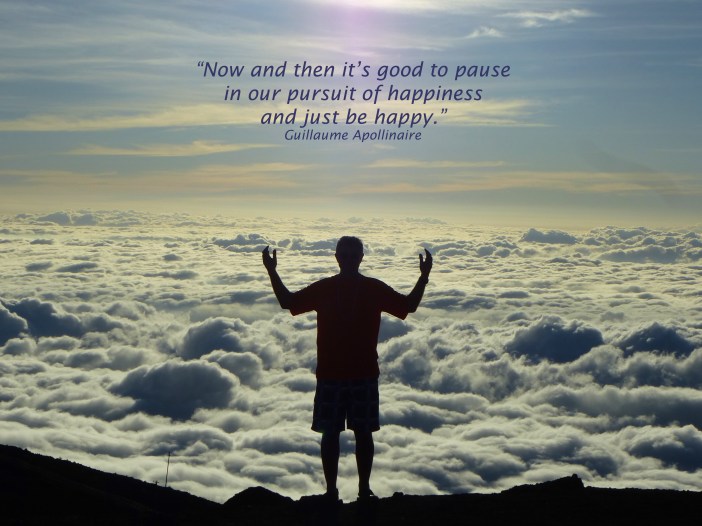
Thanksgiving
One of the fine things about holidays is that there is a license to meander a bit with less of an eye on the clock – which explains how I could find myself today reading JFK’s Presidential Proclamation 3560 issued in November 1963, shortly before his assassination.
“Yet, as our power has grown, so has our peril. Today we give our thanks, most of all, for the ideals of honor and faith we inherit from our forefathers–for the decency of purpose, steadfastness of resolve and strength of will, for the courage and the humility, which they possessed and which we must seek every day to emulate. As we express our gratitude, we must never forget that the highest appreciation is not to utter words but to live by them.
Let us therefore proclaim our gratitude to Providence for manifold blessings–let us be humbly thankful for inherited ideals–and let us resolve to share those blessings and those ideals with our fellow human beings throughout the world.”
These are fine words indeed, but as stated, the challenge is not simply to “utter words” but to “live by them.” As JFK noted in the Proclamation, we are called to share our blessings and ideals. Note the choice of “share” instead of “covet” or “flout” or “impose” or other such words that might replace “share.”
In declaring November 28, 1963 a national day of thanksgiving, JFK challenged us all:
“On that day let us gather in sanctuaries dedicated to worship and in homes blessed by family affection to express our gratitude for the glorious gifts of God; and let us earnestly and humbly pray that He will continue to guide and sustain us in the great unfinished tasks of achieving peace, justice, and understanding among all men and nations and of ending misery and suffering wherever they exist.”
It occurs to me that more than 50 years later, that prayer should remain on our lips, and that those are not only words to utter, but to live by.
 It occurs to me...