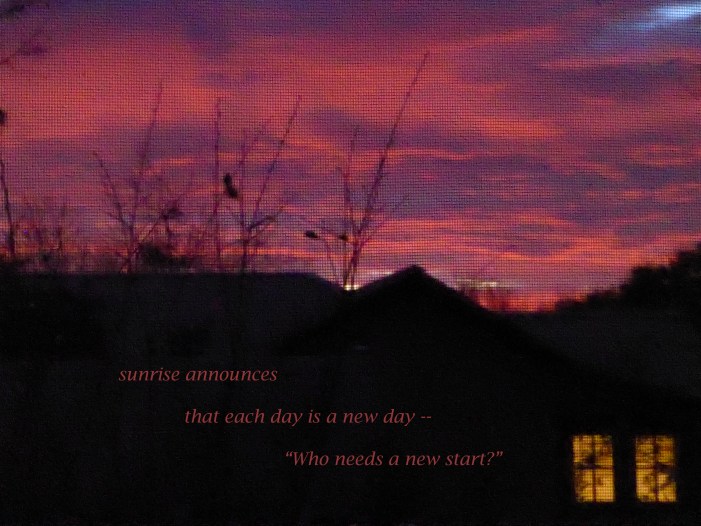
Photo taken our my window this morning — screen and all.
Photo taken our my window this morning — screen and all.
As many times as I have read the story of the Prodigal Son in Luke 15 I have never wandered beyond the three characters – the father and the two sons. I have often played the mind game of which of the three I am, which of the two brothers or the father, and concluded I am different ones at various time). Today, duh, I recognized that there were more than three characters in this drama. In fact, the story is full of people playing various roles. I am sure the younger son did not “waste his substance on riotous living” alone. He had help from many, including the “harlots” his older brother refers to. Then there was the citizen of another country who hired the younger son. Once the prodigal son approaches his home we have servants getting robes and rings and shoes, and others killing and preparing the fatted calf and other things for the feast. We have musicians playing the tunes that provide notice to the older brother of the party. Then we have the servant who has the task of telling the older brother what all the hubbub is about as the brother returns from the field. There is, in sum, a whole cast of characters all of whom play an integral part in the story.
It occurs to me that this is, of course the story of life, any life, my life. There are lots of characters involved in each person’s story. Each person of course plays the central role in his/her own story, but also a supporting role of some type in the story of many others. That supporting role may be anything from a speaking role central to the story, or a “bit role” of someone who, as a doorman, opens the door for the main character hurriedly entering or leaving. The supporting role many be that of the cab driver who silently drives someone from one location to another. There are many roles in each story.
One of the regular features of publications this time of year is a listing of folks who died in the year. I admit to being drawn to those, though I can’t really understand why. I read the news enough over the course of the year to generally know when famous folks die. Rarely do I read the year end lists of deaths and see a surprise. Still, I read those lists. Maybe I read them because I can, that is, because I am not among the departed (though of course I would hardly make those lists). I don’t know.
Anyway, in reading those I noted one grievous omission in most lists, even on Texas based publications. Even in the sub listings of song writers in many of the national publications, Guy Clark didn’t make the lists I read. Thankfully, he was recognized in Rolling Stone, and I suspect that would have been good enough for him. In a very short tribute to him, the magazine noted Clark was a “Texas troubadour who blended high wit with pure poetry and turned it into timeless, vibrantly visual songs.” I guess that’s as close as anyone can come to describing his music. But then it occurs to me that the magic of Guy Clark’s music, at least part of it, was that it never needed explaining. With his “high wit and pure poetry” he sang truth, and truth just is. Guy Clark’s truth, his music was/is, to quote him, “stuff that works, stuff that holds up, the kind of stuff you don’t hang on a wall. Stuff that’s real, stuff you feel, the kind of stuff you reach for when you fall.”
My annual new year’s custom or practice is to identify a word of the year to use to help guide me through that coming year. Thinking over the past few weeks about this, a word settled in fairly comfortably in my head, to the exclusion of other contenders – “recognition.”
By definition “recognition” is “acknowledgment of something’s existence, validity, or legality” or “identification of a thing or person from previous encounters or knowledge.” As has been the case over the years, this choice is a word that can have multiple meanings. I guess that makes sense when the word is going to be with me for 365 days – it needs to be versatile. I suppose I settled on the word because it was easy to come up with a list of things I need to “recognize.” That list is so long I won’t even begin to lay it out here, but suffice it to say that recognition is, I think, at its heart, realization of the truth. I have turned sixty. Donald Trump is going to be president. I have aches and pains I’d rather not have. Cedar fever season is here. (I am fairly sure the first two are related! Well, okay, the first three.)
“Recognition” also has at its heart acknowledgment of the role of the “other” in my life, that is, other than me. This includes recognition of the role that other people play or can play in my life, but also the role of other things/qualities that do/can – things like grace, kindness, stubbornness (assuming I ever was) or, (ahem, theoretically speaking) pride. As I said, the list is long. There is and will be much to “recognize” in 2017. But hey, it is only 10:00 on December 31. I still have about 14 hours to be self-centered and oblivious to other people and things around me! I best get busy.
Happy New Year!
From Paulo Coehlo’s The Alchemist: “[P]eople fail to recognize the good things that happen in their lives every day that the sun rises.”
It occurred to me this morning after reading this that this is the time of year when the focus is on two things – the past and the future. Anything I read has a “year in review” for 2016, whether it be greatest sports moments, significant world events, a list of people who passed away this year, the best books or movies of 2016 …. And then there are the resolutions about what we are going to do next year, that looking to the future. Amongst all that looking backward and forward it becomes easy to lose track of the now. I know much about that — I have a well-honed skill of looking backwards with regret and looking forward with anxiety, all the while forgetting the now. I suspect it is a common malady, but I am too busy looking at my own past and future to confirm that.
All that as a set up to the thought that perhaps this time of year is the time to increase my efforts to focus on today, and not on yesterday’s events and regrets, not on tomorrow’s possibilities and promise. Heck, maybe the time to do that is every day.
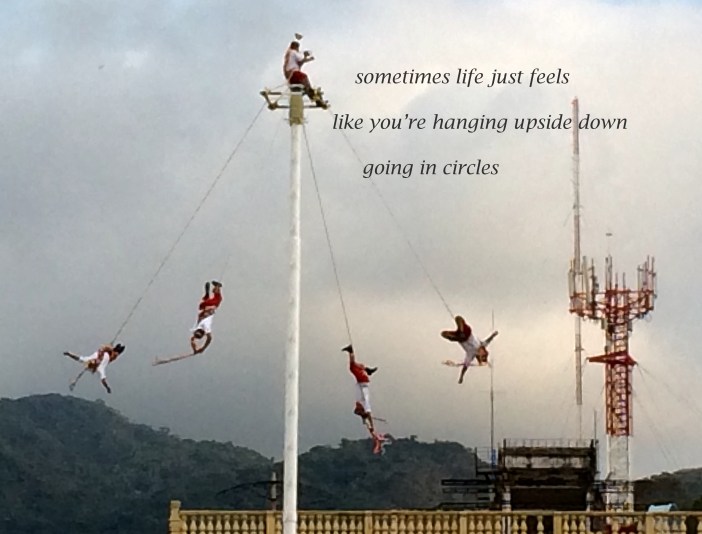
Photo taken last week of the danza de los voladores (dance of the flyers) in Puerto Vallarta. It occurred to me that while the danza de los voladores was a relatively uncommon thing, the feeling of earning money hanging upside down and spinning in circles was less so.
From “The Alchemist” by Paulo Coelho – Santiago, a shepherd, speaking of his sheep:
“The problem is that they don’t even realize that they’re walking on a re road every day. They don’t see that the fields are new and the season’s change. All they think about is good and water. Maybe we’re all that way, the boy mused.”
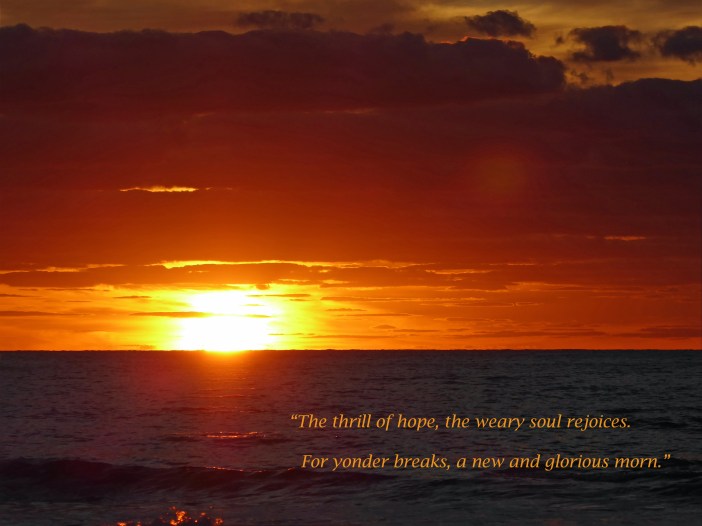
Photo taken in Galveston earlier this year. Merry Christmas!
I went to prison last night for our weekly prayer and share. (Well, it happens weekly when the men are not in lock-down, confined to their cells. And I only go once a month, but still, it is a weekly occurrence.) As these guys greeted me they wished me a Merry Christmas. It immediately occurred to me that they had no reason to look forward to Christmas. They were all wearing standard issue whites, green jackets not warm enough for the cold outside, standard issue shoes. All that to say that they, we, were in prison, only I got to leave in an hour. There would be no presents for them this year, none of the Christmas “trappings” I take for granted. Not even fruitcake! Then it occurred to me that some of these guys are lifers, so their reality was that Christmas, as I think of it, would never be reality to them. Still – “Merry Christmas” rolled off their tongues more easily than mine –I now felt guilty for even saying it. Then, this line came to mind just when I needed it. From Dr. Seuss and How the Grinch Stole Christmas:
“Maybe Christmas, he thought, doesn’t come from a store. Maybe Christmas, perhaps, means a little bit more!”
No, these men would not experience Christmas as I think of it, but maybe I need to adjust my thinking. Yes, we were here inside multiple fences wrapped in barbed-wire with care, but not in hopes that St. Nicholas would soon be there. Nope, this was a celebration of God’s presence among us, a celebration of the real Christmas that “doesn’t come from a store.”
Hopefully, like the Grinch, my heart “grew three sizes that day.”
Also among my Christmas favorites is In the Bleak Midwinter. One of my favorite versions is by (go figure) the Crash Test Dummies. The song is rather old. It was originally a poem written by Christina Rossetti in 1872, then was put into song in 1906. I guess it is not really a popular song. It is, after all, 110 years old and ensconced in the Episcopalian Hymnal. But it is such a great winter song.
In the bleak midwinter, frosty winds made moan; earth as hard as iron, water like a stone….”
That is a simple testament to how words can transport you. Even sitting in a warm house those first lines send a shiver down your spine and transport you to that point in location and time in your life where you have been really cold.
It is also a great Christmas song, and for that matter, a great all year song, because of a later verse:
What can I give Him, poor as I am? If I were a shepherd, I would bring a lamb. If I were a wise man, I would do my part. Yet what can I give Him – give my heart.
Amen.

