Speaking

I started down this path after reading of, then listening to Meryl Streep’s speech last night in which she speaks her mind on Donald Trump.   Then he “spoke”his.

It is, I suppose, a constant conundrum –  when to hold your tongue.  One can find seemingly inconsistent positions on this.  Heck, just within Proverbs we are told “he who opens wide his lips comes to ruin” (Proverbs 13:13), but also that “the lips of the wise spread knowledge.”  I doubt the Bible wants us all to be mute on all issues.  Like all things, there is a time to shut up and a time to speak up (though that’s not in the famous Ecclesiastes 3 run of “a time to”s.  Protesters have a right to protest.  People have a right to respond.  Meryl Streep has a right to speak her mind.  Donald Trump has a right to call her an “over-rated actress” and “a Hillary flunky who lost big.”  (I will say though that last one seems odd since in her speech Streep was holding the mike in one hand, and the just awarded Cecil B. DeMille Award for lifetime achievement in the other.  Oh well, at least he had the sense to refrain from calling her a “loser,” which would have been even more inconsistent.)

Sorry, that sounds like a political rant.  All this leads to one point – well, I guess, two:  Words matter.  Actions matter.

Homage to the “Shitty First Draft”

Today I stumbled on an excerpt from Anne Lamott’s Bird By Bird, one of her early books about writing.  From an early chapter entitled “Shitty First Drafts:”

“[S]hitty first drafts. All good writers write them. This is how they end up with good second drafts and terrific third drafts. People tend to look at successful writers who are getting their books published and maybe even doing well financially and think that they sit down at their desks every morning feeling like a million dollars, feeling great about who they are and how much talent they have and what a great story they have to tell; that they take in a few deep breaths, push back their sleeves, roll their necks a few times to get all the cricks out, and dive in, typing fully formed passages as fast as a court reporter. But this is just the fantasy of the uninitiated. I know some very great writers, writers you love who write beautifully and have made a great deal of money, and not one of them sits down routinely feeling wildly enthusiastic and confident. Not one of them writes elegant first drafts. All right, one of them does, but we do not like her very much. We do not think that she has a rich inner life or that God likes her or can even stand her.”

It occurs to me what much of what Lamott discusses relating to writing also applies generally to life – particularly at the new year.  That is, I make a resolution and expect that I will keep it for, at a minimum, 365 days, perhaps a lifetime.  It will, I think, be easy because I am resolved to stick with it.  “But this is just the fantasy of the uninitiated.”  Or, perhaps better stated, then comes January 2, then January 3, January 4, January 5, January 6, January 7, January 8, January 9, January 10, January 11, January 12, January 13, January 14, 14….  You get the point.

Mostly, success, success in writing, professional success, personal success, success in anything, comes in fits and starts, it comes through victory and defeat, through joy and sadness, through determination and resignation, then more determination and resignation.  It comes through (watch out, he’s mixing metaphors) taking the closed-eyed swing of the “shitty first draft” mess we call yesterday, trusting in grace and forgiveness, picking up the bat (or the pen, or the whatever) dusting off my ego, and taking another swing for the fence today (or hell, maybe just trying to just advance a runner with a sacrifice bunt).  To paraphrase Samuel Beckett (I don’t know if he liked baseball) success comes from trying again, failing again, but failing better.
It Is Well With My Soul

It popped into my mind this morning, and I have long given up the thought that these things are “just a coincidence:”

“When peace like a river, attendeth my way,
When sorrows like sea billows roll
Whatever my lot, thou hast taught me to say
It is well, it is well, with my soul

It is well
With my soul
It is well, it is well with my soul”

Today is Epiphany.  This is, according to Wikipedia, the day “that celebrates the revelation of God in his Son as human in Jesus Christ. In Western Christianity, the feast commemorates principally … the visit of the Magi to the Christ Child”   While the song was not written until some 1871 years later, it occurs to me that the feeling and emotion I get when I listen to It Is Well With My Soul is something like what the Magi felt as they gazed at the baby Jesus (except x some number).  “It is well, it is well, with my soul.”

The Magi did not, of course, at that point know the rest of the story.  I do:

“Though Satan should buffet, though trials should come,
Let this blest assurance control,
That Christ has regarded my helpless estate,
And hath shed His own blood for my soul

It is well (it is well)
With my soul (with my soul)
It is well, it is well with my soul

My sin, oh, the bliss of this glorious thought
My sin, not in part but the whole,
Is nailed to the cross, and I bear it no more,
Praise the Lord, praise the Lord, o my soul

It is well (it is well)
With my soul (with my soul)”

Indeed.  It is well with my soul.

Involved In Mankind

No man is an island,
Entire of itself,
Every man is a piece of the continent,
A part of the main.
If a clod be washed away by the sea,
Europe is the less.
As well as if a promontory were.
As well as if a manor of thy friend’s
Or of thine own were:
Any man’s death diminishes me,
Because I am involved in mankind,
And therefore never send to know for whom the bell tolls;
It tolls for thee.

John Donne – No Man Is An Island

This poem, or at least a line of it, popped into my head today.  “I am involved in mankind.”  Well I am, willingly or not.  That is, I guess, one of Donne’s main points.  The challenge, I guess, is not in determining  “if” I am “involved in mankind,” which seems to be a given.  I am a piece of the puzzle, a link in the chain, a cog in the wheel, or, if you will, (this would likely win a majority vote) a “clod” of the universe.

The challenge is not in the “if”, but in the “how.”

Roles

As many times as I have read the story of the Prodigal Son in Luke 15 I have never wandered beyond the three characters – the father and the two sons.  I have often played the mind game of which of the three I am, which of the two brothers or the father, and concluded I am different ones at various time).  Today, duh, I recognized that there were more than three characters in this drama.  In fact, the story is full of people playing various roles.  I am sure the younger son did not “waste his substance on riotous living” alone.  He had help from many, including the “harlots” his older brother refers to.  Then there was the citizen of another country who hired the younger son.  Once the prodigal son approaches his home we have servants getting robes and rings and shoes, and others killing and preparing the fatted calf and other things for the feast.  We have musicians playing the tunes that provide notice to the older brother of the party.  Then we have the servant who has the task of telling the older brother what all the hubbub is about as the brother returns from the field.  There is, in sum, a whole cast of characters all of whom play an integral part in the story.

It occurs to me that this is, of course the story of life, any life, my life.  There are lots of characters involved in each person’s story.  Each person of course plays the central role in his/her own story, but also a supporting  role of some type in the story of many others.  That supporting role may be anything from a speaking role central to the story, or a “bit role” of someone who, as a  doorman, opens the door for the main character hurriedly entering or leaving.  The supporting role many be that of the cab driver who silently drives someone from one location to another.  There are many roles in each story.

Guy Clark

One of the regular features of publications this time of year is a listing of folks who died in the year.  I admit to being drawn to those, though I can’t really understand why.  I read the news enough over the course of the year to generally know when famous folks die.  Rarely do I read the year end lists of deaths and see a surprise.  Still, I read those lists.  Maybe I read them because I can, that is, because I am not among the departed (though of course I would hardly make those lists).  I don’t know.

Anyway, in reading those I noted one grievous omission in most lists, even on Texas based publications.  Even in the sub listings of song writers in many of the national publications, Guy Clark didn’t make the lists I read.  Thankfully, he was recognized in Rolling Stone, and I suspect that would have been good enough for him.  In a very short tribute to him, the magazine noted Clark was a “Texas troubadour who blended high wit with pure poetry and turned it into timeless, vibrantly visual songs.”  I guess that’s as close as anyone can come to describing his music.  But then it occurs to me that the magic of Guy Clark’s music, at least part of it, was that it never needed explaining.  With his “high wit and pure poetry” he sang truth, and truth just is.  Guy Clark’s truth, his music was/is, to quote him, “stuff that works, stuff that holds up, the kind of stuff you don’t hang on a wall.  Stuff that’s real, stuff you feel, the kind of stuff you reach for when you fall.”

Recognition

My annual new year’s custom or practice is to identify a word of the year to use to help guide me through that coming year.  Thinking over the past few weeks about this, a word settled in fairly comfortably in my head, to the exclusion of other contenders – “recognition.”

By definition “recognition” is “acknowledgment of something’s existence, validity, or legality” or “identification of a thing or person from previous encounters or knowledge.”  As has been the case over the years, this choice is a word that can have multiple meanings.  I guess that makes sense when the word is going to be with me for 365 days – it needs to be versatile.  I suppose I settled on the word because it was easy to come up with a list of things I need to “recognize.”  That list is so long I won’t even begin to lay it out here, but suffice it to say that recognition is, I think, at its heart, realization of the truth.  I have turned sixty.  Donald Trump is going to be president.  I have aches and pains I’d rather not have. Cedar fever season is here.  (I am fairly sure the first two are related!  Well, okay, the first three.)

“Recognition” also has at its heart acknowledgment of the role of the “other” in my life, that is, other than me.  This includes recognition of the role that other people play or can play in my life, but also the role of other things/qualities that do/can – things like grace, kindness, stubbornness (assuming I ever was) or, (ahem, theoretically speaking) pride.  As I said, the list is long.  There is and will be much to “recognize” in 2017.  But hey, it is only 10:00 on December 31.  I still have about 14 hours to be self-centered and oblivious to other people and things around me!  I best get busy.

Happy New Year!

Now

From Paulo Coehlo’s The Alchemist: “[P]eople fail to recognize the good things that happen in their lives every day that the sun rises.”

It occurred to me this morning after reading this that this is the time of year when the focus is on two things – the past and the future.  Anything I read has a “year in review” for 2016, whether it be greatest sports moments, significant world events, a list of people who passed away this year, the best books or movies of 2016 ….  And then there are the resolutions about what we are going to do next year, that looking to the future.  Amongst all that looking backward and forward it becomes easy to lose track of the now.  I know much about that — I have a well-honed skill of looking backwards with regret and looking forward with anxiety, all the while forgetting the now.  I suspect it is a common malady, but I am too busy looking at my own past and future to confirm that.

All that as a set up to the thought that perhaps this time of year is the time to increase my efforts to focus on today, and not on yesterday’s events and regrets, not on tomorrow’s possibilities and promise.  Heck, maybe the time to do that is every day.

Haiku of the Whenever

sometimes-life-just-feels-text

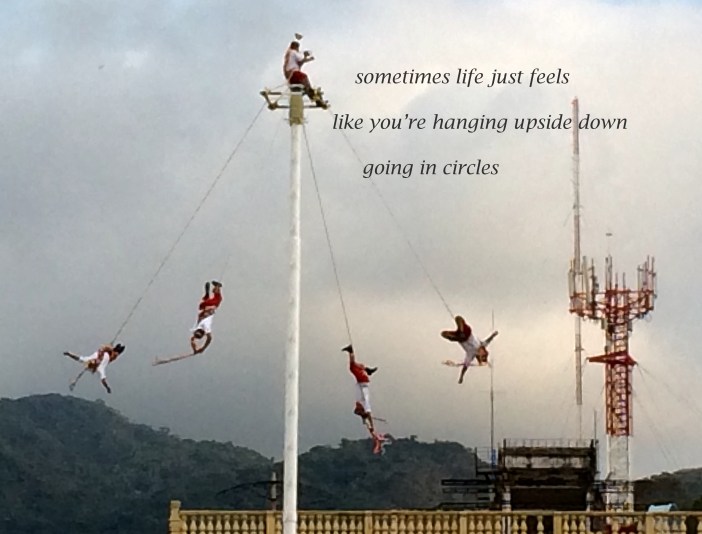
Photo taken last week  of the danza de los voladores (dance of the flyers) in Puerto Vallarta.  It occurred to me that while the danza de los voladores was a relatively uncommon thing, the feeling of earning money hanging upside down and spinning in circles was less so.