Toss the Lifesaver

I attended a service last night and had this from Thomas Merton laid in front of me: “Our job is to love others without stopping to inquire whether or not they are worthy.”  This reminds me of a C. S. Lewis quote I can’t locate right now.  The gist of the Lewis quote is that when we are standing on a dock holding a lifesaver (not the candy, the floating ring) and see a man drowning in the water in front of us, we don’t, prior to tossing out the lifesaver, demand a reasonable explanation as to why or how the man got in the water in the first place if he couldn’t swim.

Toss the lifesaver, damn it!

Pocket-Sized God

My reading today is from James Martin’s The Jesuit Guide to Almost Everything.  In writing on the various paths to God, he writes of the path of exploration.  The benefits of this path are readily apparent – an explorer has a lot to choose from.  There is truly a buffet line of faiths out there, each with its own beliefs to pick and choose.  Yet Martin notes that the path of exploration has some pitfalls.  We can become overwhelmed with choices, and thus never choose.  That is, the exploration never ends.  Also, in the exploration mode it is easy to develop what Martin refers to as a “pocket-sized God,” a personal God that is small enough to pull out as needed, but put back in my pocket when personal God doesn’t suit me or isn’t needed.  This is, I suppose, creating God in my own image, or at least to my own liking.  I am reminded of the quote I like so much from Anne Lamott’s Traveling Mercies — “You can safely assume you’ve created God in your own image when it turns out that God hates all the same people you do.”

It occurs to me that this is like treating God as a screwdriver or some other tool.  I get the tool I want/like and then I pull it out as needed.  I have this Craftsman screwdriver set.  Do I need a straight blade or a Phillips, and what size?  But of course no one ever (at least I hope not) develops a relationship with a screwdriver.

Belief/Unbelief

“I do believe; help me in my unbelief.”  Mark 9:24

In Bible study yesterday someone pointed out this verse was, well, challenging.  To provide context, the speaker is the father of the son who has, “from childhood” been afflicted with what we would generally think of today a seizures.  The father has brought the son to Jesus for healing as Jesus is passing through town.  Jesus tells the man: “Everything is possible for him who believes.”  The father replies: “I do believe; help me in my unbelief.”

One can, I suppose, look at this cynically, and think that the father is willing to say anything to have his son healed, so saying “I do believe” seems a small price to pay, even if it is a “white lie.”  That said, an alternative consideration here is to think that perhaps the father believes about like I do, and is simply, just like I should, owning up to his doubt.

In my on-line dictionary, “belief” is defined as “an acceptance that a statement is true,” and alternatively as “trust, faith, confidence in something.”  It occurs to me that “belief” and “faith” necessarily involve some doubt or uncertainty, otherwise they would be, well certainty.  If I put a 2×4 on the floor I am certain (assuming sobriety) I can step onto it, walk the length of it, and step off it, all without falling.  If however, that 2×4 is suspended, firmly fixed, 20 feet in the air, then I would likely say that I “believe” or “have faith” that I can walk across it — not to say I would do it, because I have my doubts and fears, and the stakes in being wrong seem fairly high

Sometimes when I am called on to have faith, the 2×4 is on solid, level ground.  No brainer.  But sometimes it is suspended up in the air, at a few inches, a few feet, and sometimes at what seems to me to be a mile high.  Which brings me full circle to the father, and to me — “I do believe; help me overcome my disbelief.”.
Bad Bet

This morning, out of respect for Phil Connors (Bill Murray’s character) I listened to Sonny and Cher sing I Got You Babe.  It is, after all, Groundhog Day.  The movie (Groundhog Day) is one of my favorites, and I am sure that today my head will be filled with some of my favorite lines.  Among the many that come to mind this morning. This one rises to the top.  To set the stage, Phil (who seems to be destined to repeat the same crappy day over again, starting with the Sonny & Cher tune blaring on his alarm clock) is speeding down a railroad track in a car, looking into the headlight of an oncoming train.  His line is simple and direct.  “I’m betting he is going to swerve first.”

I like that line because it exemplifies the “bad bet.”  Bad bets are, well, bad bets.  That said, betting on the train to swerve in a game of chicken is a REALLY bad bet (you see, the train…).  Phil’s situation aside (no risk, he was gonna wake up again to a crappy tomorrow and Sonny & Cher, or not), it occurs to me that it is easy to make bad bets in life – at least it is easy for me.  Some bad bets are quickly laughable, others take a bit more time to recover from.  To name a few, I bet on (purchased) the blue leisure suit.  (I am told that was a bad bet.)  I bet that people and/or circumstances won’t change (bad bet).  I bet that worrying is the appropriate response and will somehow change things (I guess I do.  Why else would I do it?)

Here’s the worst, though.  I bet that I am always right.  Or is it I always bet that I am right?  Same difference!  And when I place that bet is when my alarm clock needs to cue up Sonny & Cher and Phil’s line needs to ring in my head —  “I’m betting he is going to swerve first.”

A Joke Turns Serious

So this devout cowboy, a daily Bible reader, loses his bible and is distraught.  He prays to God regularly for its return.  Lo and behold, sometime later a cow walks up to the cowboy with the Bible in its mouth.  “It’s a miracle” the cowboy shrieks.  “Not really,” the cow says, “your name was on the front inside cover.” [rim shot]

I don’t know why, but this joke made me laugh for days.  I have, however, told it enough to know that it is, well, not as well received by others.  So am am going for the serious message in it, thinking maybe I should stick with that.  I often miss the real miracle that occurs in front of me, the real message I am supposed to get.  I see one thing and don’t recognize the other.  In the world of possibilities, a cow could walk up to a cowboy with a Bible in its mouth.  Unlikely, yes, but within the realm of possibility.  (Sort of like my “a guy and a giraffe walk into a bar” joke – a high ceilinged bar or an outdoor bar.)  But the thought that a cow could speak, let alone, read, is, well, impossible as far as I know.  THAT would be a miracle.

The cowboy missed the miracle.  All of which begs the question – how often do I miss the miracle?  Miracles aside, how often do I see events unfold and fail to recognize the true take away because I focus more on something else, the popular reaction, the instinctive emotional response?   There is lots going on around me.  In this world of instant news there is much to react to.  It occurs to me, again, that I should observe and ponder a bit more, react and respond a bit more slowly.  Wait, I think I have heard that before.  “Everyone should be quick to listen, slow to speak, and slow to become angry, for man’s anger does not bring about the righteous life that God desires.”  James 1:19-20

No Exploding Head

“The right to be heard does not automatically include the right to be taken seriously.”

Hubert Humphrey

A friend passed that quote along recently and it stuck in my head.  Over the course of the day I hear a lot.  To some extent I have control over what I hear, I get to choose what I hear – but not always.  I may overhear conversations in an elevator, or hear communications from those who stick their head in my office door and start talking.  I may hear news reports I’d just as soon not hear from the TV blaring here or there.  On reflection, I see that over the course of the day I hear a lot of things I’d just as soon not hear.  But I have 100% control over what I “take seriously.”  It occurs to me that such gatekeeping, deciding what goes into the “take seriously” bin and what goes into the “mindless drivel” bin, is a significant responsibility God gave me.  Still, I am thankful for the choice.  I am pretty sure God gave me that ability as a means of keeping my head from exploding.

Nothing Twice

Nothing Twice – Wislawa Szymborska

Nothing can happen twice.  In consequence, the sorry fact is that we arrive here impoverished and leave without the chance to practice.  Even if there is no one dumber, if you’re the planet’s biggest dunce, you can’t repeat the class in summer: this course is only offered once.

I read this a while back and saved it.  I particularly like the line – “we leave without the chance to practice.”  Given that, and given that “the course is offered only once,” it brings home the thought that there is little time or attention to be given to things like anger, jealousy, pettiness,  and things of that ilk that have little value in life, including spending a second in thought about the Kardashians.

Questions, Not Answers?

“I pray to the God within me that He will give me the strength to ask Him the right questions.”   Elie Wiesel – Night

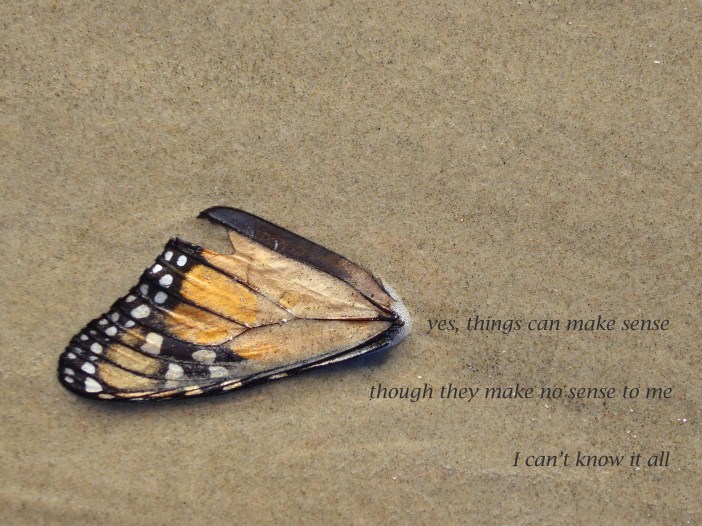
I came across this quote recently and it reminded me that my constant quest to have things make sense to this pea-brained human is driven by the desire to have answers – answers to questions I posit and which may not even be the right questions.  Having the right answer is great, yes, but it is equally, if not more important, to have the right question.  I recently queried my phone on how to get from Point A to Point B and it promptly gave me directions and told me that it would take me about an hour.  Since it was only thirty minutes to my appointed meeting time, that did not make me happy – but then I realized my phone was giving me walking directions, not driving directions.  I had the right answer to the wrong question.  I might know that three is the square root of nine, but if I am hungry and my question is “Where can I get a quick breakfast?” that answer is of little use to me.  Thinking down this path, when someone upsets or disappoints me in some way, perhaps trying to discern the perfect way to get even is not as useful as the more compassionate question of “I wonder what has __ upset today?” or perhaps the more appropriate one “I wonder what I just did to piss __ off?”

Questions, not answers?