Note to self, intended to lower my frustration level (or at least help me understand it):
“A remarkable feature of virtues is that you cannot argue people into having them when they do not.” Paul Woodruff from Reverence
Note to self, intended to lower my frustration level (or at least help me understand it):
“A remarkable feature of virtues is that you cannot argue people into having them when they do not.” Paul Woodruff from Reverence
Leonard Pitts, Jr. is one of my favorite columnists, and to that end I commend to you his most recent column, Living In A Time of Hatred, We Are All Called To Witness, which promoted my thoughts put to words here.
As long as I live and breathe, I am, like it or not, a witness. Particularly in this day and age of connectivity, where I can stream live most anything anywhere in the world, the question is not whether I will see and experience things – I will witness. No, as Pitts writes, the question is not whether I will see and experience things, but a different question — “What kind of witnesses shall [I] be?”
The image that comes to mind is that of walking along a shore and finding a bottle, then finding the bottle has a message in it. That is kind of cool, and I could simply take it home, clean the bottle up, and put the bottle on the shelf, message still intact, unread. Every time someone visited I could show off the bottle with the message in it. Or, I could….
I am coming off a bout with the flu (yes, I had a flu shot) that lasted the better part of a week. During that time, it may have been “well with my soul,” but the rest of me, the physical part, would have begged to differ. All of this served as a reminder (read “slap in the face”) as to how much I take wellness for granted. It occurred to me often over the past six days that failing to thank God each day for wellness, for the ability to get up out of bed and carry on with the day, no matter now “normal” and “uneventful” that day might be is…, well, is not good.
C. S. Lewis from Mere Christianity:
“I am only trying to call attention to the fact that this year, or this month, or, more likely, this very day, we have failed to practice ourselves the kind of behavior we expect from others. There may be all sorts of excuses for us. That time you were so unfair to ___ was when you were very tired. That slightly shady business about the money – the one you have almost forgotten – came when you were very hard up. And what you promised to do for ___ and have never done – well, you would never have promised if you had known how frightfully busy you were going to be. And as for your behavior to ___ or ___ if I knew how irritating they could be…. For you notice that it is only for our bad behavior that we find all these explanations. It is only our bad temper that we put down to being tired or worried or hungry; we put out good temper down to ourselves.”
A twist on the Golden Rule, a painful one – practice myself the kind of behavior I expect from others; accept their excuses as readily as I proffer and accept my own. Wait, it occurs to me that practice sounds suspiciously like “forgive us our sins as we forgive those who have sinned against us.”
“’Will you give me a drink?’…. ‘Sir’, the woman said, ‘you have nothing to draw with and the well is deep.” John 4:11
This is such a simple exchange that it is easy to pass over as we read of Jesus’ encounter with the Samaritan woman at the well. It occurs to me that the woman has apparently realized that she holds all the cards here. The scene occurs at a well. Jesus wants a drink. He can’t get a drink without a bucket. The woman has the bucket. So, he starts a conversation and asks, recognizing he needs her help.
It occurs to me that this scene of course plays out daily in life. When I need the bucket, how willing am I to ask for help from the one who had the bucket? What holds me back from starting the conversation and asking? When I hold the bucket, what is my reaction when someone asks for it?
“The moment you have a self at all there is the possibility of putting yourself first – wanting to be the center – wanting to be God.” C. S. Lewis Mere Christianity
Hmm. Lewis is, true to form, understating the issue. I think I would replace “possibility” with (at least at times) “certainty” or, on my better days, “likelihood.” In any event, the quote from today’s Lewis reading stuck out to me because it coincided with a reading last night from Paul Woodruff’s book – Reverence. In it, Woodruff writes:
“Reverence begins with a deep understanding of human limitations; from this grows the capacity to be in awe of whatever we believe lies outside our control – God, truth, justice, nature, even death. The capacity for awe, as it grows, brings with it the capacity for respecting fellow human beings, flaws and all…. Simply put, reverence is the virtue that keeps human beings from trying to act like gods.”
Lewis and Woodruff are on to something (duh!) It occurs to me that what troubles us now, self included, is that we are putting ourselves at the center, wanting to be God. We lack reverence. Not only do we lack “awe of whatever we believe lies outside our control,” we simply deny anything lies out of our control.
Granted, it was a different time in 1965 when the song came out, but It occurs to me that Burt Bacharach was close, so close.
“What the world needs now, is [reverence] sweet [reverence]. It’s the only thing that there’s just too little of.”
Of course, “reverence” has too many syllables, and it may not be “the only thing that there’s just too little of,” but it is one of them.
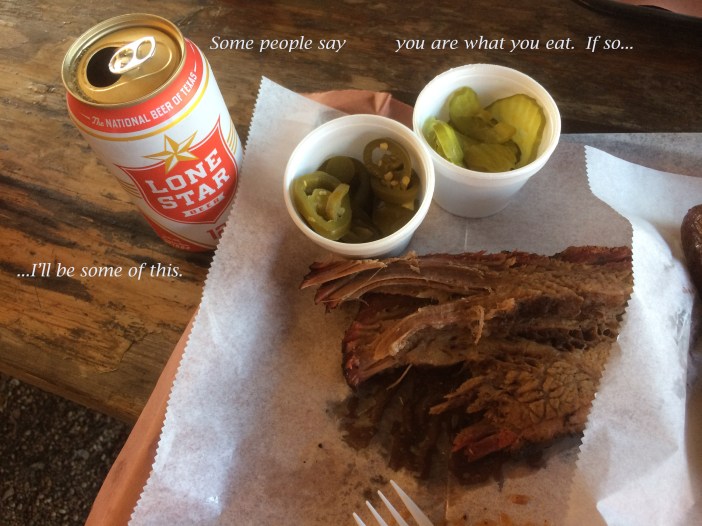
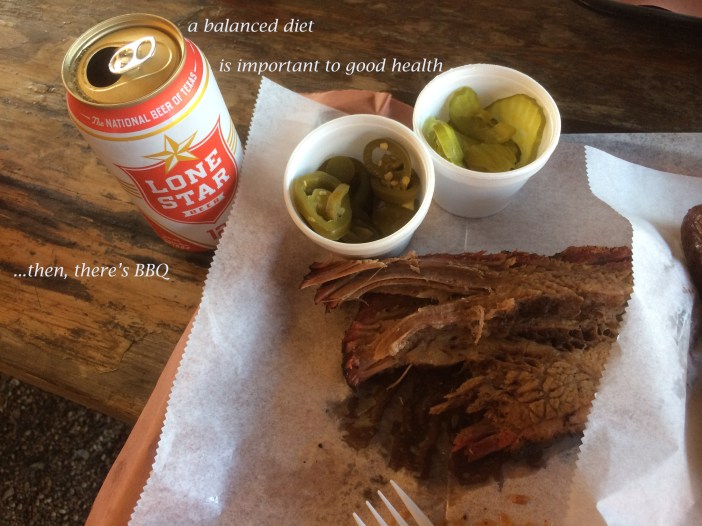 Just like it is difficult to choose between brisket and sausage, it was difficult for me to choose a text — so I choose both. Photo taken at Snow’s BBQ in Lexington, Texas this past week.
“[W]e brought nothing into this world, and we can take nothing out of it.” 1 Timothy 6:6
There it is as cold as truth can be. I come in with nothing and leave with nothing. My stuff is, well, just stuff. I ain’t taking it with me when I leave. Granted, it may become someone else’s stuff, but it won’t be mine any more, only something that used to be mine. So if life ain’t about the stuff….
Dreaming and Doing
Today Oswald Chambers writes of dreaming and doing. “Dreaming about a thing in order to do it is right; but dreaming about it when we should be doing it is wrong.” A perfectly thought out plan is of little use to anyone unless and until it is put into action. Well, the plan may impress me, and I may take some pride in my being able to come up with such a clever plan, but that is about all one can squeeze out of it. The juice is in the execution of the plan. Suppose, on seeing a drowning man, I think quickly and devise a foolproof plan on saving him. The plan is of little use unless and until it is executed. Which takes us to Chambers’ punchline – [A]lways beware of giving over to mere dreaming when once God has spoken. Leave Him to be the source of all your dreams and joys and delights, and go out and obey what He has said…. Dreaming after God has spoken is an indication we do not trust Him.”
What plans do I have sitting on the shelf that God has led me to, helped me devise? Perhaps it is time to check the expiration date on them.

