Schadenfreude

I pick up and reread C. S. Lewis’ Mere Christianity now and again and I am (shouldn’t be by now) often surprised by how it feels so contemporary.  But of course, that is how reading about  universal truths should feel.

“Suppose one reads a story of filthy atrocities in the paper.  Then suppose that something turns up suggesting that the story might not be quite true, or not quite so bad as it was made out.  Is one’s feeling ‘Thank God, even they aren’t quire so bad as that,’ or is it a feeling of disappointment, and even a determination to cling to the first story for the sheer pleasure of thinking your enemies as bad as possible?”

There’s a lot of that going around some fifty years after Lewis wrote it.  That is, essentially, the essence of schadenfreude – bad joy.  But it gets worse (and feels more uncomfortable) as Lewis continues:

“If it is the second then it is, I am afraid, the first step in a process which, if followed to the end, will make us into devils.  You see, one is beginning to wish that black was a little blacker.  If we give that wish its head, later on we shall wish to see gray as black, and then to see white itself as black.”

This is, of course, where that “love thy neighbor” thing, and the lesson from the Good Samaritan parable, come into play – if I can put down my paint brush and can of black paint.

Hospitality

“Practice hospitality.”  Romans 12:13

It is always nice to get clear instructions.  This two-word direction is about as short as an instruction can be – one verb, one noun.  But then I guess the complexity of the instructions are largely dependent on the meaning given to the noun – hospitality.  In common parlance we seem to have narrowed the use and meaning of “hospitality” to a transactional context, as in the “hospitality business” or “hospitality industry.”  Hospitality seems most commonly to be thought of as something that is expected on payment for it to a hotel or some other business entity providing services for a fee.

The biblical meaning of “hospitality” seems much broader.  In the Romans passage, the instruction comes as a summary of the paragraph above it (in a section captioned “Love” in my Bible) that includes admonitions about love (Love must be sincere.” v. 9), hate, honor, zeal, joy, hope, patience, and sharing (Romans 12:9-13), and thus the suggestion is that hospitality invokes all of those things.  There is no mention of a precondition of money changing hands.  The usage of the word in 1 Peter 9 is similar — “Offer hospitality to one another without grumbling.” — as is the context.  That usage (in a section captioned “Living for God” is preceded by a notation about  love — “Above all, love each other deeply, because love covers over a multitude of sins.” v. 8

Okay, I suppose there is supposed to be some point to this meandering.  But I am not sure I can do better than the source.  Practice hospitality without precondition, without grumbling, and don’t hold your hand out for the tip.


Words

Among those great feelings in life (which can be in scarce supply at times like these, whatever that means) – when a book grabs me with an early line and I keep returning to those lines.  This from Richard Russo’s newest, Chances Are, which I am about fifty pages into but already feeling good about:

“What were the odds that these three would end up assigned to the same freshman dorm suite at Minerva College on the Connecticut coast?  Because yank out one thread from the fabric of human destiny and everything unravels.  Though it could also be said that things have a tendency to unravel regardless.”

“[T]he threads of human destiny” – not a novel thought (though in this case it is), but a compelling one nonetheless.  Sometimes fine linen, sometimes a worn, oil-stained scrap of an old t-shirt in the rag bin, yet each serving its purpose.

Failures and Wisdom

Reading Max Ehrmann’s Desiderata this morning, this caught my attention:

“If you compare yourself with others you may become vain and bitter, for always there will be greater and lesser persons than yourself.”

This in turn reminded me of a similar bit of advice in Baz Luhrmann’s Sunscreen:

“Don’t waste your time on jealousy; sometimes you’re ahead, sometimes you’re behind.  The race is long, and in the end, it’s only with yourself.”

A lot of energy and resources have been spent in civilization trying to prove these concepts wrong.  Lord knows I’ve spent a good deal of time and effort  trying to do so.  My inclination is to say that we have all failed in those efforts, and in one sense that is true, but then it occurs to me that perhaps it is  in those “failures” that we are led to the wisdom they provide.

Approaching Life Facing Backwards

“The path is unchartered.  It comes into existence moment by moment and at the same time drops away behind us.  It’s like riding a train sitting backwards.  We can’t see where we’re headed, only where we’ve been.”        When Things Fall Apart – Pema Chodron

Probably not what she had in mind, but Chodron’s comments about “riding a train sitting backwards” made me think of the now long gone “lounge seating” that was on Southwest Airlines planes for a quarter of a century but has been phased out as they retired planes – two sets of three seats, one set facing forward, one backwards.  The backward facing seats where against the bulkhead, so they didn’t recline.  Southwest officially called these “lounge seats,” which might fit because I am sure the alcohol consumption of passengers in those seats was double that of other seating positions.  Still, frequent fliers knew them as the “party seats.”  A flight attendant once told me that they were “the most loved and hated seats on the plane” and that seemed correct to me, for both flight attendants and occupants.  The seats held an odd collection of elderly folks, people with mobility issues (the party seats were located in the front of the plane, but also in the middle) very tall folks, and (by experience) people who wanted to look fellow passengers in the eye while they (the talkers, particularly tall talkers) drank and engaged in incessant monologues poorly disguised as conversations.  Many a life story was shared from those seats in the short hops Southwest was so famous for.  Clearly, I was not a fan of those seats, particularly the ones that required you to sit facing rearward .

But I digress.  My point was that all these other issues aside, there was an uneasiness in riding “backwards” on a plane, particularly on takeoff, when inertia was forcing you toward the person in the forward-facing seats and you hoped your seatbelt held.  But Chodron’s analogy to life never occurred to me as another reason I hated those rear-facing seats.  She is right, of course, those seats imitate life — life is like riding sitting backwards – “We can’t see where we’re headed, only where we’ve been.”  While reality, that is unnerving.  Particularly if (throat clearing) you are one of those people who has this persistent crick in the neck from trying to look ahead, worrying about what is coming up.

So there’s the sitting next to old folks (of which I am now one), people in casts, and talkative people who are drinking, but there’s also, at least subliminally, the reality that we face life with our backs turned.  And maybe that, as much as anything else, explains the increased alcohol consumption in those seats.
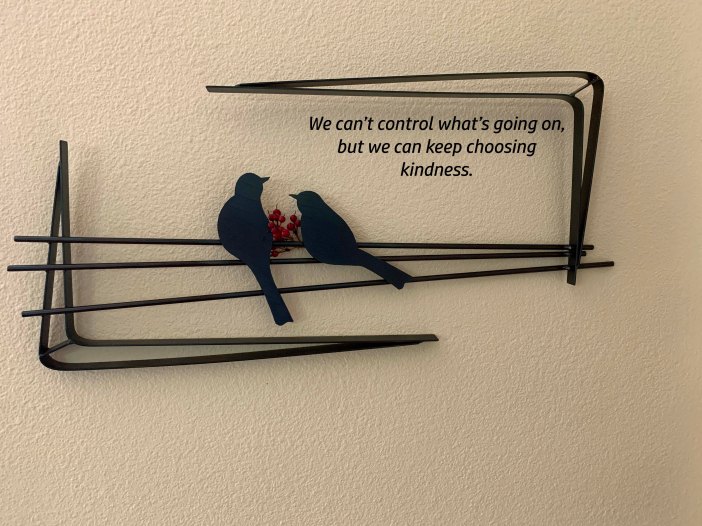
“What good is it, my brothers, if a man claims to have faith but has no deeds.”  James 2:14

This got me to thinking today.  In this time of sheltering in place and social distancing and virtual church…. it is even easier for faith to become mental, not physical, for faith to be a noun, not a verb.  As noted in James, faith blooms through action, and I don’t know about you, but in my pandemic world action is in shorter supply.  It occurs to me that this is the risk, at least a risk, the risk that because my deeds can’t take their usual form, they just stop even though the needs they address are still there.  If I don’t have a gym to go to I’ll just stop exercising.  What I recognize, in glimpses of enlightenment, is that some adaptation is needed – that I need to ditch “normal” and step into the unease of abnormal (though some would say I have lived there comfortably for years).  Going to church needs to take on some other form and those needs need to be met some other way.  Lunch with a friend who needs to talk (or lunch with me who needs to talk) ain’t gonna happen and will need a substitute.  That Friday morning men’s bible study will need to become virtual for now.  And of course, some needs will be unmasked as unneeded.   Onward.

Experience

“Experience is a hard teacher because she gives the test first, the lesson after.”  Vernon Law

This seems unfair, but thinking back on my experience in test taking at school, getting the lessons first provided me a mass of information, only some of which could be learned, remembered, or mastered when the test rolled around, and only very little of which (but I didn’t know which) was needed for the test.  But in taking the test first, I am (if I am paying attention) being told the information that is important, I am provided the outline of that information which is needed to ace the test.  And, mercifully, there will be more tests.