Kindness and Winning

“Always remember that to argue, and win, is to break down the reality of the person you are arguing against.  It is painful to lose your reality, so be kind, even if you are right.”  Haruki Murakami

I ran across this quote today and it is yet another pointer to a word that has been much on my mind lately – “kindness.”  It has recently occurred to me that “kindness” is a powerful yet underappreciated  sibling of “love” that is somehow relegated to a lesser role.  Anyway, that’s a whole ‘nother story.  What struck me here was the admonition – “be kind, even if you are right.”  We could, of course, just put the “.” after “kind” and leave it at that, but the point is a significant one.  It is easy to “rub it in” when I am right, and kindness should be part of the celebration ritual.  In winning, there is always a related loss, and the opportunity exits to amplify the winning with kindness.

Transcendence

I heard this quote recently on a podcast and it stuck with me:

“We must transcend the places that hold us.” Ruben “Hurricane” Carter

This from a boxer who spent 20 years in prison before being released on a what was deemed to be a wrongful conviction — that is, he knows something about “places that hold us.”

But the quote obviously begs the question — “What are the places that hold me?” And of course, the follow up — “How do I transcend them?”

Yellow Cars and Cotter Pins

I have this concept that likely has some long scientific name and explanation but I just call it the yellow car principle. It is fairly simple. You may not really pay attention to the number of cars on the road that are yellow (.2%, or 2 out of 1000 per Google), but you know they are fairly rare. That said, if you buy a yellow car, or even just in reading this yellow cars come to the front of your mind, for some time after that, yellow cars will seem more common. That is, you’ll see them more often. Now obviously, buying a yellow car only puts one more yellow car on the road, and thinking about yellow cars puts no more on the road. So seeing more yellow cars is a mental thing. It is not that there are more yellow cars on the road.

This yellow car principle came to my mind recently when I picked up a cotter pin off the street while running (it was me running, not the cotter pin or the street). Oddly, this occurred while I was listening to Merle Haggard sing Holding Things Together , which is of course what cotter pins do. I see lots of things on the road when I run. Washers, bolts, change — even found a dollar bill last week — but I don’t recall ever seeing a cotter pin. but since then I have seen picked up two more (neither while listening to Merle).

By this time, you’re wondering where the hell this is going. So am I. But I guess the point, if there is one, is this. How might I change my life if I preloaded it with good things instead of bad, good news instead of bad news, stories of accomplishment and success instead of failure? And what’s the harm in engaging in that experiment?

Non-Haiku of the Whenever

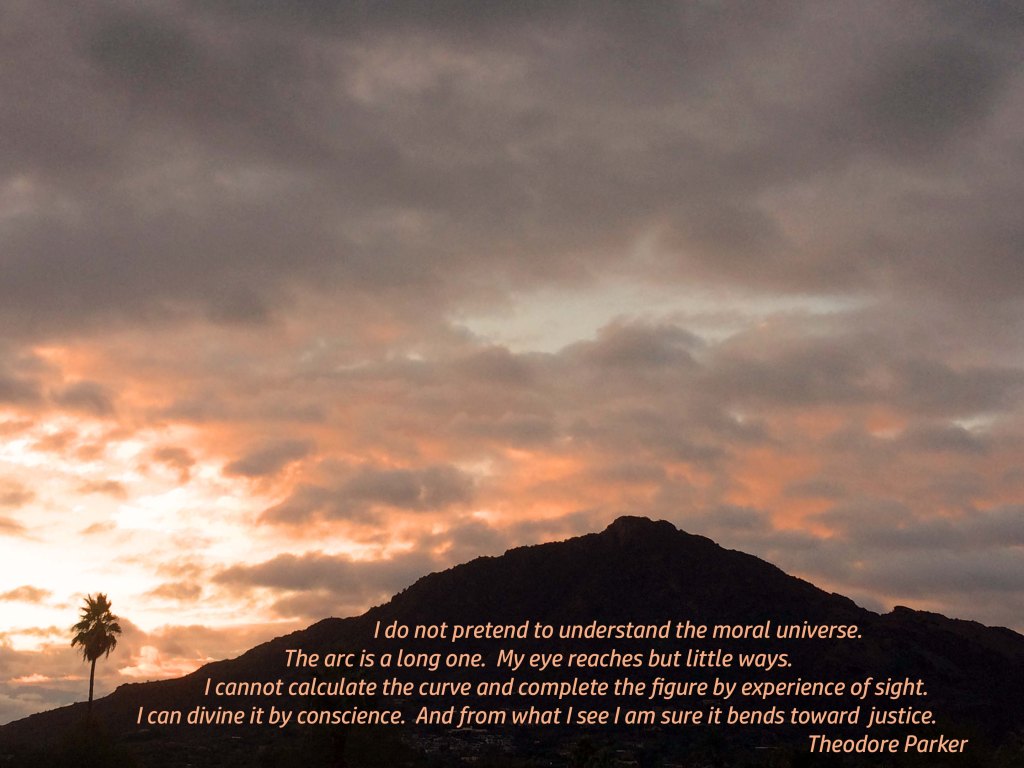
Photo taken in Phoenix a few years back. Text is the longer and original (1853) portion of a sermon by abolitionist minister Theodore Parker shortened by Martin Luther King, Jr. a century later to — “The arc of the moral universe is long, but it bends toward justice.” Long or short form, the concept is the same, and is true — but damn, I love those days where the “bends toward justice” part is most apparent, because sometimes it isn’t.

Faith and Jell-O

In a podcast I recently listened to, Bishop Michael Curry defined “faith” this way: “I don’t know how all that works.  I just trust that it does.”  Faith is often written about, often discussed, but that thirteen words in two sentences pretty much nails it. It occurs to me that the key word is “trust,” which my Webster’s defines as “firm belief in the character, strength, or truth of someone or something.”  Admittedly, my “firm belief” sometimes seems to be materially consistent with Jell-O.  But still….