Photo taken this week in Galveston. I couldn’t chose between the two haiku, thus today’s twofer.
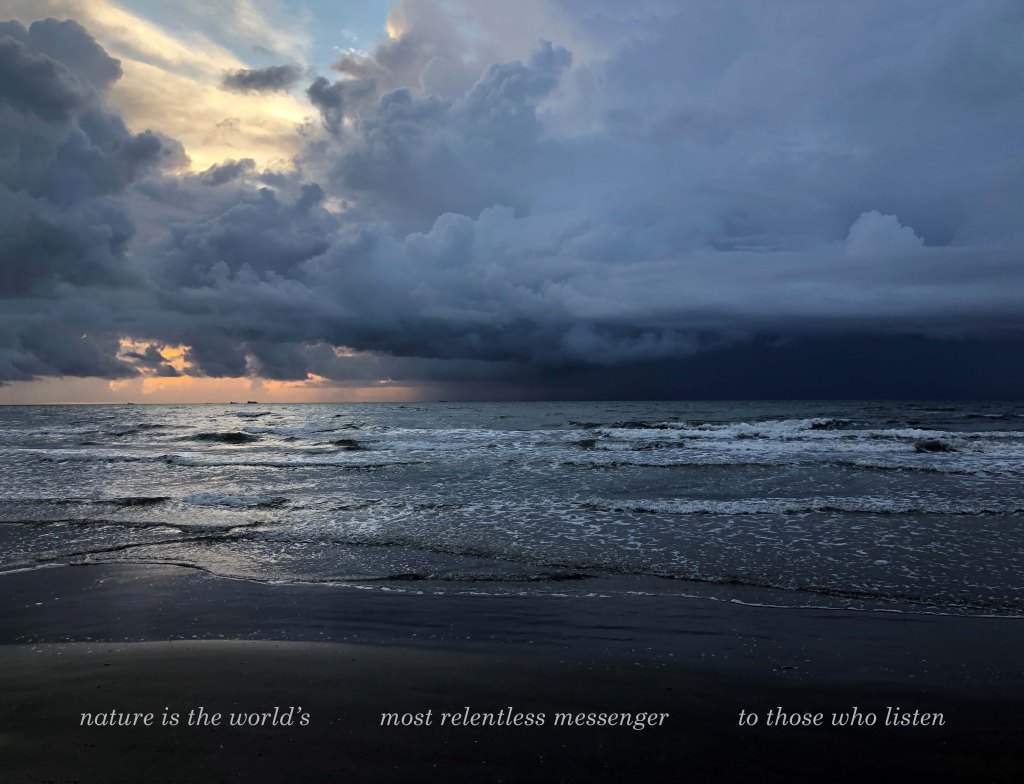
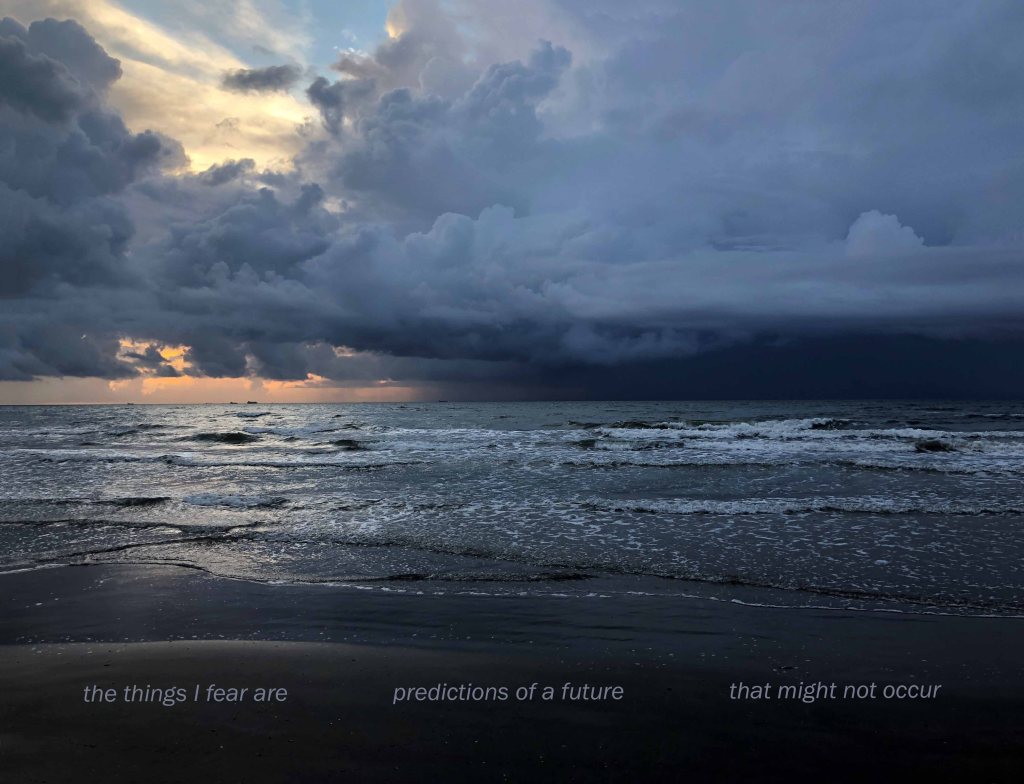
Photo taken this week in Galveston. I couldn’t chose between the two haiku, thus today’s twofer.
From Howard Thurman’s Deep Is the Hunger:
“[L]ife in any form seems to have a little way of its own, moving with quiet assurance to some special end. It is of immeasurable comfort to remember that much of the chaos and disorder of our own lies is rooted in causes that are understandable; much of the evil in life is reasonable, in the sense that its roots can be traced and it is not necessary to place the blame upon the devil or some blind senseless process. The naked responsibility for human misery, you and I and ordinary human beings like us must accept. In this doomful fact there is the ground of hope, because it means that in the creation of man, God provided for limitless resourcefulness, and because of any situation, however chaotic, can be understood and reconstructed if we have no fear to do, if need be, the radical, the revolutionary deed.”
There is so much there to unwrap. Life moves “with quiet assurance to some special end” settles in so softly, but Thurman sends along with it the unsettling message that we all share some of “the naked responsibility for human misery.” But as he notes, within that “doomful fact” there is “grounds for hope” so long as we recall and act upon our innate ability to perform “the radical, revolutionary deed.”
That “radical, revolutionary deed” comes in many forms, shapes and sizes. We can pause and listen, stop and help, contribute, smile, encourage…. All of course fit under the single most “radical, revolutionary deed” – love.
Overheard in an Everything Happens podcast, from the guest, Will Willimon:
“God is always saying: ‘Give me something to work with and I’ll turn it into something interesting.’”
“Something to work with” and “something interesting” are, of course, rather nebulous, a bit uncertain, but of course, that describes life well, doesn’t it?
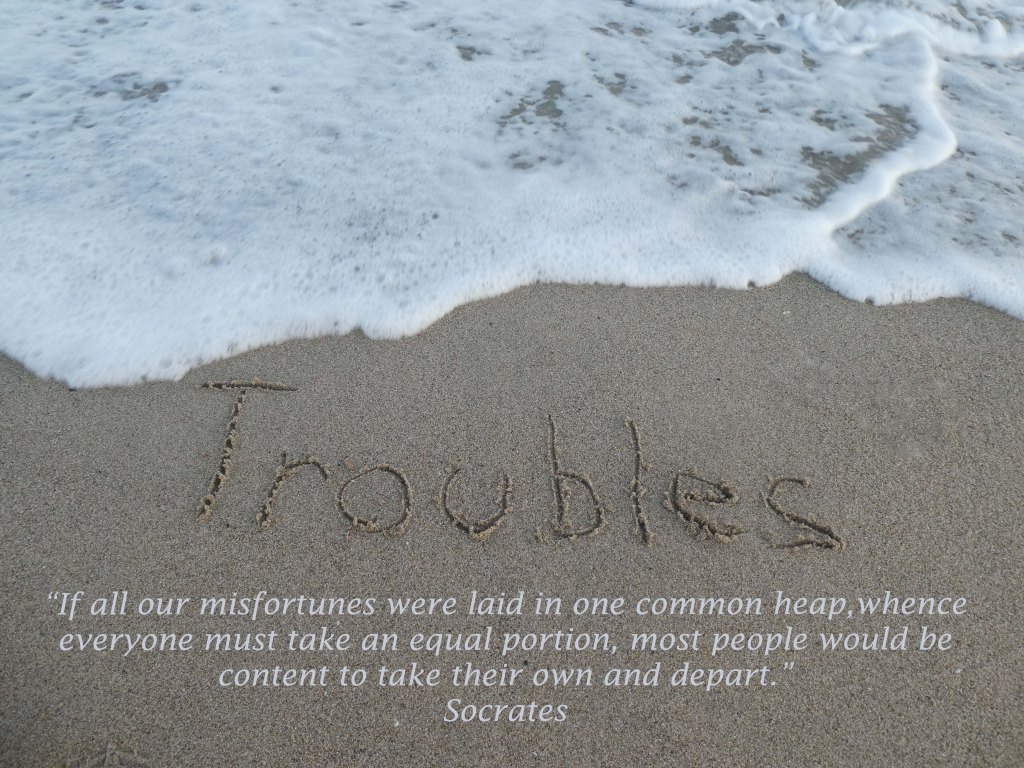
Photo taken a few years back and used previously, but this is a merger of a favorite photo and a favorite quote. A bit late for Thanksgiving, but it applies all year anyway.
I was taken today by this line in The Longly-Weds Know by Leah Furnas (https://allpoetry.com/poem/3571202-The-Longly-weds-Know-by-XxEmOtiOnjOxX), reminded both that I am of that “longly wed” classification and of the truth of the statement:
The Longly -Weds Know
“That it isn’t about the Golden Anniversary at all,
But about all the unremarkable years
that Hallmark doesn’t even make a card for.”
But perhaps my favorite sequence:
“It’s about the 37th year when she finally
decided she could never change him
And the 38th when he decided
a little change wasn’t that bad.”
And of course, the payoff:
“But most of all its about the end of the 49th year
when they discovered you don’t have to be old
to have your 50th anniversary.”
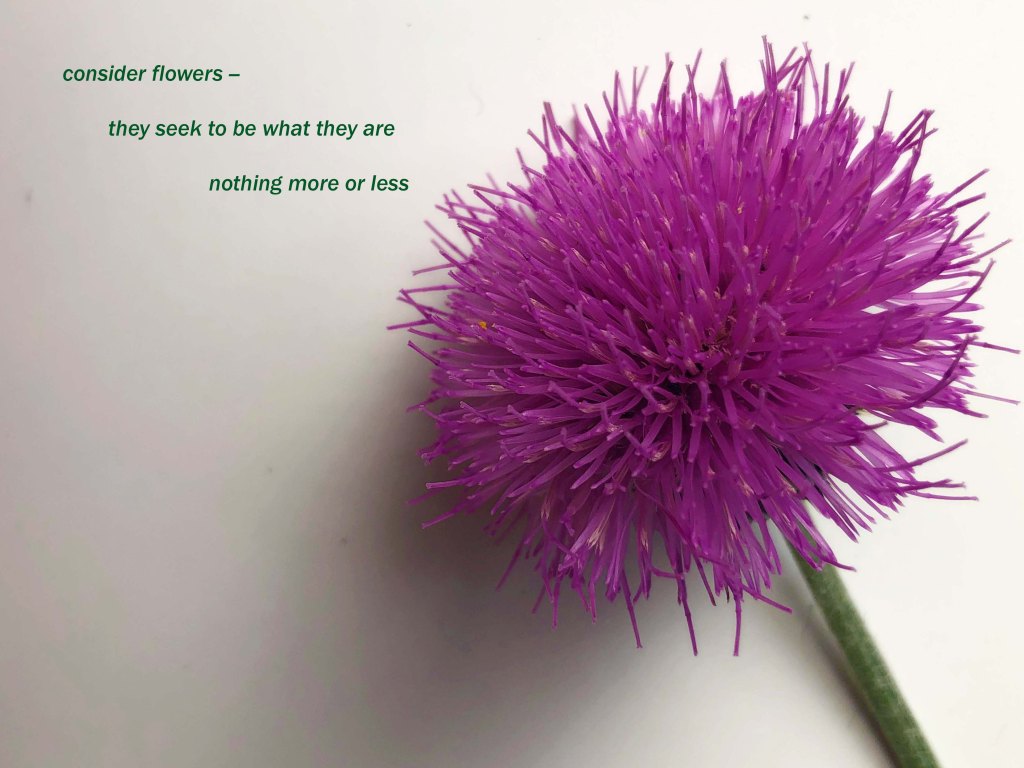
Photo of a “weed” (such arbitrary name assignments) pulled from the back yard some time back.
Reminded today of the power of just showing up – funerals, weddings, birthdays, various life evvents. So often I can talk myself out of showing up because of the perceived awkwardness of doing so. Julia Kasdorf takes that head on in her beautiful poem – What I Learned from My Mother, a good read, which in part goes as follows:
“I learned to attend viewings even if I didn’t know the deceased, to press the moist hands of the living to look in their eyes and offer sympathy, as though I understood loss even then. I’ve learned that whatever we say means nothing, what anyone will remember is that we came.”
This in turn pointed my memory to a This I Believe essay by Deidre Sullivan, which I pulled up and listened to again. At age 16, against her wishes, her father drives her to the viewing for a 5th grade math teacher so that she can go inside.
“When the condolence line deposited me in front of Ms. Emerson’s shell-shocked parents, I stammered out, “Sorry about all this,” and stalked away. But for that deeply weird expression of sympathy delivered 20 years ago, Ms. Emerson’s mother still remembers my name and always says hello with tearing eyes.”
https://www.poetryfoundation.org/poems/48491/what-i-learned-from-my-mother
Reading today from Kate Bowler’s Advent devotional, the season of almost, where she is speaking of Advent and the pandemic:
“Yes, things have changed. Yes, life looks different and our limitations are so much more obvious.”
There is certainly lots to dislike about a pandemic, the list is too long to start, but I like how Bowler boils it down to its essence – in a pandemic, at least this one we are experiencing, “life looks different and our limitations are so much more obvious.”
I am never comfortable when “life looks different.” After all [Hubris Warning!] I spent a whole lot of time and effort making it look like it did, or at least getting used to/resigning myself to how it looks. And oh, how I hate for my limitations to become obvious. It is bad enough that I recognize them, but the pandemic seemingly puts them on display in the holiday window at Macy’s. And of course Bowler’s/Advent’s solution to all this does not sit well – her admonition to wait. Doesn’t she know that I, along with many others, suck at waiting. This society of fast food, home delivery, buy today get it delivered today sucks at waiting and prides itself in NOT having to wait.
Which is, I suppose, the lesson to be taught, if not learned, in advent – have patience, wait. On this, Bowler quotes Bonhoeffer’s writing from the 1940s (so these issues with waiting are not new):
“Celebrating advent means being able to wait. Waiting is an art that our impatient age has forgotten. It wants to break open the ripe fruit when it has hardly finished planting the shoot. For the greatest, most profound, tenderest things in the world, we must wait. It happens not here in a storm but according to the divine laws of sprouting, growing, and becoming.”
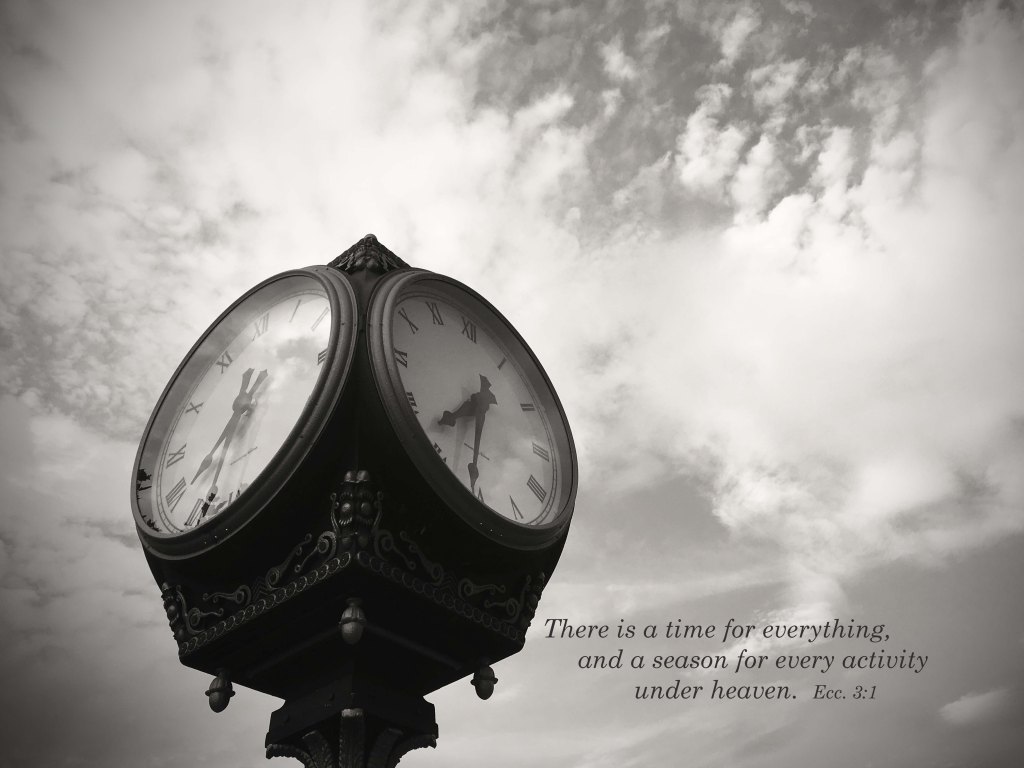
“There is a time for everything, and a season for every activity under heaven.” (Ecclesiastes 3:1)
“To everything (turn, turn, turn)
There is a season (turn, turn, turn)
And a time to every purpose, under heaven” (Pete Seeger)
Whether you come to this through Ecclesiastes 3:1 or through the 1965 #1 hit by the Byrds (Turn, Turn, Turn; written by Pete Seeger), the message is (excuse the pun) timeless.
Photo taken a few years back in Huntington, West Virginia
From Howard Thurman, Deep Is the Hunger:
“The fact that a man can always be in error with reference to the things that he thinks he understands most clearly is an ever-present reminder of human frailty. It is a challenge to humility even in the presence of one’s deepest convictions. The truth is we are never able to get our hands on all the facts in a given situation; some thing that is important always escapes our consideration and may lead us to a false conclusion honestly arrived at…. We are all creatures of limitation and it behooves us to recognize this fact at every point This does not mean that we are excused for our errors due to a lack of knowledge, experience, or patience. But it does mean that even when we have done our best thinking, our most honest proving of our own motives, plumbed the depths of our innermost cumulative experience of living, we may arrive at a point less than right.”
So much to unfold there, but what I am drawn to in reading this today is the lesson in humility. No matter how much I know about “x”, there is something, perhaps some things, that I do not know about “x.” Or to dredge up a saying, it is not what I know that gets me in trouble so much as what I think I know.
It is not so much that I need to fix anything.* In fact, given the above, it seems the first step toward humility is recognizing that I can’t fix this. That is, I need to recognize that I am one of Thurman’s “creatures of limitation,” and even my well-intentioned analyses often take me to (Thurman is kind here) “a point less than right.” But here’s the payoff — once I step out of my solipsistic self I am in a new place and on the verge of recognizing that perhaps someone else has some of the answers I don’t have, and perhaps I have some answers they don’t have. That is, it becomes easier to see that because no one knows it all, we are all in the same boat, or at least we are all adrift in the same ocean. Good to know I have company.
*Of course, I would think that.
 It occurs to me...