Riveted – Robyn Sarah

Riveted – Robyn Sarah

It is possible that things will not get better than they are now, or have been known to be. It is possible that we are past the middle now.

It is possible that we have crossed the great water without knowing it, and stand now on the other side.

Yes: I think we have crossed it.  Now we are being given tickets, and they are not tickets to the show we had been thinking of, but to a different show, clearly inferior.

Check again: it is our own name on the envelope.  The tickets are to that other show.

It is possible that we will walk out of the darkened hall without waiting for the last act: people do.  Some people do.

But it is probable that we will stay seated in our narrow seats all throught he tedious denouement to the unsurprising end – riveted, as it were; spellbound by our own imperfect lives because they are lives, and because they are ours.
Enough

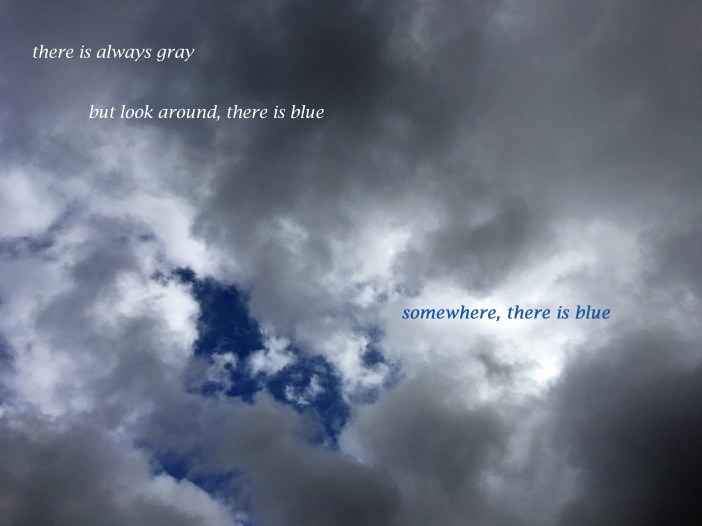
Much time and effort is spent on getting “enough,” much more time than trying to figure out how much is “enough.”  But in thinking about “enough” recently, it occurred to me that I am no stranger to “enough.”  No, “enough” is a spot I pass through often, in my trips between “too little” and “too much.”  In that sense, it is like that place alongside the highway that I pass by frequently, often thinking I ought to stop in sometime.  And when, after passing by it countless times, I finally stop, and find that I enjoy it, I wonder why I passed by it all these years, why it took me so long to stop.

Love Is Indiscriminate

“This is my commandment, that you love one another as I have loved you.”  John 15:12

Anthony DeMello writes in The Way To Love of the three characteristics of love – love is indiscriminate, gracious, and not self-conscious.

Love is indiscriminate.  Think, DeMello implores us, of the rose, the light, and the tree.  The rose offers its fragrance to anyone, not to only those it deems “good” or “worthy,” but to all.  The light does not illuminate for the good only.  The tree offers its shade to all comers.  “Observe the marvelous change that comes over you the moment you stop seeing people as good and bad….  To see this is to acquire the indiscriminate quality one so admires in the rose, the lamp, and the tree.”

Certainty and Doubt

“What you were sure of yesterday, you know now to be false, but what you are sure of today is absolutely true.”  Mignon McLaughlin

This thought about the folly, the uncertainty, of certainty comes around in my head from time to time – but not often enough.  I have too many of those “What was I thinking?” revelations, most of which are best answered by the same reply – “Well, perhaps you weren’t!”  But boy, was I certain of them nonetheless!

Maybe certainty is assigned to some thought out of laziness.  The quest for truth seems like a lot of trouble when preconceived notions, stereotypes, and prejudices are so readily accessible.    I mean, who craves doubt?  Who wants uncertainty?  That quest for truth can require work!  What’s worse, it can require an open mind.  And you know what happens when you have an open mind – people keep wanting to put stuff in it.

Perhaps Voltaire has it about right: “Doubt is not a pleasant condition, but certainty is absurd.”  It is [certainly] a good thing to develop and hold on to beliefs.  Yet it occurs to me that if past experience is any indicator, some things I am certain of today will, in time, be proven to be incorrect.  In fact, some are just rubbish.

Hearing, Understanding, Believing, Remembering

“We hear only half of what is said to us, understand only half of that, believe only half of that, and remember only half of that.”  Mignon McLaughlin

Okay, here’s my analysis, but feel free to do your own.

I hear only 50% of what is said to me.  That seems low if it truly means “hear,” but if what is meant is “listen to” or “take in,” then that 50% seems high to me.  Here, I must quote Simon and Garfunkel – “A man hears what he wants to hear, and disregards the rest.”

I understand only 25% of what is said to me.  That seems a bit low.  But if it means “really understand,” as in I comprehend fully the message that the speaker is intending to give to me through the speech (that is, I understand the message, not just the words), that 25% seems a bit high.

I believe only 12.5% of what is said to me.  While I have no empirical proof, that sounds about right, unless the speaker is a politician, a salesperson, or a weather forecaster, in which case that 12.5%  seems high.

I remember only 6.25% of what is said to me.  Time would, of course, be a crucial factor here, and I guess, context.  In the ten minutes it takes me to get to the store I forget at least one thing on the four-item grocery list (25%) my wife tells me.  But then I can remember the lyrics to the theme song from most sitcoms from forty or fifty years ago.  Go figure.

Still, with all the lack of hearing, misunderstanding, disbelief, and forgetfulness, life goes on.  It’s a miracle!

The Hardest Lesson

“The hardest-learned lesson: that people have only their kind of love to give, not our kind.”  Mignon McLaughlin

I don’t know if that is the “hardest-learned lesson,” but it damn sure ranks up there in the top five or so.  It occurs to me that much of my conflict and angst is generated by my expectation of the response I want, not the one the other has to give.  Somehow, what comes to mind here is that instance where I am due change from a cashier who, being out of or low on quarters, gives me five nickels in change.  Okay, it is not what I expected, not what I wanted (as if carrying the four additional coins is a burden), but I have not been short-changed.  I was given what the other had to give.  And it occurs to me how frustrated I get standing in front of a parking meter that wants change when I don’t have any to give.  I have bills, I have credit cards, but no change.

Okay, she may be right: “The hardest-learned lesson: that people have only their kind of love to give, not our kind.”

Confession

This settled in my soul after reading it today.  It is, I suspect, best understood by Catholics who spent some time as children in and waiting to go in a confessional.  That said, it seems to be universally instructive:

Teaching a Child the Art of Confession – David Shumate

“It is best not to begin with Adam and Eve.  Original sin is baffling, even for the most sophisticated minds.  Besides, children are frightened of naked people and apples.  Instead, start with the talking snake.  Children like to hear what animals have to say.  Let him hiss for a while and then tell his own tale.  They’ll figure him out in the end.  Describe sin simply as those acts which can cause suffering and leave it at that.  Steer clear of musty confessionals.  Children associate them with outhouses.  Leave Hell out of the discussion.  They’ll be able to describe it on their own terms soon enough.  If they feel the need to apologize for some transgression, tell them that one of the offices of the moon is to forgive.  As for the priest, let him slumber a while more.”

That could have been useful knowledge to me back in my grade-school years at St. Anne’s, but in reality, it would have gone over my head.  Some things can be learned only looking at my reflection in the mirror and noticing what is behind me.