Photo taken on a recent walk
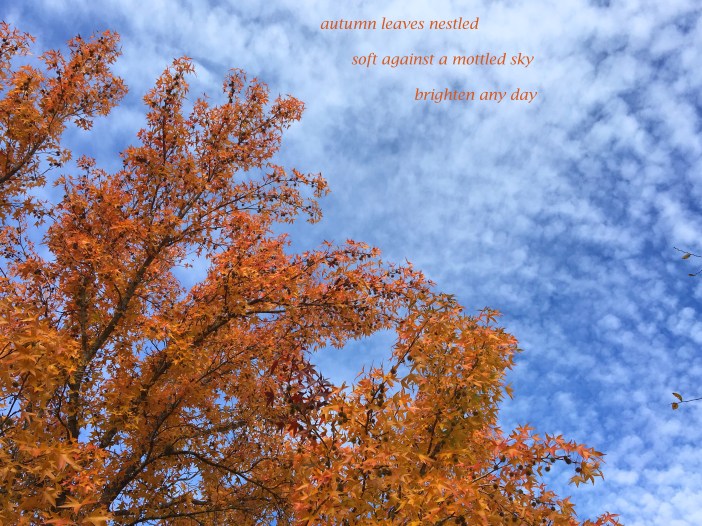
Photo taken on a recent walk
More Christmas Music
“May Santa fill your stocking, and Jesus fill your heart, with peace and joy this season, and when the new year starts. …. May His love lead and guide you, every step of the way, so every day, of every year, becomes thanksgiving day.”
I love this Christmas song for many reasons, including the fiddle intro and exit and Ray Benson’s deep baritone voice, but mostly I like how it successfully manages to weave together Santa and Jesus into one song – and pull it off quite nicely.
December 1 is a great day for me as I get to “unwrap” my Christmas music. Yes, it is a self-imposed deadline, but still, it is an exciting day for one who likes music and Christmas as it opens my Christmas music feast for the next 31 days (Yes, I go 31 days as I have to wean myself off in the days between Christmas and New Year’s Day.
I held out until about 8:30 this morning, when I cued up “It’s Beginning to Look a Lot Like Christmas (I favor the Harry Connick Jr. version). Granted, a lot of Christmas music is pure schlock. I Want a Hippopotamus for Christmas, Grandma Got Run Over by a Reindeer, and personal my favorite, Santa Lost a Ho.” Fun schlock, yes, and I listen to it more than I care to admit, but there is a lot of the Christmas message and sentiment of the season buried amongst all the music. It is like the quest for that favorite Christmas gift, you just have to keep looking. Take It’s Beginning to Look a Lot Like Christmas. A lot of stuff about shopping and commercialism, yes, but also this gem buried in all that:
It’s beginning to look a lot like Christmas
Soon the bells will start
And the thing that will make them ring is the carol that you sing
Right within your heart
And of course, that gets to the point of it doesn’t it? For all the wringing of hands and gnashing of teeth about the commercialism of Christmas, Christmas, and Christmas music is and will always be what we, each of us, makes it out to be — “the carol that you sing right within your heart.”
Now, onto Santa Lost a Ho!
This from a prayer by Thomas Merton caught my attention today:
“My Lord God, I have no idea where I am going. I do not see the road ahead of me. I cannot know for certain where it will end. Nor do I really know myself, and the fact that I think I am following your will does not mean that I am really doing so.”
This is so strong in its surrender that it is startling. Still, it rings true in a “let’s get the obvious out of the way. You are God and I am not” kind of way. And that seems like a good start to any prayer, one better stated than not lest I fall quickly into the trap of making prayer my magnanimously choosing to serving God in an advisory capacity by giving God my list of what I think he ought to do.
Photo taken outside Hyde Park Bar & Grille in Austin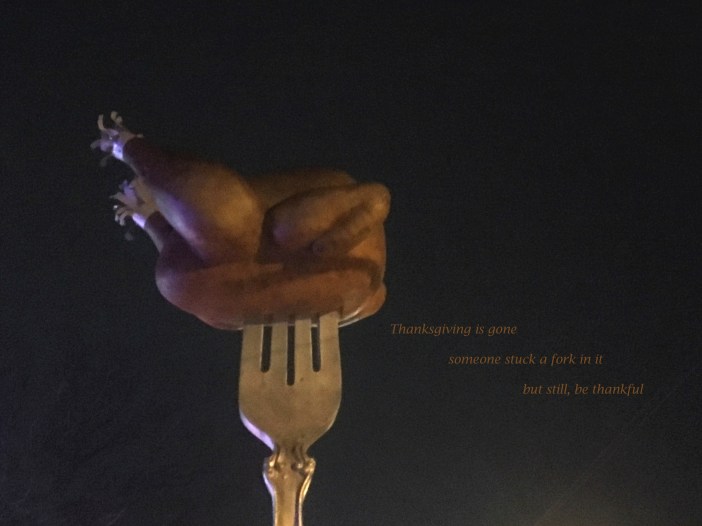
More from Rachel Remen – My Grandfather’s Blessings.
“Most of us have been given more blessings than we have received. We do not take time to be blessed or make the space for it. We have filled our lives so full of other things that we have no room to receive our blessings.”
Yikes! Initially, I wanted to quibble. How can I have been given more blessings than I have received? (That is, in fact, a complex legal issue – when does an offer become accepted and create a contract.) And how can I not have room to receive my blessings? My troubles, okay, but my blessings? Yet it quickly becomes apparent that I am on the losing side of this argument and Remen delivers the kill shot with the text that follows.
“One of my patients once told me that she has an image of us all being circled by our blessings, sometimes for years, like airplanes in a holding pattern at an airport, stacked up with no place to land, waiting for a moment of our time, our attention.”
What blessings do I have still up in the air? Which ones have I had circling for years? So here I am, in the air traffic control tower, computer screen in front of me, headset on. To which of those circling blessings do I give the okay to land?
More from Rachel Remen’s My Grandfather’s Blessings:
“As life becomes colder, and somewhat harder, we struggle to create places of safety for ourselves and those we love through our learning, our skills, our income. We build places of security in our homes and our offices and even our cars. Those places separate us from one another. Places that separate people can never be safe enough. Perhaps our only refuge is in the goodness of each other.”
My first, shallow thought is – “Uh oh. We’re screwed.” But of course, Remen is correct on all fronts. Perhaps it is because I heard my first Christmas song in a store yesterday, but this somehow connects me to that punchline from the Grinch after Who-ville goes on with its Christmas celebration despite the Grinch’s thievery:
“And he puzzled three hours till his puzzler was sore. Then the Grinch thought of something he hadn’t before. Maybe Christmas, he thought, doesn’t come from a store. Maybe Christmas…perhaps…means a little bit more.”
And perhaps that “little bit more” and Remen’s “goodness of each other” are one in the same. We could do worse than to hope/rely on those.
Yesterday, through a series of coincidences I picked up a book that, per the note on the inside cover, was given to me by a friend in December of 2001 – My Grandfather’s Blessings by Rachel Remen. I keep few books, so the fact that I kept this one for nearly eighteen years suggests that it seemed worthy of keeping. So I picked it up today and the wisdom poured out of it as I read it again, revisiting previously underlined passages and underlining new ones.
“Sometimes if you stay the course long enough, divergent paths reveal themselves to have the same destination.” My Grandfather’s Blessings – Rachel Remen
This strikes me as a simple truth and a complex truth. Often, as my wife and I ride/drive in a car headed to a known and often visited destination, one of us comments (or on better days, just thinks silently) something to the effect of “Oh, you’re going this way.” The suggestion, of course, is likely “…but I would have gone a different route.” Each time this occurs I am reminded that, as Remen notes, the “divergent paths reveal themselves to have the same destination.” That is of course true in a much larger, more complex sense. We are all on “divergent paths” at some level, as no two lives are lived the same. It occurs to me that I spend a lot of time and effort trying to drag people over onto my path, or perhaps more subtly, expecting them to have the same journey though they are on a different path. Still, in the end, if we stay the course long enough, we get to the same destination.
In Remen’s words:
“Here we are too often fooled by someone’s appearance, their age or illness or anger or meanness or just too busy to recognize that there is in everyone a place of goodness and integrity, no matter how deeply buried. We are too hurried or distracted to stop and bear witness to it. When we recognize the spark of God in others, we blow on it with our attention and strengthen it, no matter how deeply it has been buried or for how long. When we bless someone, we touch the unborn goodness in them and wish it well.”
And all of that is just in the Introduction!
“Be grateful for what you already have while you pursue your goals. If you aren’t grateful for what you already have, what makes you think you will be happy with more?” Roy T. Bennett
I like that last part – “If you aren’t grateful for what you already have, what makes you think you will be happy with more?” Still, there is a tendency to live life that way. “I’ll be happy when…” gets replaced with another “when” upon achievement of the first “when,” then “when” #2 is achieved and replaced by “when” #3, and on, and on, and on. In a multitasking world, surely it is possible to “be grateful for what you already have while you pursue your goals.” The “grateful” need not be extinguished by the “pursuit,” and in fact the gratefulness might in fact just make the pursuit a bit more enjoyable.
“We must never forget that thanksgiving is a word of action.” Robert Emmons
Well, I looked it up, and my dictionary tells me that “thanksgiving” is a noun, not a verb, not an “action word” as I define a verb to be. Maybe technically it needs to be “thanks giving” to be a verb? Still, once you get past the thought of turkey, ritual overeating, and football games, when you talk about “thanksgiving” and not “Thanksgiving,” it feels like a verb. Indeed, the 1 Thessalonians 5:18 statement – “In everything give thanks” is nothing if not a call to action. Thanksgiving calls us to to 1) recognize and 2) share our blessings.
 It occurs to me...