More Counsel of Years
From Max Ehrmannn’s Desiderata:
“Take kindly the counsel of the years, gracefully surrendering the things of youth.”
I missed, and a friend reminded me (that’s what friends are for) of the connection between this from Ehrmannn and Paul’s writing in 1 Corinthians 13:11-12:
“When I was a child, I talked like a child, I thought like a child, I reasoned like a child. When I became a man, I put the ways of childhood behind me. For now we see only a reflection as in a mirror; then we shall see face to face. Now I know in part; then I shall know fully, even as I am fully known.”
Reflecting on these It occurs to me that while there is some correlation, the “counsel of the years” that allows us to “put the ways of childhood behind [us]” has less to do with chronological age and more to do with the obstacles we put (or allow to creep in) between us and truth. Thinking of it another way, no age or generation has “cornered the market” on the inability (or, for that matter, the ability) to see clearly – though I think the 70s disco era may deserve some type of award based on music, clothing, and hair styles alone.
The Counsel of Years
From Max Ehrmann’s Desiderata:
“Take kindly the counsel of the years, gracefully surrendering the things of youth.”
I had previously thought of this as an admonition to accept the wisdom of your elders, or the like, but it occurs to me that in the “counsel of years” Ehrmann is digging deeper, referring to our own internal wisdom, the things, if (big IF) we are open to them, we come to believe over time not because those things have changed, but because we have changed. As a simple example, my thoughts on salad have changed with time. Salad hasn’t really changed, still the same lettuce, tomato, dressing, etc. Instead, the “counsel of years” has caused me to readjust that thinking, and resulted in my “surrendering the things of youth.” Of course this hopefully happens on a grander stage, and the “counsel of the years” alters how I see people, races, genders, etc. The “counsel of years” has been busy, and certainly has more work ahead of it.
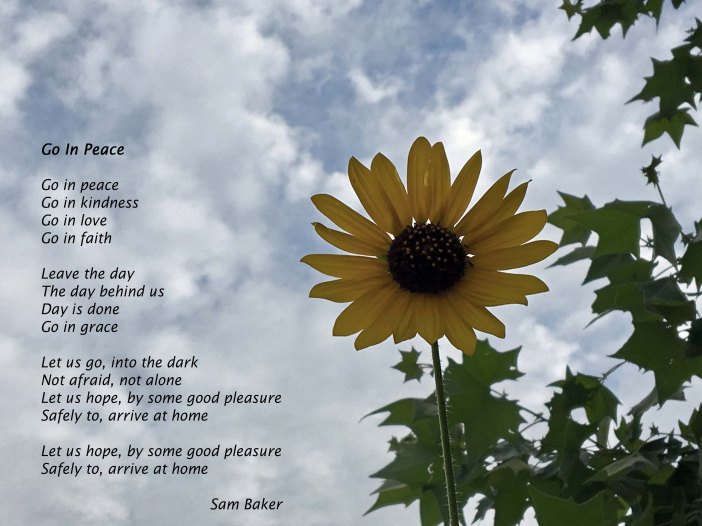
Go In Peace
Song lyrics by Sam Baker. Give it, him, a listen.
Photo taken on a recent run.

Resolution
“I have resolved from this day on, I will do all the business I can honestly, have all the fun I can reasonably, do all the good I can willingly, and save my digestion by thinking pleasantly.” Robert Louis Stevenson
Seems like a good place to start, but I’m glad he found the time to write a few things along the way.
New Arrivals
From Rumi’s The Guest House as translated by Coleman Barks:
“The dark thought, the shame, the malice
Meet them at the door laughing,
And invite them in.
Be grateful for whoever comes,
Because each has been sent
As a guide from beyond.”
I pick this up and read it from time to time. I regularly need that reminder that: “Being human is a guest house. Every morning a new arrival.” Indeed — Sometimes a whole tour bus before the morning passes.
Happiness
From Anthony DeMello’s The Way To Love:
“You now carry in your heart a happiness that nothing outside of you can put there, and nothing can take away.”
It’s damn sure more difficult to locate at some times than others, but still, it’s there. It occurs to me that sometimes, often, we are, to borrow from Johnny Lee’s song, lookin’ for happiness in all the wrong places.
Silence and Peace
From Max Ehrmann’s Desiderata:
Go placidly amid the noise and haste, and remember what peace there may be in silence.”
In this noise-filled world, where silence has become the exception, it is easy to forget “what peace there may be in silence.” Rather than inducing peace, silence more commonly induces unease and anxiousness. If you doubt this, stop speaking (a challenge for some of us) for three, four, five seconds in the middle of a speech, a presentation, even a conversation, turn off that television or radio or (this is getting personal) stop that incessant humming and see how quickly the anxiousness floods the void. Silence is so powerful, so attention drawing that it has become a powerful tool to get listeners to pay attention, to refocus on the things being said. That is to say, they’d rather listen to you drone on about your PowerPointed issues than face the silence.
Still, all that notwithstanding, there can be peace in silence – if we let there be. But first, we have to “remember what peace there can be in silence.”
Not Haiku of the Whenever
Photo taken in Galveston recently (Galvez Hotel), Photoshopped.
Quote from Song of Solomon by Toni Morrison.

God and Religion
“I do not feel obliged to believe that the same God who has endowed us with sense, reason, and intellect has intended us to forgo their use.” Galileo Galilei
This from a man condemned by the Catholic Church for “vehement suspicion of heresy” and sentenced to live the rest of his life under house arrest because of his belief that the sun, not the earth, was the center of the known universe. Interesting how he was able to make the distinction between “religion” and “God,” — two things easily confused.