I often have a song rolling around in my head. Sometimes it just appears for reasons I can’t explain, at other times it is prompted by something I see, hear, or think of in the course of a day. This morning, these two lines from Prayers, by Stephen Kellogg greeted me for an as yet unknown reason: “Every unkind word we say leads to our unhappiness.” And in the next verse: “Every unkind word we say, only drives the love away.” Should be an interesting day!
Awesome Place
In Genesis 28 a tormented Jacob sets out on a journey (more of a flight) from Beersheba to Haran. The text (v. 11) tells us only that he chose his spot for the night “because the sun had set.” In other words, this was no special place. Yet this is where “Jacob’s Ladder” dream occurred. Thereafter, he thinks to himself: “Surely the Lord is in this place, and I was not aware of it…. How awesome is this place! This is none other than the house of God; this is the gate of Heaven.” What made the place so “awesome?” What made it “the gate of heaven?” It occurs to me that what made it special was that this was a spot where Jacob’s mind was open to God’s presence. That is, of course, what can transition any place to an “awesome” place.
Enough
“Enough” as defined in my dictionary is “as much as is needed or required.” It is a tricky thing, enough. Even in a state of “enoughness,” if I am not careful, my focus turns to scarcity, to times when I did not have enough, or to the concern that while I may have “enough” now I might not have “enough” in the future. That is, I can squander my ability to enjoy “enough” now because I am focused on having “more” later.
The Practice Of Wearing Skin
In An Altar In the World Barbara Brown Taylor writes of “the practice of wearing skin” as a spiritual practice. Granted, we don’t think of it so much in those terms. We think of spirituality more in the intellectual sense, something played out in the mind, not in the physical body. But, se writes: “In an age of information overload…the last thing any of us needs is more information about God. We need the practice of incarnation…. Not more about God. More God.” In his last chance to meet with his disciples before dying on the cross, Jesus didn’t fill their heads with information, he didn’t recite the Ten Commandments, repeat the Beatitudes, or, as far as we know, the Lord’s Prayer. He sat down amongst them, had a meal, and washed their feet.
It is, of course, much safer to live out spirituality in the head, but the actions we take once the thinking is done, that is where “the rubber meets the road.” As Taylor notes, “here we sit, with our souls tucked away in this marvelous luggage, mostly insensible to the ways in which every spiritual practice begins with the body.”
Be Yourself
I have written and commented on Max Ehrmann’s Desiderata a good deal over the years. A copy sits on my desk at home, and it is more likely than not that I read all or part of it once a week, perhaps more. I have gone through the exercise enough to know that different parts of the Desiderata jump off the page on different days, yet today I focused on two words in the middle that I don’t think I had previously focused on – “Be Yourself.”
At first those two words seem a little silly – I mean, who else would I be? As Oscar Wilde put it: “Be yourself; everybody else is already taken.” Yet while we know those things to be true, I am me and everyone else IS taken, that doesn’t stop us (no matter how irrational) from trying to be something or even someone else. Heck, most all advertisement plays on that. We are bombarded with the images of what or who we could be if only we bought ________. Indeed, as Ralph Waldo Emerson wrote: “To be yourself in a world that is constantly trying to make you something else is the greatest accomplishment.”
Thus, Ehrmann’s reminder – “Be yourself.”
Human Beings and Obstacles
In An Altar In The World Barbara Brown Taylor notes of herself (though she could have taken this from my journal): “I know that I have an easier time loving humankind than I do loving particular human beings…. Particular human beings rarely do things the way I think they should do them, and when they prevent me from doing what I think I should be doing, then I can run short of reverence for them.”
I guess “running short of reverence” is a nicer sounding than “get pissed off at.” But most important here is Taylor’s proposed remedy:
“One remedy for my condition is to pay attention to them when I can, even when they are in my way. Just for a moment, I look for the human being instead of the obstacle.”
Relationships, indeed, life, can take on a different tone when “I look for the human being instead of the obstacle.”
Learning To Trust Life
From Rachel Remen’s My Grandfather’s Blessings:
“Life has an elegance that far exceeds anything we might devise. Perhaps the wisdom lies in knowing when to sit back and wait for it to unfold. Too hasty an activism may lead to lesser outcomes and, more important, may cause us to trust ourselves rather than learning to trust life.”
I like that initial sentence – “Life has an elegance that far exceeds anything we might devise.” It is such a genteel way of reminding me that I am not as smart as I think I am. But the phrase that really sticks with me is “learning to trust life.” That is some tough learning, a degree plan seemingly not offered at the “School of Hard Knocks.” Still, based on the returns to date, relying on life’s elegance may be the better bet.
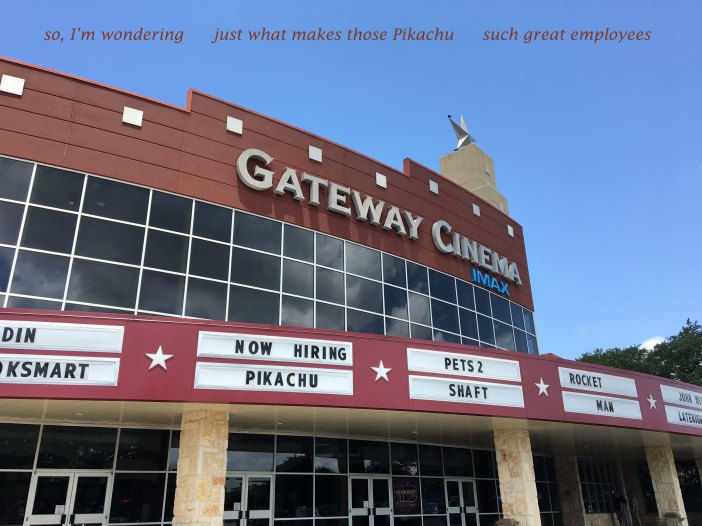
Haiku of the Whenever
Photo taken recently at a nearby movie theater.
Paying Attention/Reverence
From An Altar In The World by Barbara Brown Taylor, this relating to paying attention/Reverence:
“The practice of paying attention really does take time. Most of us move so quickly that our surroundings become no more than the blurred scenery we fly past on our way to somewhere else. We pay attention to the speedometer, the wristwatch, the cell phone, the list of things to do, all of which feed our illusion that life is manageable. Meanwhile, none of them meets the first criterion for reverence, which is to remind us that we are not gods. If anything, these devices sustain our illusion that we might yet be gods – if only we can find some way to do more, faster.
“Reverence requires a certain pace. It requires a willingness to take detours, even side trips, which are not part of the original plan.”
What jumps out at me there is “the illusion that life is manageable.” I would expound on that but I need to answer my cell phone while looking at the speedometer and my wrist watch and composing my list of things to do today. But to fill any possible unoccupied space of time I’ll look on my phone for the Alabama song I’m In A Hurry written by Roger Murrah and Randy VanWarmer.
“I’m in a hurry to get things done, oh I rush and rush until life’s no fun. All I really gotta do is live and die. But I’m in a hurry but don’t know why.”
“We’re the big door prize!”
“In spite of ourselves, we’ll end up sittin’ on a rainbow. Against all odds, honey we’re the big door prize” In Spite of Ourselves – John Prine
Prine’s lyrics are often deceptively simple until you find the substance behind them – or maybe I just overthink them. Anyway, this seems like one of those. Hidden in a humorous little song is this thought that people and relationships are what really matter. Yes, there’s all that stuff, all that obsession over things and achievements, but when all is said and done, those things fade in time, and one day, if we are lucky, we realize that “against all odds, honey we’re the big door prize,” and go about our lives with that in mind.
 It occurs to me...