Photo taken at the Houston Museum of Art some years back.
Revival & Grace
Reading again the Prodigal Son story in Luke 15, I am reminded of the grace of the father, and in particular as reflected in v. 32, the last words of the story: “But we had to celebrate and be glad, because this brother of yours was dead and is alive again; he was lost and is found.”
The grace that strikes me here is what I see as the celebration of revival – “But we HAD to celebrate….” It is so easy to hold on to screw ups, mine or others, even after the realization of the screw up and the metanoia, the changing of the heart and mind as a result of that realization. It is so easy to berate myself or others for mistakes, even after the mistake is acknowledged and remedial action is taken. But the father here does not go there, despite the urging of the older son. The father recognizes the revival and the need to celebrate it: “But we had to celebrate and be glad, because this brother of yours was dead and is alive again; he was lost and is found.”
Peace
“If it is possible, as far as it depends on you, live at peace with everyone.” Romans 12:18
“As far as possible without surrender, be on good terms with all persons.” Max Ehrmann – Desiderata
Written a few centuries apart, but the same sentiment. The “as far as it depends on you” and “without surrender” are key phrases. “Peace,” at times, seems aspirational, and détente is the best one can achieve.
The Mistakes of Others
“Learn from the mistakes of others – you can’t live long enough to make them all yourself.” Martin Vannbee
To complicate this, sadly, it seems one doesn’t come to this wisdom until his/her time to learn from the mistakes of others is also significantly diminished. Luckily, the mistakes of others from which one can learn is, particularly in this information age, virtually unlimited.
Wild Geese – Mary Oliver
Photo taken recently in Galveston. The bird is not a goose, but the verse seemed to fit, nonetheless.

Haiku – Mardi Gras Edition
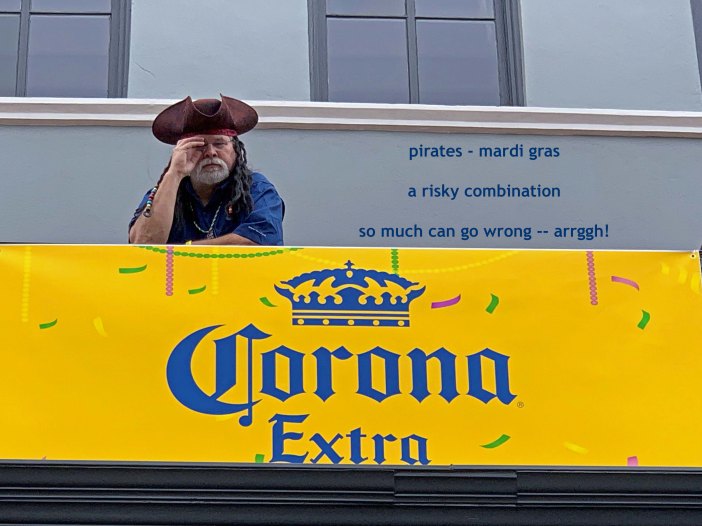 Photo taken this past week at Galveston Mardi Gras
Hope
“At first we hope too much; later on, not enough.” Joseph Roux
It occurs to me that what intervenes in between the “too much” and “not enough” is that I start to believe that I was wholly responsible for what brought me to where I am. That is, the hope gets squelched by the self-adulation.
Hope and Love
Contemplating Valentine’s Day, and I ran across this:
“For one human being to love another human being; that is perhaps the most difficult task that has been entrusted to us, the ultimate task, the final test and proof, the work for which all other work is mere preparation.” Rainer Maria Wilks.
I like that thought, that love is “the work for which all other work is mere preparation.” That the actualization of that thought has its difficulties does not make it any less true. Which of course takes me back to yesterday’s thought in 1 Cor. 13:13: “And now these three things remain: faith, hope, and love. But the greatest is love.” Maybe Paul was correct after all.
In Support of Hope
“And now these three things remain: faith, hope, and love. But the greatest is love.”
1 Cor. 13:13
In Paul’s book, at least here, hope is second best, and perhaps third. There is, however, an argument to be made that hope is shortchanged here. I offer these three bits of evidence in support of that proposition:
From Alexander Pope, An Essay on Man:
“Hope springs eternal in the human breast;
Man never Is, but always To be blest.
The soul, uneasy, and confin’d from home,
Rests and expatiates in a life to come.”
From Lisel Mueller, the poem Hope:
“It is the singular gift
we cannot destroy in ourselves,
the argument that refutes death,
the genius that invents the future,
all we know of God.”
And from my favorite movie character, Andy Dufresne in The Shawshank Redemption:
“Hope is a good thing, maybe the best of things, and no good thing ever dies”
One can never discount love’s power (see 1 Cor 13:1-8), and faith is pretty good, but here’s to hope, because sometimes (apologies to Paul) it feels like the only one of the “three things” that is present.
Photo & Text – The Layers
Photo taken in Portland some years back. Text from Stanley Kunitz, The Layers.
https://www.poetryfoundation.org/poems/54897/the-layers

 It occurs to me...