Photo taken on UT campus. I run by these from time to time.
O Lord
The word “hope” seems to be experiencing a revival these days. Thinking on that this morning these two quotes came to mind:
“So we do not lose heart. Though our outer self is wasting away, our inner self is being renewed day by day.” 2 Cor. 4:16
“This is another day, O Lord. I know not what it will bring forth, but make me ready, Lord, for whatever it may be.” In the Morning – Book of Common Prayer
I have always liked the Book of Common Prayer passage, particularly for the versatility of the “This is another day, O Lord” part. Some days I say the “O Lord” in a prayerful way; on other days it comes out more as a statement of exasperation and dread. – “Oh Lord!” It is particularly in those latter “O Lord!” days that I need to be reminded that while the “outer self” may, as I see it be “wasting away,” when it looks like things are really turning to (or already are) #%*!, I need that belief/hope that the “inner self is being renewed day by day.”
“So we do not lose heart.”
Morning Prayer
Photo of my home office desk.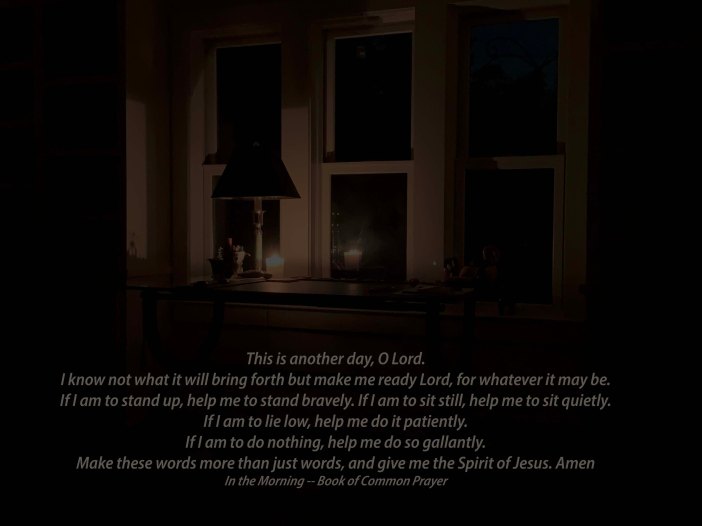
John Prine
Singer/songwriter John Prine died last night. I can’t really remember the first time I heard a John Prine song. I assume it was some time in my teens, but for at least fifty years, the answer to the question of when I last heard a John Prine song was likely today or, at most, yesterday. I am reminded of the old Wolf brand chili commercial and offer this take: Neighbor, how long has it been since you’ve been treated to a John Prine song? [Pregnant pause, and if Prine were saying it, he would clear his throat here.] Well, that’s too long.
Of course, his death will not lessen my listening experiences, will likely increase/enhance them, and he gave us a new album last year, so Prine and his music will remain mainstays in the jukebox that passes for my ears and head. Still, the promise of seeing him perform again is gone, and he will be sorely missed.
Roger Ebert, Kris Kristofferson, Bob Dylan, and countless others have written and attempted to describe Prine’s voice, his music, his appeal, so I won’t even try as I would fail, as would anyone, because his music was more a feeling than anything else. He didn’t appeal to everyone, but I doubt that bothered him a bit because he got to do what he loved doing, which was clear any time you saw him perform. That said, I am partial to an early comment by Kristofferson who is credited with “discovering” Prine. “No way somebody this young can be writing so heavy. We may have to break his thumbs.” Thankfully, his thumbs and that uniqueness remained in place for some fifty more years. And I think Ebert hit the nail on the head when he wrote this after seeing Prine for the first time in the 70s: “He sings rather quietly, and his guitar work is good, but he doesn’t show off. He starts slow, but after a song or two, event the drunks in the room begin to listen to his lyrics. And then he has you.”
Prine and his music had me for half a century, will continue to have me, and for that I am thankful.
“That’s the way that the world goes round, you’re up one day, the next you’re down. It’s a half an inch of water and you think you’re gonna drown. That’s the way that the world goes round.”
Hope
“At first we hope too much; later on, not enough.” Joseph Roux
It occurred to me on reading this that I am wandering through the “later on” phase. Gone are the thoughts, the hope, that this time of “social distancing” and Zoom meetings, of virus, illness, and death would somehow magically pass quickly. “At first” hope was easy to muster, yet now it feels more vague, less certain, like I am intensely searching for hope as one looks for Waldo on a crowded page and as time passes doubt arises as to whether there IS a Waldo on this page. But of course that is the point of this quote, there is a Waldo, and there is hope.
It occurs to me that this “at first too much, later not enough” sequence is also the apostle’s story, and the Easter story — too much through the miracles and on the road to Jerusalem, not enough after the crucifixion, on the road to Emmaus, and then there’s poor Thomas!
Yesterday I picked a first rose off one of my rose bushes. Those first roses seem so perfectly formed, and so fragrant, I suppose in part because there is the knowledge that many more will follow.
“At first we hope too much; later on, not enough.” Keep hope alive.
Maturity – How we carry our load
April 5, 2020
“I have come to think that age cannot ultimately reduce a man, though it can inflict wounds, and cram pain into him, and feed him indignity, and rob him of those he loves, and finally kill him. But the mark of our maturity is how we carry our load….” Brian Doyle, Leaping
In aging it is easy to fall into looking backward, whether toward good memories or bad. It becomes easy to forget there is a present (I am) and with God’s grace, a future (I will be). And engaging in some of that backward looking, I note (Ecclesiastes 7:10) that we have been warned of this tendency for more than 2,000 years:
“Do not say ‘Why were the old days better than these?’ For it is not wise to ask such questions.”
I like Doyle’s approach to this – yes, bad things may happen to us along the way (so do good things) but “the mark of our maturity is how we carry our load.” I have had, have, some good mentors in that respect that have modeled what Paul wrote in 2 Corinthians 4:16:
“So we do not lose heart. Though our outer self is wasting away, our inner self is being renewed day by day.”
I am reminded of what one of those mentors, Jim Mulford, would tell me late in his life – “Live in the gratitude lane.” So I am thankful today for that renewal, for those mentors, for the past, the present, and, because I am “being renewed day by day,” for the future.
Prayer
While prayer is always appropriate, it currently seems more so despite the lingering thought as to the value of prayer. At times like these, prayer can seem like desperation, like an empty gesture, kind of like buying a lottery ticket with your last dollar. Thus, I welcomed reading this today from Brian Doyle on why we pray. The set up is that Doyle has just learned of the terminal illness of his friend, Pete:
“Do I really think that my prayers will save Pete, or cut his pain or dilute his fear as he sees the darkness descending? Do I really think my prayers will make his wife’s agony any less, or reduce the confused sadness in his little boy?
No.
But I murmur prayers anyway, form them in the cave of my mouth and speak them awkwardly into the gray wind, watch as they are instantly shattered and splintered and whipped through the old oak trees and sent headlong into the dark river below.
Did they have any weight as they flew?
I don’t know.
But I believe with all my heart that they mattered because I was moved to make them. I believe that the mysterious sudden impulse to pray is the prayer, and that the words we use for prayer are only the envelope in which to mail pain and joy, and that arguing about where prayers go, and who sorts the mail, and what unimaginable senses here us is foolish.
It’s the urge that matters – the sudden Save us that rises against horror the silent Thank you for joy. The children are safe, and we sit stunned and grateful by the side of the road; the children are murdered, every boy and girl in the whole village, and we sit stunned and desperate, and bow our heads, and whisper for their souls and our sins.
So a prayer for my friend Pete, in gathering darkness, and a prayer for us all, that we may be brave enough to pray, for it is an act of love, and love is why we are here.”
That last part, the “prayer for us all” is worth repeating – “that we be brave enough to pray, for it is an act of love, and love is why we are here.” So here’s the envelope – it is quite large and the postage is pre-paid. (The flap is pre-gummed, so particularly in these times, don’t lick it!) Fill it with the pain, the joy, the worry, with whatever, and send it on its way to the one who sorts the mail.
Hoopla Free Easter
While I won’t pretend to understand all that is going on in this pandemic, how it is influencing our lives, and may do so for years to come , it occurs to me that one thing it is doing is driving us to the center, to the core, driving us to what matters. So I was thinking today that this year we are going to have Easter without all the hoopla. No fashion show in a church packed on Easter Sunday, no plastic grass in colors grass never grows in to line an Easter basket for the Easter egg hunt that is not going to occur, and (damn it!) no Reese’s peanut butter cups shaped like eggs. No, we are left with just Easter and the Easter story – but what a story! Jesus as man. Miracles. Jesus at the Last Supper. Jesus betrayed and condemned. Jesus on the cross. Jesus in the tomb. Jesus alive again and walking down the road to Emmaus. Jesus in our hearts.
And what comes to mind here for me is Raymond Carver’s Late Fragment:
“And did you get what you wanted from this life even so?
I did.
And what did you want?
To call myself beloved, to feel myself beloved on earth.”
Easter without all the hoopla…”to feel myself beloved on earth.”
Normal Days
In a time when I may start to forget what a “normal day” looks like, this, written by Mary Jean Irion, resurfaced and reminded me that my appreciation of normal days should not be limited to times when there aren’t any. The mental list of “normal” things I currently long for is growing by the day. I wonder if I’ll have the sense to remember and appreciate that when things “return to normal?”
“A normal day. Holding in my hand this one last moment, I have come to see it as more than an ordinary rock. It is a gem, a jewel. In time of war, in peril of death, people have dug their hands and faces into the earth and remembered this. In time of sickness and pain, people have buried their faces in pillows and wept for this. In time of loneliness and separation, people have stretched themselves taut and waited for this. In time of hunger, homelessness, and want, people have raised bony hands to the skies and stayed alive for this….
Normal day, let me be aware of the treasure you are. Let me learn from you, love you, savor you, bless you before you depart. Let me not pass by you in quest of some rare and perfect tomorrow. Let me hold you while I may, for it will not always be so. One day I shall dig my nails into the earth, or bury my face in the pillow, or stretch myself taut, or raise my hands into the sky, and want more than all the world your return. And then I will know what I am guessing; that you are, indeed, a common rock and not a jewel, but that a common rock made of the very mass substance of the earth in all its strength and plenty puts a gem to shame.
The day is over and now I will sleep.”
Haiku -Bridges
Photo (edited) taken a few weeks back in Portland, OR.

 It occurs to me...