Seeing and Recognizing


No matter which of the four gospels we are talking about, the post-resurrection story is anticlimactic.  They share that in common.  I mean, how could it not be anti-climactic?  Maybe that’s how it has flown under my radar so long – the seeming inconsistencies.  Was Jesus recognizable after the resurrection or not?

Probably the most well-known post-resurrection story is that in Luke, the so-called Road to Emmaus story in Luke 24.  You know the story.  Jesus has died, but is now missing from the tomb.  As “two of them” (whoever “them” is) are walking to Emmaus “Jesus himself came and walked along with them; but they are kept from recognizing him.”  We aren’t given details on why “they” didn’t recognize him, only that they didn’t.  And this is not a “didn’t recognize him” from across a room, in a brief glance, this is “they” didn’t recognize him in the 6 to 7 mile walk from Jerusalem to Emmaus.  In a walk of about two hours, close enough to converse, “they” didn’t recognize Jesus.  Those dudes need some glasses!  It was not until they are eating later that day, after Jesus “took bread, gave thanks, broke it and began to give it to them” that “their eyes were opened and they recognized him.”  We scratch our heads, of course, how would “they” not recognize him?  It is almost enough to make us forget that the person they didn’t recognize had been dead and was alive again.  Oh, that we understand – but how could “they” not recognize him”

Well, “they” are seemingly in good company.  In John 20, when Mary Magdelene was standing outside the tomb, she has a conversation with Jesus but “did not realize that it was Jesus.”  She tells him (you can hear the brave sternness in her voice): “Sir, if you have carried him away, well me where you put him and I will get him.”  But the dialogue continues, and when Jesus answers her by name Mary Magdelene finally recognizes him.  So seemingly, Mary Magdelene, though a little slow out of the gate, beats the “they” to the finish line in the race to recognition.

Compare “they” and Mary Madgelene to the story in Matthew, which is short on detail.  The two Marys find an empty tomb and are running to tell the others: “Suddenly Jesus met them,” he greets them, and  the two Marys recognize him, “clasped his feet and worshiped him.”

Finally, in Mark (in a section my Bible tells me was not in many of the early manuscripts) we see what is essentially a re-telling of the story from the other three Gospels, above – somewhat of a summary of those events.

It is easy (as it is always easy to be critical of others) to scratch our heads and wonder how “they” could have missed the obvious.  The easy questions are there – Why do “they” and Mary Magdelene not recognize Jesus, at least not at first?   And why do some come to recognition more quickly than others?  What kept them from recognizing him immediately?  Well, the answers that occurs to me, when I think on it, suggest that this all seems about right.  My powers of recognition are about the same, or maybe not even that good.  Sometimes I see Jesus immediately, but not generally.  Not Jesus, himself, you understand, but Jesus in others.  Sometimes it takes a while for the switch to flip and the light bulb to come on – if it indeed ever does.  There are times, okay, many times, where Jesus has been right there in front of me and I missed him.  I know that with surety because sometimes the clarity of that being in the presence of Jesus hits me well after the fact — a minute, an hour, a year, a decade later.  Still, when the recognition comes it is powerful, even awesome.

I am, at best, “they.”  At worst I am recognition-challenged, quick to see, slow to recognize.  But the good news is that Jesus doesn’t give up easily.  He kept walking with them on the Road to Emmaus despite the fact that “they” didn’t recognize him; he hung in there in dialogue with Mary Magdelene until the light bulb of recognition shone brightly.   I do not/will not recognize from time to time, but it would be a shame to quit looking, quit trying to recognize Jesus just because I don’t always recognize Him immediately.  In this I am reminded of one of my favorite quotes, from Justice Feliz Frankfurter: “Wisdom too often never comes, and so one ought not reject it merely because it comes too late.”  If I just keep walking, keep looking, keep the dialogue open, the switch will flip on for me – it has and it will.  And oh, what a glorious light when I finally realize he was/is there, right there beside me!
Knowing Everything

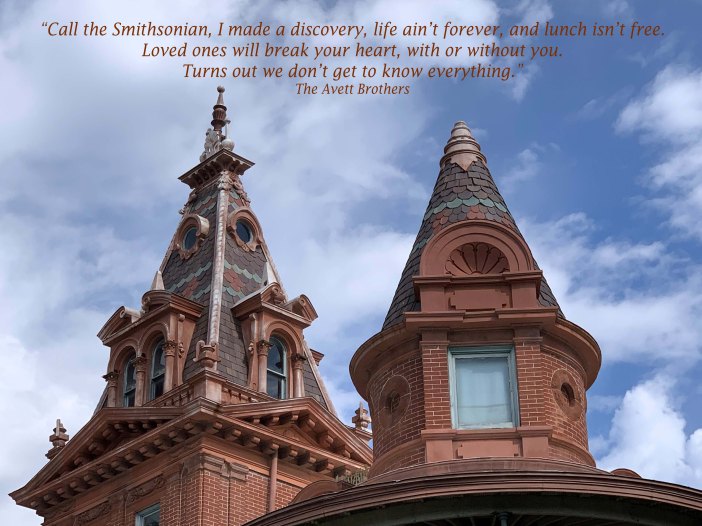
As one thing leads to another, a friend mentioned an Avett Brothers song, which through this meandering path, ultimately took me to another, Smithsonian, with these lyrics I now can’t get out of my head.  So I figured, why keep them to myself, why not throw them out there to the universe?  The chorus goes like this:

“Call the Smithsonian, I made a discovery;

Life ain’t forever, and lunch isn’t free.

Loved ones will break your heart, with or without you;

Turns out we don’t get to know everything!”

That last line is the one that grabs me – “Turns out we don’t get to know everything.”  Indeed, damn it, we don’t.  It occurs to me that much consternation in life is precipitated by that reality – we don’t get to know EVERYTHING.  But, would we want to?  Its bad enough as it is, and I can see myself easily slipping into the “insufferable prick” category if I did actually know everything.  I mean, I know how I am when I THINK I know everything.

Metanoia/Life

Back on the Greek-derived word “metanoia” today, I ran across this definition: “The journey of changing one’s heart, self, mind or way of living; a change of heart.”  I like that so much better than the typical Biblical translation into “repent.”   It occurred to me in reading that definition that one could use that same definition for “life,” as in:

Life: The journey of changing one’s heart, self, mind, or way of living; a change of heart.

Prescience

Listening to Garrison Keillor recently as he noted that day was the birthday of Fred Astaire,  Keillor reported one of the reviewers in an early screen test evaluated Astaire as follows: “Can’t act.  Can’t sing.  Balding.  Can dance a little.”  That is, on research, somewhat Hollywood lore, but it is apparently documented that David O. Selznick, who signed Astaire to RKO and commissioned the screen test, stated afterwards in a memo, “I am uncertain about the man, but I feel, in spite of his enormous ears and bad chin line, that his charm is so tremendous that it comes through even on this wretched test.”

After the initial laugh, it occurs to me in this that in life I am no more prescient than the reviewers noted above.  That is, in my judgments  of people, trends, and talent (which amazingly continue despite my abysmal “batting average”) I sometimes manage to perceive just enough of the reality to make myself comically wrong.

Fixing Our Eyes

From 2 Cor. 4:16-18:

“Therefore, we do not lose heart.  Though outwardly we are wasting away, yet inwardly we are being renewed day by day.  For our light and momentary troubles are achieving for us eternal glory that far outweighs them all.  So we fix our eyes not on what is seen, but on what is unseen.  For what is seen is temporary, but what is unseen is eternal.”

Such beautiful prose, and so full of fruit to pick.  I fret a lot over “light and momentary troubles.” When they are happening to me they rarely seem either “light” or “momentary,” yet they are almost always revealed as such in retrospect.  That is perhaps part of the human condition.  But the phrase that jumps out today is that admonition to “fix our eyes not on what is seen, but on what is unseen.”  That almost seems impossible, doesn’t it — to “fix our eyes…on what is unseen,” but then I am reminded of that gaze we are all capable of, where we are looking at everything, yet looking at nothing in particular – often referred to as an “empty gaze” or “staring into space.”  Paul is, I think, calling on us to take it all in lest we fail to recognize the “unseen” and “eternal” that is right there in front of us.

Words and Labels

From Eckhart Tolle, A New Earth:

“Words reduce reality to something the human mind can understand, which isn’t very much.  Language consists of five basic sounds produced by the vocal cords.  They are the vowels a, e, i, o, u.  The other sounds are consonants produced by air pressure: s, f, g, and so forth.  Do you believe some combination of such sounds could ever explain who you are, or the ultimate purpose of the universe, or even what a tree or stone is in its depth?”

Tolle is, of course, correct.  Words, which are effectively socially agreed upon labels we choose to associate with things, are inherently inadequate.  “Red,” in and of itself, does nothing to tell me the color of something, not does “sad” convey much with that arrangement of three letters.  Those words, all words, are labels that help my mind quickly page through the thick dictionary it has created to make a connection.  The flaw in all this, of course (and let’s skip over the obvious, that my definitions may be incorrect) is that my labels and definitions are not your labels and definitions.  Deep thoughts for a Sunday morning.  Still, he’s on to something here.

Pure Heart, Steadfast Spirit

“Create in me a pure heart, O God, and renew a steadfast spirit within me.” Psalm 51:10

The writer has a lot of requests in Psalm 51 – so many that one can get the impression that he carries around a list (though don’t we all!).  He seeks mercy, cleansing, wisdom, joy, and forgiveness, just to name a few of his requests.  Among all those requests though, the two in this passage seem central, and the most sustaining: 1) a “pure heart”, and 2) a “steadfast spirit.”  One could, I suppose, argue that “faith, hope, and love” ought to make the list, perhaps others, but it occurs to me that if one has the “pure heart” and “steadfast spirit,” the rest follow, or there would be no/less need for them.  All that to say that while the “pure heart” and “steadfast spirit” may not be a complete list, those are at least a damn good start.

Born Again

Wow, that month April was a unique one.  Working at home, not getting out much.  The many references to the movie Groundhog Day seemed appropriate – and actually I do have I Got You Babe as one of the wake-up songs on my phone alarm.  It is easy to slip into that rut.  I think it may be that feeling that pushed me back to listening to an old song of Slaid Cleaves (based on some Woodie Guthrie lines), whose poetical song lyrics I have always appreciated.  I’ve only put a little below, and a link to the rest.  The song, the lyrics, are a reminder


This morning I was born again and a light shines on my land,

I no longer look for heaven in your deathly distant lands.

I do not want your pearly gates, don’t want your streets of gold.

This morning I was born again, and a light shines in my soul.

This morning I was born again, I was born again complete,

I stood up above my troubles, and I stand on my two feet.

My head it feels unlimited, my body feels like the sky,

I feel at home in the universe where yonder planets fly.

https://www.youtube.com/watch?v=-vKilDBMhwA

I am reminded here that there is, or can be, a revival of sorts each day.  Each day I am “born again and a light shines in my soul.”  What I do with that is, of course, up to me.  I can wake up to the same Sonny and Cher song  each day, avoid my old classmate Ned Ryerson as I turn the corner, step into that water puddle, or I can go another route and see the possibility the beauty, of each day.