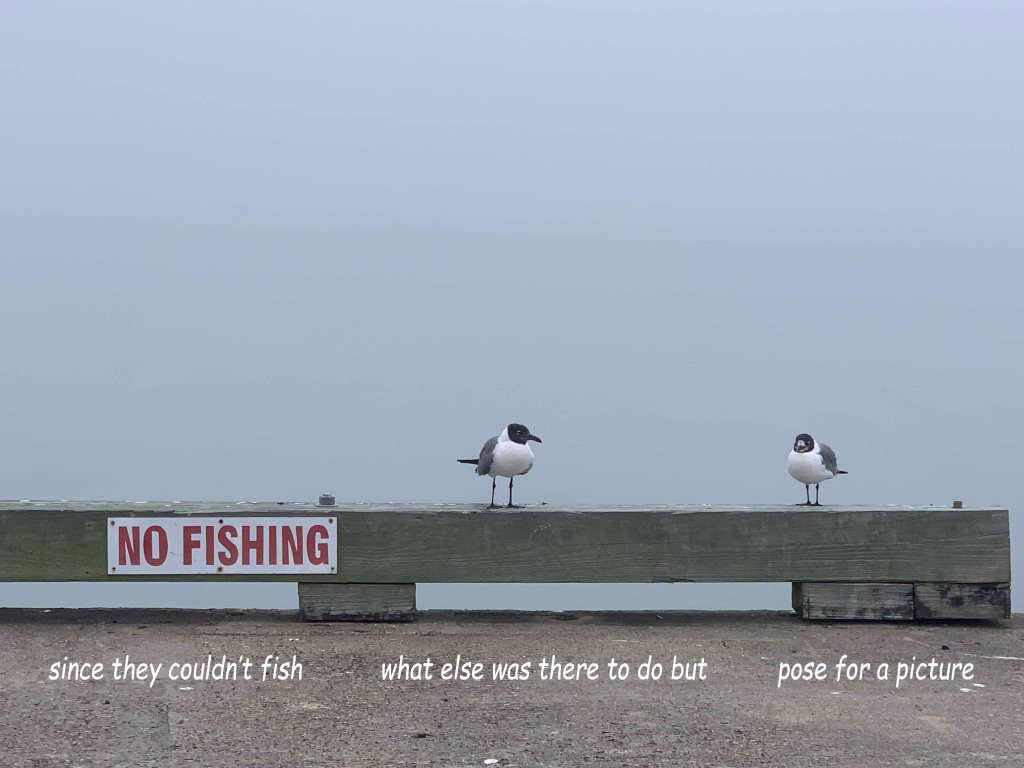
Photo taken recently in Galveston. My distributed photos would seemingly suggest that it is always a majestic sunrise on a clear day. Alas, not true. But still…

Photo taken recently in Galveston. My distributed photos would seemingly suggest that it is always a majestic sunrise on a clear day. Alas, not true. But still…
From Howard Thurman’s Meditations of the Heart:
“There is a curious logic in human experience that finally permits no man to escape the good and the bad…. To be alive is to be involved in events, some which take their rise uniquely in the individual’s experience and some of which flow into the life, apparently without rhyme or reason. To accept all experience as raw material out of which the human spirit distills meanings and values is a part of the meaning of maturity.”
Wow! There’s a lot there to unwrap there, particularly that last sentence. I love Thurman’s admonition to “accept all experience as raw material out of which the human spirit distills meanings.” It occurs to me in that perhaps Thurman is on to something here, that maturity arrives when I recognize (and perhaps most importantly, accept) that my “life puzzle” doesn’t have the same pieces as others’, or for that matter, the same picture on the box.
Miracles
From 2 Kings Chapter 5 through Not By Bread Alone:
So Naaman, an army commander apparently somewhat full of himself, has leprosy. His wife’s servant, an Israelite, suggests that to be cured he go see the prophet Elisha, in Israel. Namaan goes to his boss, the king of Aram, who sends Namaan on his way with an entourage, a lot of money, and a letter for the king of Israel. The king of Israel balks at all this, but Elisha gets word of it and sends word for Namaan to come see him. Namaan directs his entourage to Elisha’s place. Elisha doesn’t bother to come out, but sends a servant to tell Namaan to “go wash yourself seven times in the Jordan, and your flesh will be restored and you will be cleansed.
This pisses off Namaan, who thinks that Elisha should have come out to see him, waved his hand over Namaan, and cured him on the spot — he wanted, felt he deserved, a spectacle. Namaan’s servants (obviously, less full of themselves) urge Namaan to do as Elisha told him. So after more grumbling he does, and “his flesh was restored and became clean like that of a young boy.”
A long but effective way to make a point. A good lesson on how easy it is to want God to be present only in the WOW, not in the now. A point perhaps best stated by Thomas Merton:
“The miracle is not to walk on water. The miracle is to walk on the green earth, dwelling deeply in the present moment and feeling truly alive. Every day we are engaged in a miracle which we don’t even recognize: a blue sky, white clouds, green leaves, the black, curious eye of a child – our own two eyes. All is a miracle.”
And as the Not By Bread Alone piece concludes – “Find your miracle today.”
Photo taken in Galveston this past week.

Thinking about grace recently, I had a thought of (obscure cultural reference) the Otis Campbell character on the long-ago TV show, Mayberry RFD. To the uninitiated, Otis was the good-natured town drunk who Andy or Barney would lock in the small jail cell after Otis had a period of hard drinking. When Otis sobered, he just reached outside the cell, grabbed the jail keys that were hanging on the brick wall right outside his cell, and released his sober self out into the world.
It occurs to me that grace is like that. Whatever transgression, God leaves the keys hanging there on the wall.
An imperfect analogy, I am sure, but one that makes me smile nonetheless, and not just because I always liked Otis.
Photo recently taken in Galveston
From the Not By Bread Alone Lenten devotional for today:
[C]an we view everything instead through a Gospel prism and realize once again, finally, that the light touches all of us…? .”
I don’t think the writer meant that as a rhetorical question.
Photo taken from the Congress Avenue Bridge on a recent run; struck me as a Far Side moment.

I come into my own through God. God comes into God’s own through me. Same God, same deal. That said, a lot of time and effort is made trying to come into my own by other means. I like the analogy Anthony DeMello uses on this point.
“It’s like imagining that you change your handwriting by changing your pen. Or that you change your capacity to think by changing your hat. That doesn’t change you really, but most people spend all their energies trying to rearrange their exterior world to suit their tastes. Sometimes they succeed – for about five minutes – and they get a little respite, but they are tense even during that respite, because life is always flowing, life is always changing.”
There are two constants in the partnership. One is a bit more steady than the other.
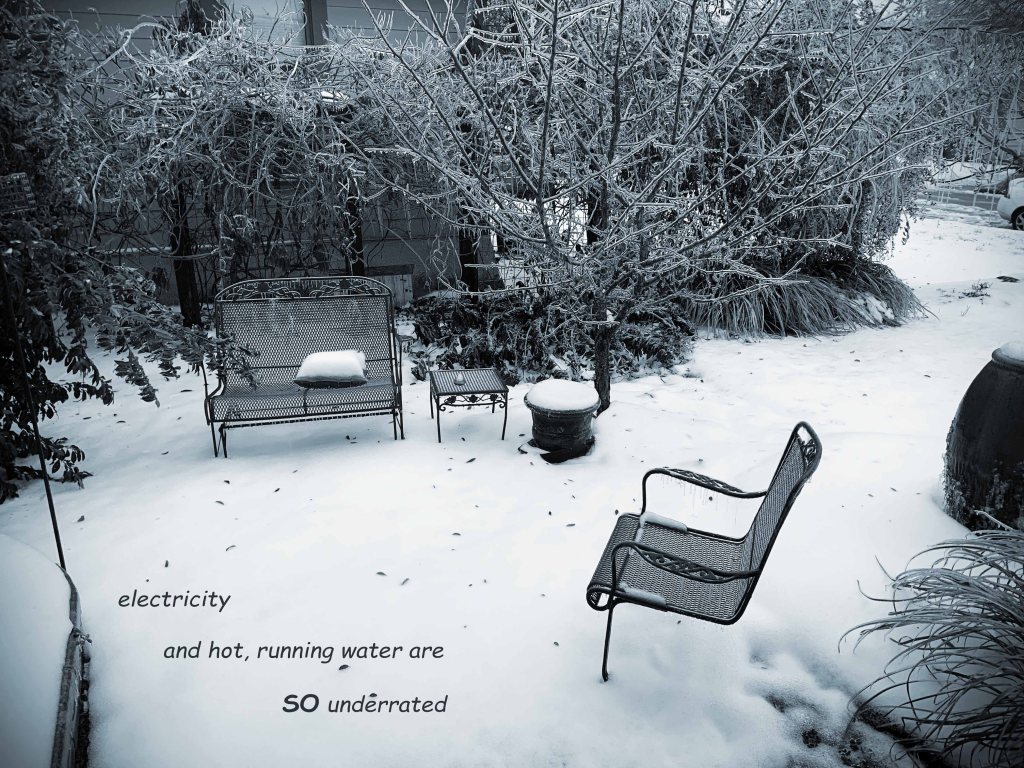
Photo taken off the front porch, day three of no electricity or hot water.
 It occurs to me...