Photo taken in Galveston last year, sunrise at one of my fishing spots. The text — well, it helps us see that Ali was more than a boxer.

Photo taken in Galveston last year, sunrise at one of my fishing spots. The text — well, it helps us see that Ali was more than a boxer.
Photo taken on a run last year. For anyone who is counting, the song turns 55 this year.
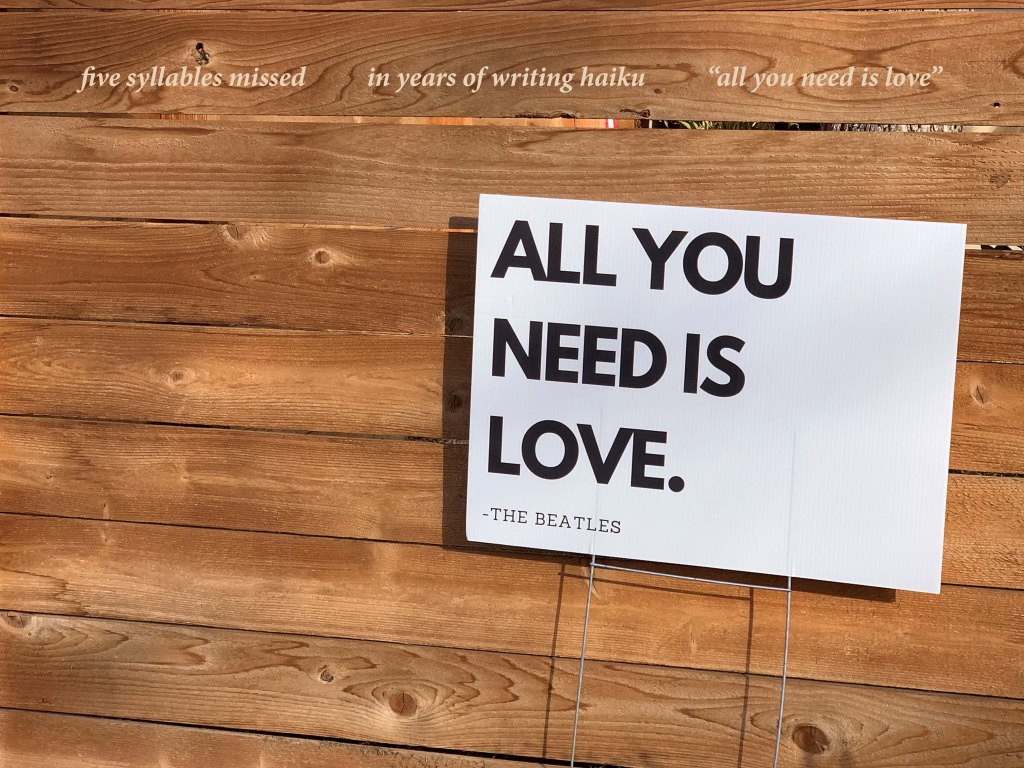
Listening to an On Being podcast in which Sharon Salzburg was the guest, Salzburg said something akin to this — “We spend our effort rowing frantically but fail to see that we left our boat tied to the dock.” It has occurred to me several times since, particularly when I am struggling with something that seems like it ought to be easier — Is my boat still tied to the dock?
Photo, appropriately so, taken at sunrise of Pleasure Pier, in Galveston.
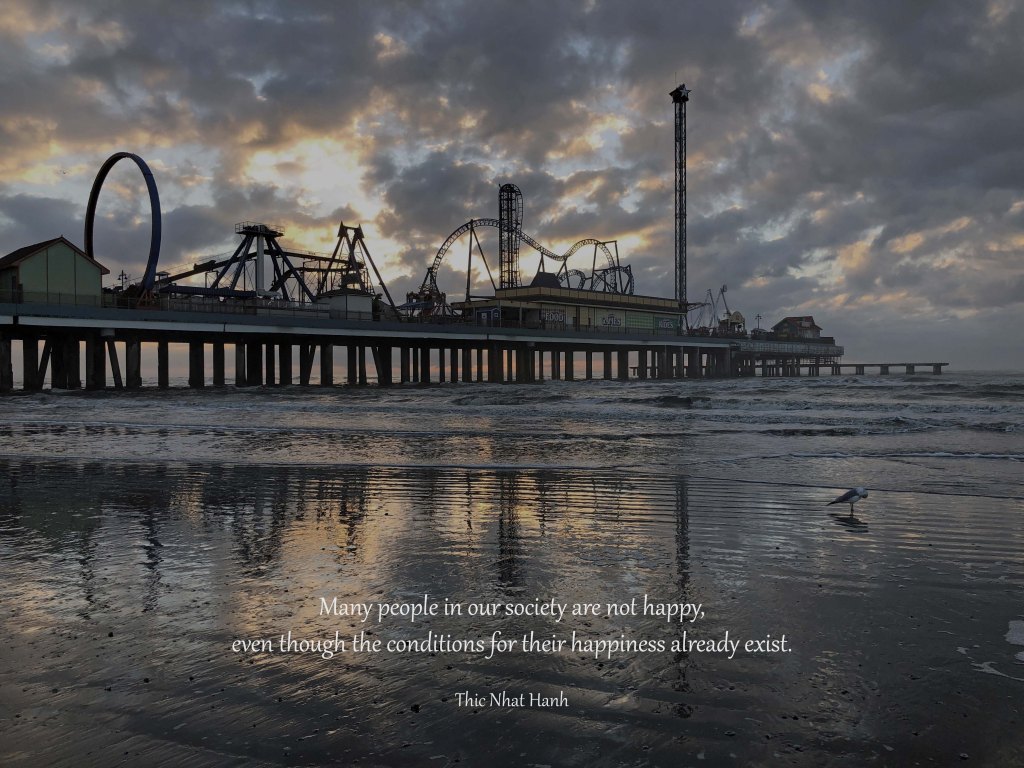
Galveston sunrise shot taken earlier this year.
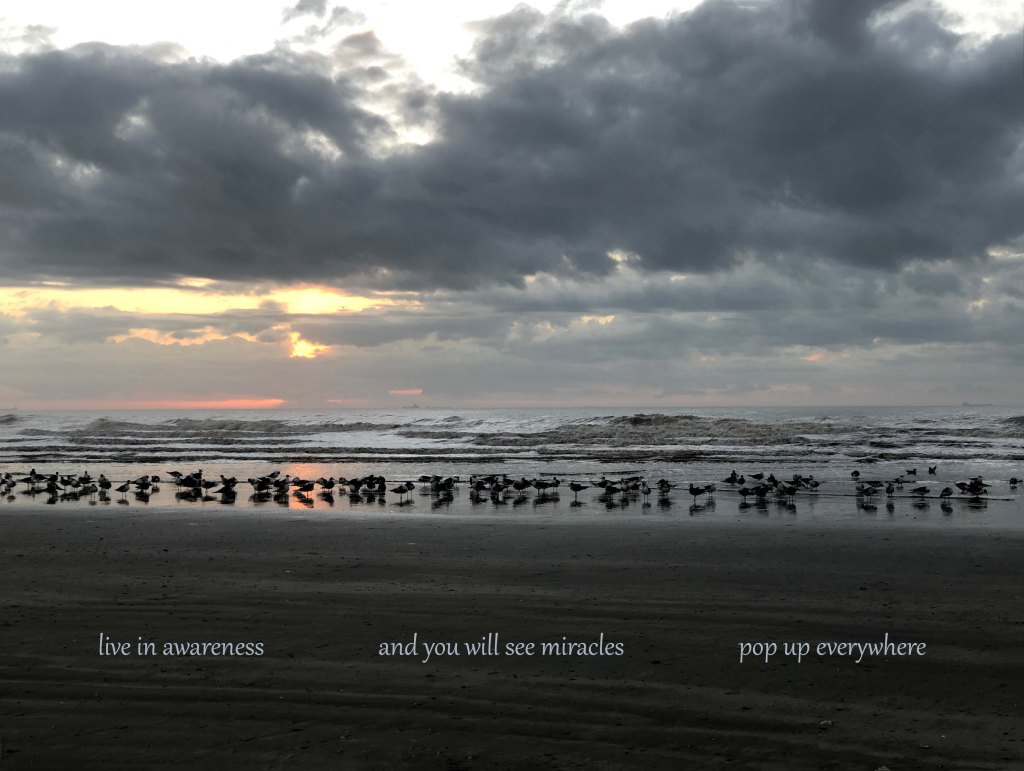
“You have an appointment with life, an appointment that is with the here and now.” Thich Nhat Hanh
So complex a statement, so much to unwind. Indeed, reflecting on it, my glances at my Outlook calendar are heavily weighed to the past (to figure out what I did, when) and to the future (when I am supposed to be where and what I am supposed to do, then). It becomes easy to let the present slip away, easy to forget to be in the here and now because I am busy looking back and forward.
The lesson (not a new one, but one that needs repeating) is encapsulated in this passage from Hanh:
“ How can you love if you are not here? A fundamental condition of love is your own presence. In order to love you must be here. That is certain. Fortunately, being here is not a difficult thing to accomplish. It is enough to breathe and let go of thinking or planning. Just come back to yourself, concentrate on you breath, and smile. You are here, body and mind together. You are here, alive, completely alive. This is a miracle.”
Indeed, a miracle.
I read an article a while back that noted that in recent brain research scientists determined that humans have as many as 6,000 thoughts per day. I am not a scientist, have not conducted brain research, and I did not stay at a Holiday Inn Express last night, but I venture a guess that if those folks in the study were polled 48 hours later, they might recall less than a 100 of those 6,000 thoughts they had that day. Hell, my wife would be impressed if I remember a handful of them. All that to get to this. Friday my friend Matt Dow shared this one thought, one of his 6,000, which became one of my 6,000, a lesson Matt learned from a friend of his, Bill Baker — “Speak words that bless.”
“Speak words that bless.” Four words, one lesson, one thought. As they rumbled around in my head on a Saturday morning long run, the power started to become obvious. While I am sure I don’t have 6,000 opportunities to speak in a given day (I hear the collective sigh of relief) there are at least some opportunities to do so, and if one adds in texts, emails, and various other electronic means of communications, those opportunities to “speak” multiply. That is, in social media terms, we become, on some scale, “social influencers.” There are, of course, other choices on the “Speaking Menu.” Each chance to speak provides an opportunity to “speak words that DO NOT bless.” While my ability to discuss that option is ample, on that I am going to invoke my 5th Amendment right against self-incrimination and simply note that my personal research over the past 48 hours suggests that this “speak words that bless” thing is pretty damn powerful, even if the best one can do is sprinkle a few “words that bless” in with all those other words that don’t. So go ahead, become a social influencer, make someone’s day, and yours too – “Speak words that bless.”
Photo taken a while back in Galveston.
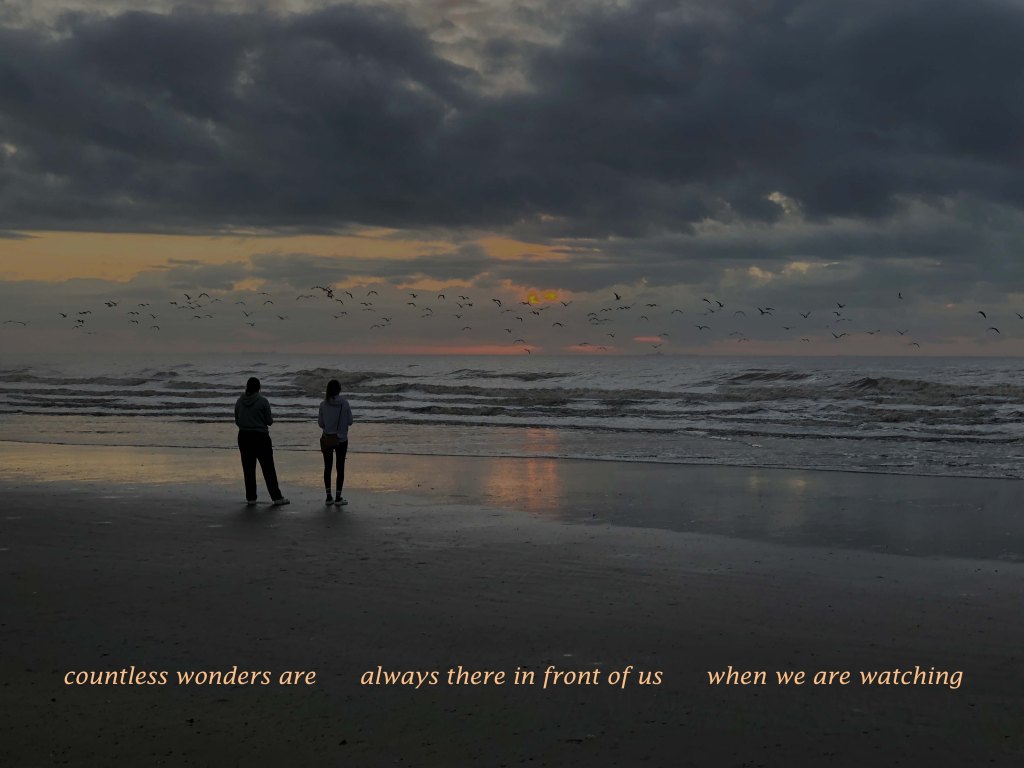
Photo taken recently of a sky that got my attention. Full poem below.

in celebration of surviving
Chuck Miller
when senselessness has pounded you around on the ropes
and you’re getting too old to hold out for the future
no work and running out of money,
and then you make a try after something that you know you
won’t get
and this long shot comes through on the stretch
in a photo finish of your heart’s trepidation
then for a while
even when the chill factor of these prairie winters puts it at
fifty below
you’re warm and have that old feeling
of being a comer, though belated
in the crazy game of life
standing in the winter night
emptying the garbage and looking at the stars
you realize that although the odds are fantastically against you
when that single January shooting star
flung its wad in the maw of night
it was yours
and though the years are edged with crime and squalor
that second wind, or twenty-third
is coming strong
and for a time
perhaps a very short time
one lives as though in a golden envelope of light
I am reminded today of the significance of poetry. Garrison Keillor puts it well: What “makes all good poems matter is that they offer a truer account than what we’re used to getting.” Which pointed me to William Stafford’s A Ritual To Read To Each Other:
If you don’t know the kind of person I am
And I don’t know the kind of person you are
A pattern that others made may prevail in the world
And following the wrong god home we may miss our star.
While there is, of course, a tendency to focus on our own role, our own lines, Stafford’s poem offers a good reminder of the ensemble cast in this production: me, you, others. It’s always good to know who the players are.
And Stafford’s poem is too good to not include in its entirety:
A Ritual to Read to Each Other
William E. Stafford
If you don’t know the kind of person I am
and I don’t know the kind of person you are
a pattern that others made may prevail in the world
and following the wrong god home we may miss our star.
For there is many a small betrayal in the mind,
a shrug that lets the fragile sequence break
sending with shouts the horrible errors of childhood
storming out to play through the broken dyke.
And as elephants parade holding each elephant’s tail,
but if one wanders the circus won’t find the park,
I call it cruel and maybe the root of all cruelty
to know what occurs but not recognize the fact.
And so I appeal to a voice, to something shadowy,
a remote important region in all who talk:
though we could fool each other, we should consider—
lest the parade of our mutual life get lost in the dark.
For it is important that awake people be awake,
or a breaking line may discourage them back to sleep;
the signals we give — yes or no, or maybe —
should be clear: the darkness around us is deep.

