Photo taken a while back in Galveston.
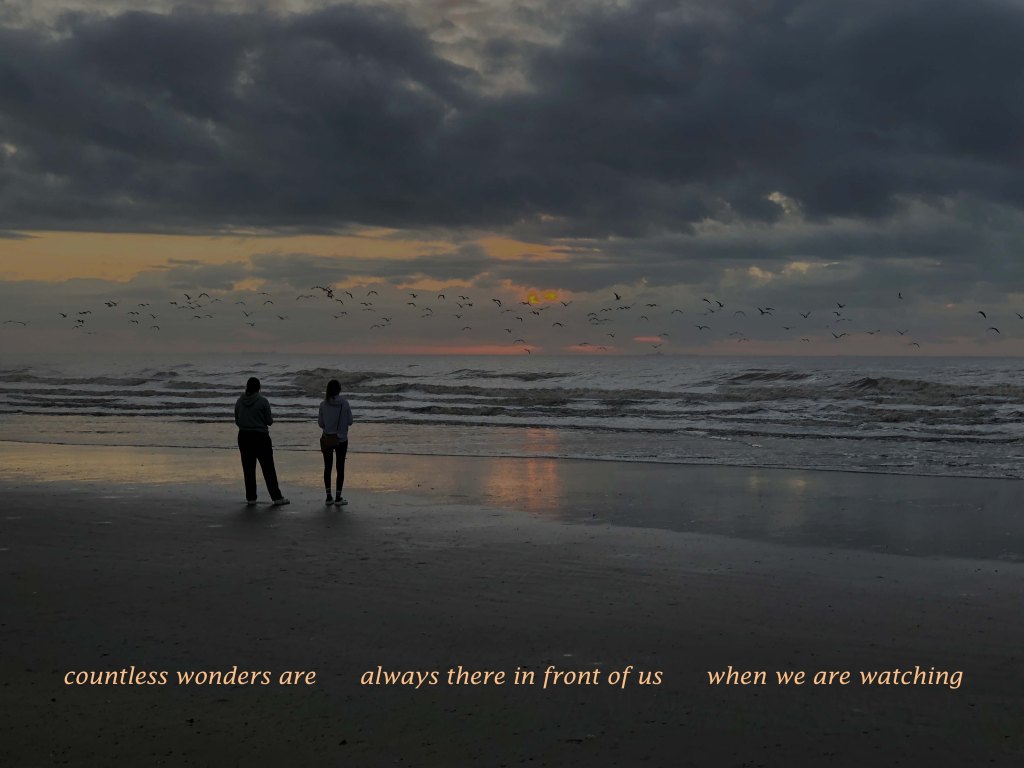
Photo taken a while back in Galveston.
Photo taken recently of a sky that got my attention. Full poem below.

in celebration of surviving
Chuck Miller
when senselessness has pounded you around on the ropes
and you’re getting too old to hold out for the future
no work and running out of money,
and then you make a try after something that you know you
won’t get
and this long shot comes through on the stretch
in a photo finish of your heart’s trepidation
then for a while
even when the chill factor of these prairie winters puts it at
fifty below
you’re warm and have that old feeling
of being a comer, though belated
in the crazy game of life
standing in the winter night
emptying the garbage and looking at the stars
you realize that although the odds are fantastically against you
when that single January shooting star
flung its wad in the maw of night
it was yours
and though the years are edged with crime and squalor
that second wind, or twenty-third
is coming strong
and for a time
perhaps a very short time
one lives as though in a golden envelope of light
I am reminded today of the significance of poetry. Garrison Keillor puts it well: What “makes all good poems matter is that they offer a truer account than what we’re used to getting.” Which pointed me to William Stafford’s A Ritual To Read To Each Other:
If you don’t know the kind of person I am
And I don’t know the kind of person you are
A pattern that others made may prevail in the world
And following the wrong god home we may miss our star.
While there is, of course, a tendency to focus on our own role, our own lines, Stafford’s poem offers a good reminder of the ensemble cast in this production: me, you, others. It’s always good to know who the players are.
And Stafford’s poem is too good to not include in its entirety:
A Ritual to Read to Each Other
William E. Stafford
If you don’t know the kind of person I am
and I don’t know the kind of person you are
a pattern that others made may prevail in the world
and following the wrong god home we may miss our star.
For there is many a small betrayal in the mind,
a shrug that lets the fragile sequence break
sending with shouts the horrible errors of childhood
storming out to play through the broken dyke.
And as elephants parade holding each elephant’s tail,
but if one wanders the circus won’t find the park,
I call it cruel and maybe the root of all cruelty
to know what occurs but not recognize the fact.
And so I appeal to a voice, to something shadowy,
a remote important region in all who talk:
though we could fool each other, we should consider—
lest the parade of our mutual life get lost in the dark.
For it is important that awake people be awake,
or a breaking line may discourage them back to sleep;
the signals we give — yes or no, or maybe —
should be clear: the darkness around us is deep.
Now and then my camera creates an image on its own and reminds me…
In today’s reading, Howard Thurman takes on “the primary question,” which he identifies as: “Is this a world with moral meaning at the center.” This is, he writes, a question that “must be answered before other questions can even be asked.” That was enough to get my attention.
At the outset. Thurman recognizes the difficulty of the task ahead – this “primary question…can never be answered with proof and finality, but some answer must be given on the level of faith.” Still, he notes, one cannot sidestep the question, for “to decide not to decide it to decide against.” Adding to the challenges, one can “make this affirmation with gusto and enthusiasm without really meaning it” not because of insincerity but “simply because there is evidence on either side. We see the sordid and tragic in life, we see the pain and suffering…. Then we see beauty, truth, love, and fulfillment.” This debate churns with us. As Thurman puts it, “the evidence is always straining within us. In consequence we may decide intellectually in favor of meaning, only to find our subconscious casting a dissenting ballot.”
At this point, however, Thurman makes a significant pivot away from the intellectual and emotional battle inside us and places the issue firmly before us and the rest of the world:
“Therefore, the great labor of life, after we have made the initial life affirmation, is to validate the decision in practice. After all, how can one believe that life has meaning if his own life does not have meaning. No words, no matter how eloquently and enthusiastically uttered, can replace the expressiveness of action. Indeed, words become true when they are lived, and they become untrue when the living of them is neglected. We shall always be ambivalent and our ‘Yes’ will never have the total assent of our total wills. Our great labor is simply to bring active affirmation as close as possible to the vocal affirmation. All else is subsidiary.”
Two points. First, I so love the “as close as possible” nod Thurman gives to recognize the difficulty of the task. A full match up of words and deeds would be great, but just get “as close as possible.” Whew! Second, provides insight as to Matthew 5:37 – “Let your “yes” be “yes” — not just in word, but in deed also.
Photo taken last week, fallen flower on pavement.

Photo taken on the beach last week
Driving around recently I saw a bumper sticker on a car and the word “gratitude” caught my eye. it seems to me that one doesn’t see that word on many bumper stickers. It was a small square bumper sticker with small print, and the road grime that covered it made it even more difficult to read. Luckily, we both caught a light, and so I had a chance to read the full message:
“Gratitude for all there is, and for all there isn’t.”
I am still pondering those ten words days later.
“Gratitude for all there is” — It occurs to me that gratitude for what there is is challenge enough. It is easy to take things, blessings if you will, for granted, and in my experience, though it seems counterintuitive, the more things and blessings I have, the more difficult it becomes to be grateful for them. That is, the easier it is to take them for granted.
“Gratitude for all there isn’t.” – Well, this is an even greater challenge, to be grateful for what we don’t have. Of course there are things we don’t have and don’t want, some problem, trouble or disease for instance. You’d think it would be easy to be grateful for their absence, though of course there is that schadenfreude thing to contend with. But even more challenging is to be grateful for things we want but don’t have, or that we want more of.
No answers here, but still savoring the thought:
“Gratitude for all there is and for all there isn’t.”
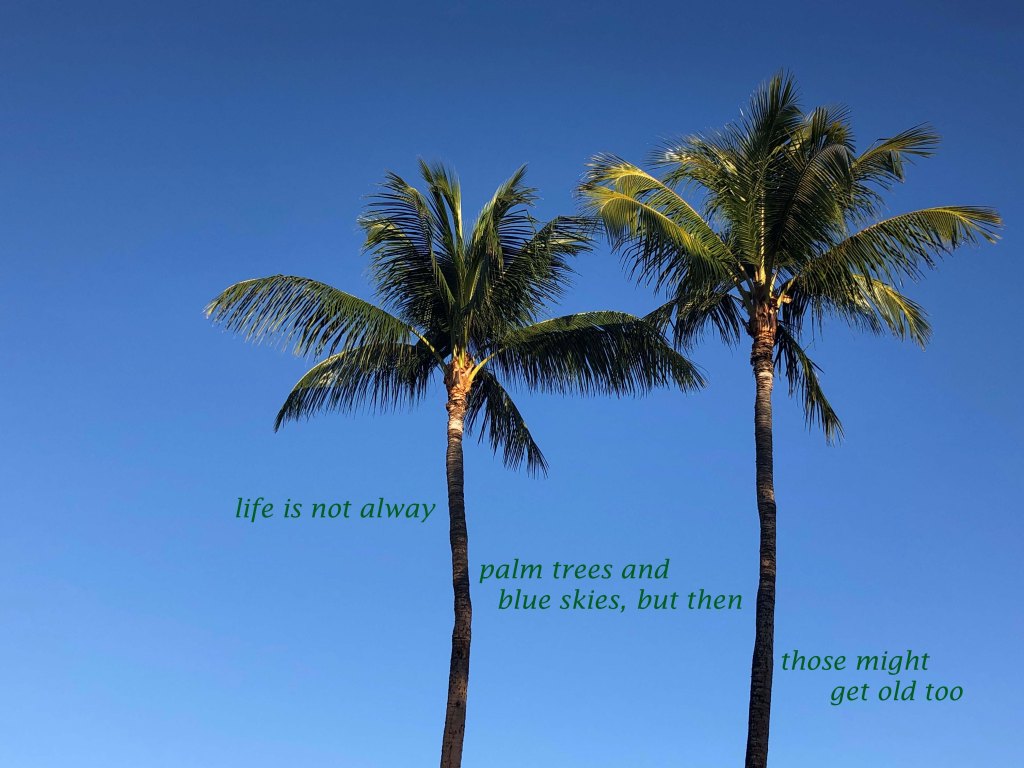
Photo taken yesterday in Kona, Hawaii, song is an old favorite.
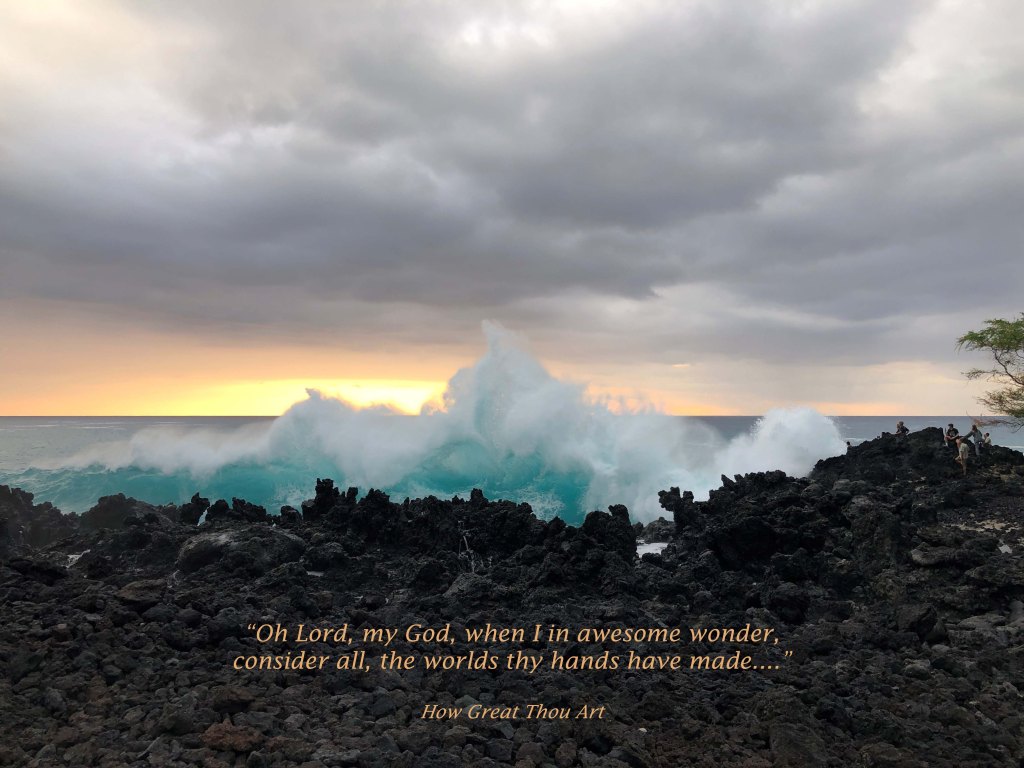
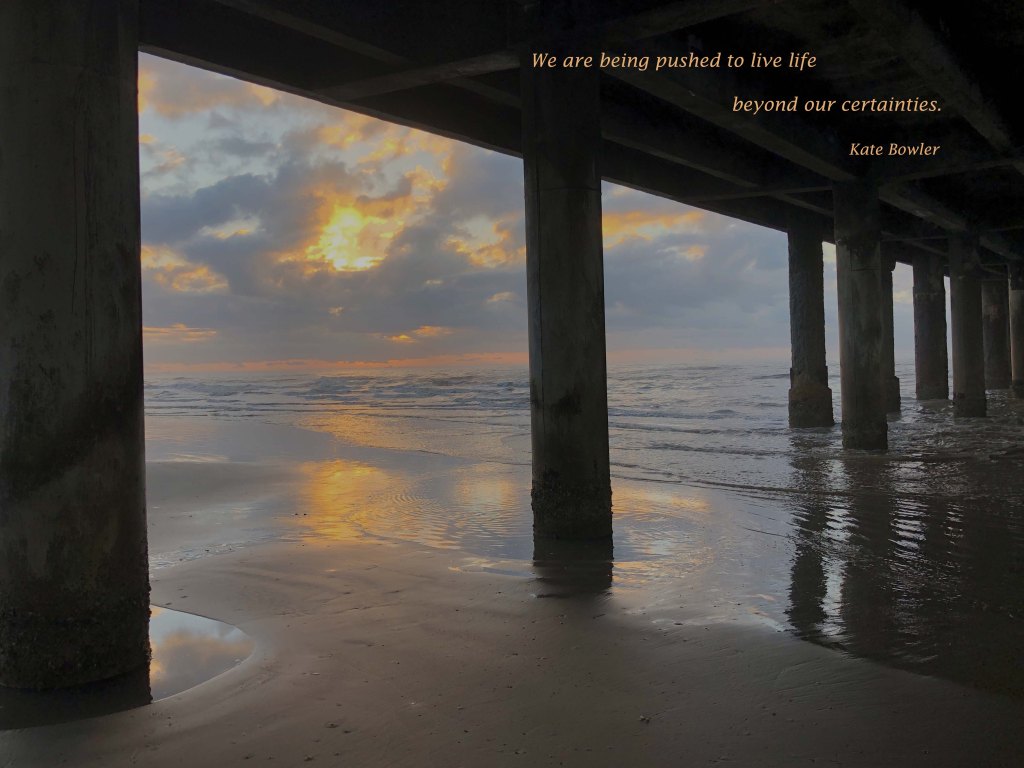
Photo taken in Galveston under the Pleasure Pier, which, apropos to the text, was previously the Flagship Hotel pier, until said hotel was seriously damaged by a hurricane and repurposed as an amusement park of sorts.
As to the quote, Bowler was speaking to the unsettling nature of the pandemic, which in many ways has “shuffled the deck” on our lives, or at least caused us to entertain the thought of looking at things differently.
 It occurs to me...