From C. S. Lewis, The Weight of Glory, this to think on:
“…so we shall then first be true persons when we have suffered ourselves to be fitted into our places.”
Still chewing on that thought.
From C. S. Lewis, The Weight of Glory, this to think on:
“…so we shall then first be true persons when we have suffered ourselves to be fitted into our places.”
Still chewing on that thought.
Provide your own haiku to me for this photo — 5 syllables, 7 syllables, 5 syllables — and I’ll put them on the photo and post them here.

A zinger today from Howard Thurman:
“It is exceedingly difficult to keep from encouraging in oneself that which one condemns in other people. Vices are apt to take on the halo of virtues when they are part of one’s own behavior, but seen in others they are regarded as being what in truth they are…. What I would consider a pose or pretense in my neighbor is apt to be called genuine when I do it.”
Arrghhh. Just when I was starting to feel comfortable around mirrors!
This poem/prayer from Mary Oliver
Thirst
“Another morning and I wake with thirst for the goodness I do not have. I walk out to the pond and all the way God has given us such beautiful lessons. Oh Lord, I was never a quick scholar but sulked and hunched over my books past the hour and the bell; grant me, in your mercy, a little more time. Love for the earth and love for you are having such a long conversation in my heart. Who knows what will finally happen or where I will be sent, yet already I have given a great many things away, expecting to be told to pack nothing, except the prayers which, with this thirst, I am slowly learning.”
Regarding the first line, the request to – “wake the thirst for goodness I do not have.” I might quibble a bit with that and suggest that the “thirst for goodness,” though perhaps latent, is always there, but perhaps that is wishful thinking. Yet what stays with me most, beyond the prayerful nature of this selection, is that last sentence:
“Who knows what will finally happen or where I will be sent, yet already I have given a great many things away, expecting to pack nothing, except the prayers which, with this thirst, I am slowly learning.”
“Who knows what will finally happen…pack nothing….I am slowly learning.” Indeed!
Much is written on the subject of prayer, but I am not sure it is explained anywhere any better than these words from Mary Oliver’s Praying:
It doesn’t have to be
the blue iris, it could be
weeds in a vacant lot, or a few
small stones, just
pay attention, then patch
a few words together, and don’t try
to make them elaborate, this isn’t
a contest but the doorway
into thanks, and silence in which
another voice may speak.
Those nine words pretty much cover it. Prayer = “thanks, and silence in which another voice may speak.”
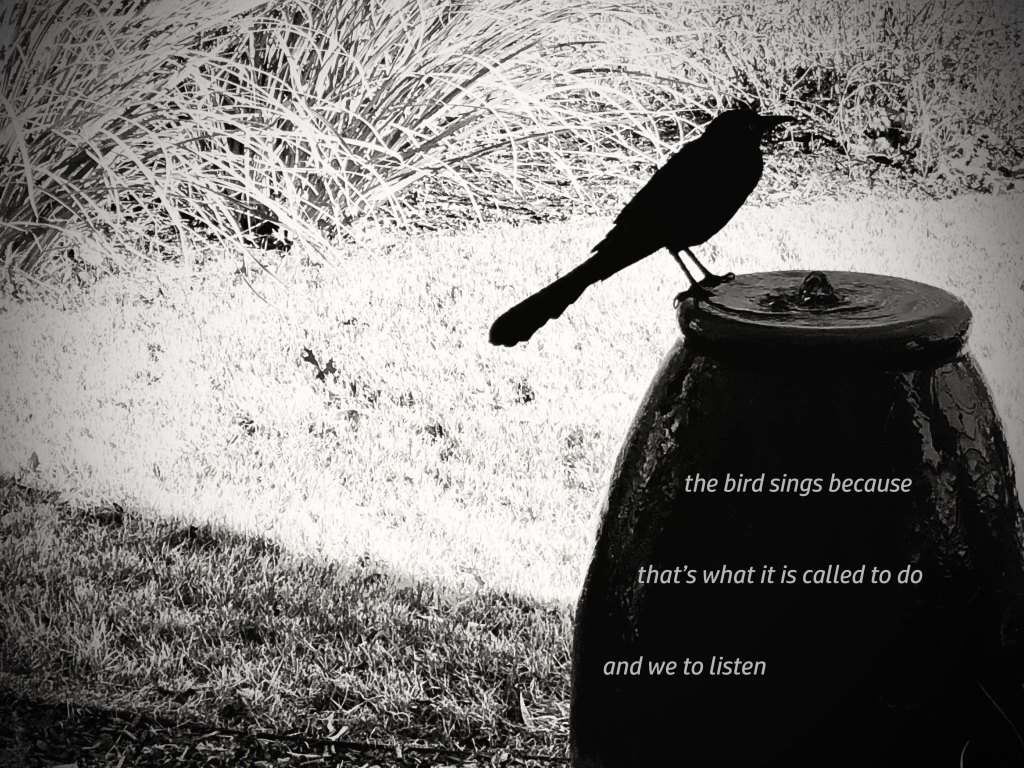
A “from the front door” view of the front yard fountain that also serves as a stage, bath and watering hole for the birds — particularly the noisy grackles.
Reading Howard Thurman’s Deep Is The Hunger today in which he discusses forgiveness, I am reminded of the C. S. Lewis quote: “Everyone thinks forgiveness is a good idea, until he has to give it.” Thurman provides insight as to why that is true — why forgiveness can be so difficult. First, he notes: “Every person stands in need of forgiveness.” Forgiveness is a universal need that is indifferent to race, gender, or age, or any other classification you want to toss into the ring. That being so, unlike so much else in life, we all, by personal experience, understand the significance of forgiveness. When we start walking in the field of forgiveness, we know the stakes or high. Thurman identifies the heart of the difficulty: “forgiveness is possible between two persons only when the offender is able to stand inside of the harm he has done and look at himself as if he were the other person.” There it is — forgiveness is difficult because it calls upon the offender (let’s say, hypothetically, me) to understand, and to some extent suffer, the very wrong inflicted on the offended. Who wants to do that? Which is, I guess, the underpinning of Thurman’s last sentence on this: “There is scarcely a greater test of character than forgiveness.”
Photo taken on a recent walk in Scottsdale, Arizona. Text is a wonderful prayer within Mary Oliver’s Six Recognitions of the Lord.

Reading today, Thich Nhat Hanh conveys this story, which seems to ring true in my life:
A person is speeding down the road on a galloping horse, apparently in a hurry to get somewhere important. A second person is walking down the road and yells out as the rider passes and speeds on: “Where are you going in such a hurry?” The second replies: “I don’t know. Ask the horse.”
“Ask the horse.” Life feels like that a lot, hurrying, working frantically to get to — well, I’m not quite sure where, or perhaps I have nominally identified a “where” but not really defined it well. Perhaps the destination is “success” or “enough,” or ….
The “horse” in the story, according to Thich Nhat Hanh, is named “habit energy,” after those mindless tendencies we follow without really thinking them through. But he also offers us the solution, the “reins” so to speak: “Mindfulness is the energy that allows us to recognize our habit energy and prevent it from dominating us.
“Where are you going in such a hurry?”
Photo taken under Pleasure Pier (formerly, the Flagship Hotel) in Galveston.

 It occurs to me...