One to chew on from Howard Thurman, Deep Is The Hunger:
“One reason why high dedication is so difficult is to be found is the fact that it is extremely arduous to formulate for oneself a purpose that is sufficiently high to be challenging and, at the same time, capable of demanding the consent of both one’s mind and heart. To so much, one’s heart may say “yes” while the mind says “no.” War at one’s center — this is the tragedy of modern man.”
A lot to digest here, but it occurs to me that this is, indeed, where the daily “battle” is often fought.
…I held my breath as we do sometimes to stop time when something wonderful has touched us….”
I’ve never thought of those breath-holding moments in that way, an effort to stop time, but it fits. Immediately on being overtaken by that sense of wonder, we take that deep breath and hold it, as if in doing so we can freeze the moment in time. And while we can’t stop time, thankfully, most of those moments, at least some of them, are stored in a virtual photo album lodged deep in the recesses of the mind. It is as if the deep breath depresses the button and the camera of the mind does its thing. We can, as we choose, pull those memories out and at recall the moment “something wonderful…touched us.”
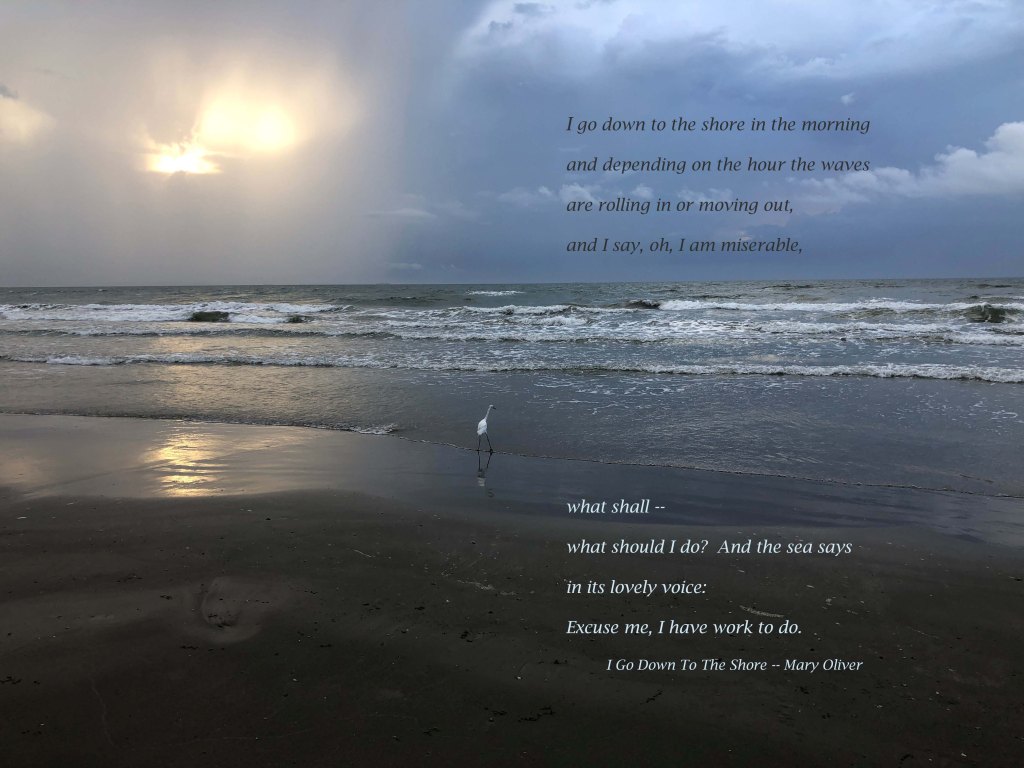
Photo taken this year in Galveston, text, as noted, from Mary Oliver.
I like the thought that as I stand on the shore releasing work-related stress (hypothetically speaking, of course), the ocean is looking back, a little annoyed at the disruption of its work.
Howard Thurman is in deep territory in today’s reading (Deep Is the Hunger). He writes of a “sense of fancy” and notes that this is “the particular gift of little children” – fairies, Santa Claus, talking with dolls – this is normal in children but (I love this line) “if this sort of thing persists into manhood and womanhood, the individual may be regarded as being somewhat off-balance.” That said, Thurman notes that as adults we must hold on to a “developed sense of fancy” which he describes as “the ability to envision things in terms of their highest meaning and fulfillment, even as one grapples with them in the present as they are.” A tall order indeed, to see things as they are, yet also see them as they might be. But there is method to his madness:
“A developed sense of fancy illumes the dark reaches of the other person until there is brought to light that which makes for wholeness and beauty in him. This is what God is doing in human life all the time.”
Indeed, it must be, or God would have given up on us long ago.
Quote from the Archbishop of Canterbury, Justin Welby overheard in a podcast:
“You don’t think about what the right thing to do is. You think about being alongside someone where everything is not right.”
A good reminder for me that it is easy to get so focused on doing the “right thing” that Ifail to do anything, and that the right thing starts with “being there” alongside, in whatever form that may take.
If you have time, I recommend you listen to the whole conversation between Welby and Kate Bowler — an hour, but an hour well spent. I get a kick out of interviews (conversations, really) in which it is difficult to tell who is interviewing whom. This is clearly one of those.
Cloud photo from who knows where. The phrase “world of particulars” is one I jotted down some time ago after hearing it, and it has been rolling around in my head — now passed along to you.
C. S. Lewis’ writing on the subject of pride has always stood out to me, but he has a rival in Howard Thurman. From Thurman:
“Pride and arrogance are always with us seeking to exert their pernicious influence in what we say and how we say it, in what we do and how we do it. No one of us escapes. Often we find ourselves most completely influenced by pride when surest that we are most self-effacing and humble. For the subtlest pose is that of humility and apparent willingness to be considered least of all.”
That last sentence is a masterful use of words, so piercing, so convicting – “For the subtlest pose is that of humility and apparent willingness to be considered least of all.”
___
Now, a less serious addendum that speaks to how my mind works, or doesn’t:
That said, Lewis and Thurman get a run for their money from the great Austin Lounge Lizards and these lines from their classic, Another Stupid Song About Texas:
“By God we’re so darn proud to be from Texas
Even of our pride we’re proud, and we’re proud of that pride, too
Our pride about our home state is the proudest pride indeed
And we’re proud to be Americans, until we can secede.”



 It occurs to me...