Photo taken on an early morning run in Galveston.

Photo taken on an early morning run in Galveston.
Wisdom from Howard Thurman:
“All of us must accommodate ourselves to the simple fact that we are not so young as we once were, and thus take life in the stride belonging to the years we have lived.”
I love that. So much subtlety to explore there. We must “accommodate ourselves” to aging. Not fight it, not resist it, not ignore it, but “accommodate ourselves” to it. It is, after all, part of us, and we part of it. And it is accommodation, not giving in, not resigning ourselves to it, but accommodate ourselves” to the years we have lived, and how they have been lived. But it gets better. We are, of course, as old as we numerically are. We have been around that many years, but Thurman is not telling us to “act our age.” No. Age aside, we each have a “stride belonging to the years we have lived,” and that defines how we are to live, to age.
Of course, those may just be the wistful ramblings of an old fart.
Photo taken of a wall of the Henley Building in Galveston. Thought has been rolling around in my head recently as things unfold.

I started reading Wallace Stegner’s Crossing to Safety. I say “started reading” because I am so captivated by the first chapter that I keep rereading it. A bit foreboding, perhaps, and some might say dark, even, perhaps, morose, with lines like these (writing of a group of close friends): “What ever happened to the passion we all had to improve ourselves, live up to our potential, leave a mark on the world?….Leave a mark on the world. Indeed, the world left marks on us.”
There is that trade off, it seems. The more one wants to “leave a mark on the world” the more one is exposed to being “marked up” by the world. And perhaps that is why I am skittish about moving on to Chapter 2.
From A Distance popped up on my playlist recently, a great song by Julie Gold, made popular by Nancy Griffith, then Bette Midler. The song rattled around in my head a while. The photo is of the kazoo that sits on a shelf in my home office, proving the point that one never knows when a kazoo will come in handy.

Photo taken recently while attending some work related lab work. I thought the contrast in material was interesting.

Howard Thurman strikes a chord today when he writes about “the fine art of gracious living.” Of it he writes: “It is the antidote to much of the crudeness and coarseness of modern life.” It is the way to combat “the supercilious flippancy used as the common coin of daily intercourse.”
That sent me to the dictionary as I had not seen/heard the word “supercilious” in so long I wanted to make sure I understood it. Webster defines it as “coolly and patronizingly haughty” whereas the online dictionary defines it as “behaving or looking as though one thinks one is superior to others.” What a great word, though I am concerned that is using it, one becomes it.
That aside, pick either definition. Thurman, as usual, has it correct. “The fine art of gracious living” is a good prescription for the “crudeness and coarseness of modern life.”
And since I have the dictionary open — per Websters: “Gracious” – “marked by kindness and courtesy.”
Indeed, particularly today, a little of that goes a long way, always has, always will.
The words aren’t quite there, but sometimes a photo does just fine without them, perhaps better. Sharing this photo taken in Galveston in April.

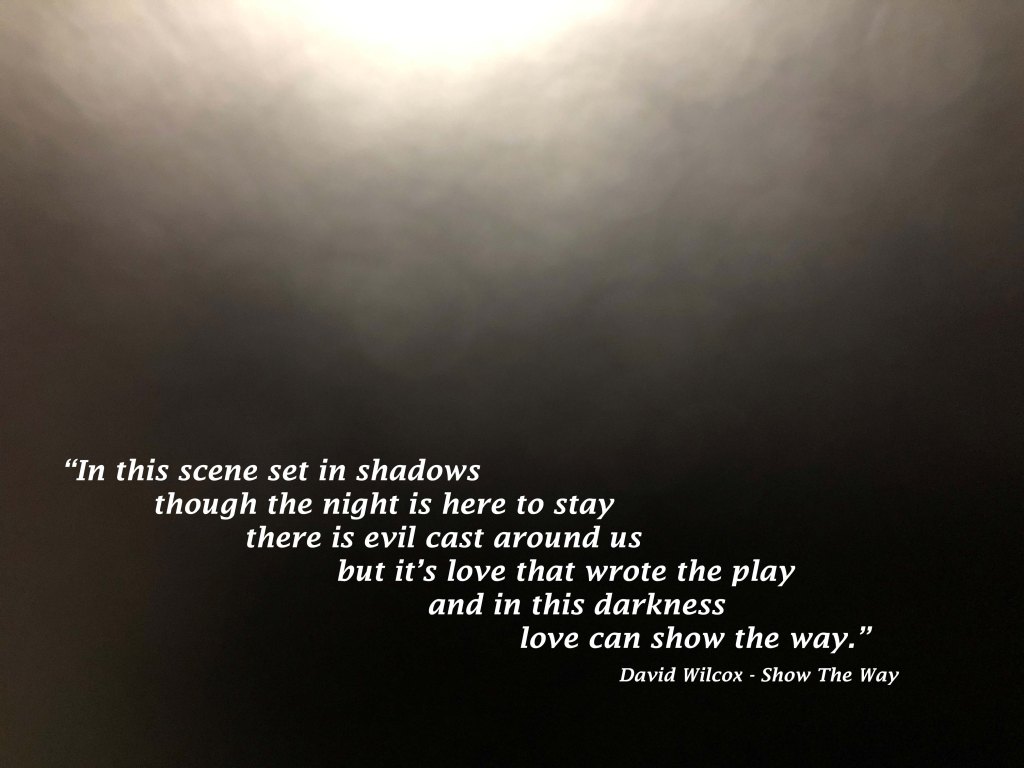
In times, on days, like these, I take solace in the lyrics of this David Wilcox song. It doesn’t fix things, but it gives me hope.
From. St. Augustine:
“Thou hast made us for Thyself and our souls are restless ‘til they find their rest in Thee.”
Quoted by Howard Thurman after (as the answer to) this:
“Whether your childhood was sad or happy as you look back upon it, there is one thing that is true. There were moments of intense and complete joy, which for the instant left nothing to be desired…. Do you remember? It was a foretaste of something for which you would be in quest all the rest of your days….”
 It occurs to me...