Another of those accidental photos that sit in my camera a while until they meet some text. The text is a jotted down line from a Kate Bowler podcast (Everything Happens).

Another of those accidental photos that sit in my camera a while until they meet some text. The text is a jotted down line from a Kate Bowler podcast (Everything Happens).
Today from Howard Thurman, this deceptively simple sentence of eight short words:
“We seem always to be on our way.”
This sent me back to one of my favorite quotes from Barbara Brown Taylor’s An Altar To The World:
“No one longs for what he or she already has, and yet the accumulated insight of those wise about the spiritual life suggests that the reason so many of us cannot see the red X that marks the spot is because we are standing on it. The treasure we seek requires no lengthy expedition, no expensive equipment, no superior aptitude or special company. All we lack is the willingness to imagine that we already have everything we need. The only thing missing is our consent to be where we are.”
Let’s string two of those sentences together:
“We always seem to be on our way.” “The only thing missing is our consent to be where we are”
Photo recently taken in Galveston. Text lifted from Psalm 118.

Buried within the lines of Mary Oliver’s The Buddha’s Last Instruction, there three lines I hung on to:
“clearly I’m not needed
yet I feel myself turning
into something of inexplicable value.”
It occurs to me that one begets the other, that we first need to understand we are “not needed” (humility) before we can attain “inexplicable value.” No new thought here, this recurring theme in all great philosophies and religions — to win you have to lose, to attain you have to give up, to reap you have to sow, to hold on to you have to let go. You’d think I’d/we’d understand this a bit better by now.
Just a random thought today on language, or since I only know one, perhaps I should limit it to English. Like many things, we take something simple and make it complicated. Take the simple four-letter word – “hard.” Simple? As an adjective, it has, in Webster’s, fourteen definitions, depending on whether you are referring to hard liquor, hard money, hard evidence, hard detergent, hard eyes, hard water, or even hard language. And that doesn’t even get you to the adjectives. No wonder it is so hard (as in “difficult”) to say what we mean and mean what we say.
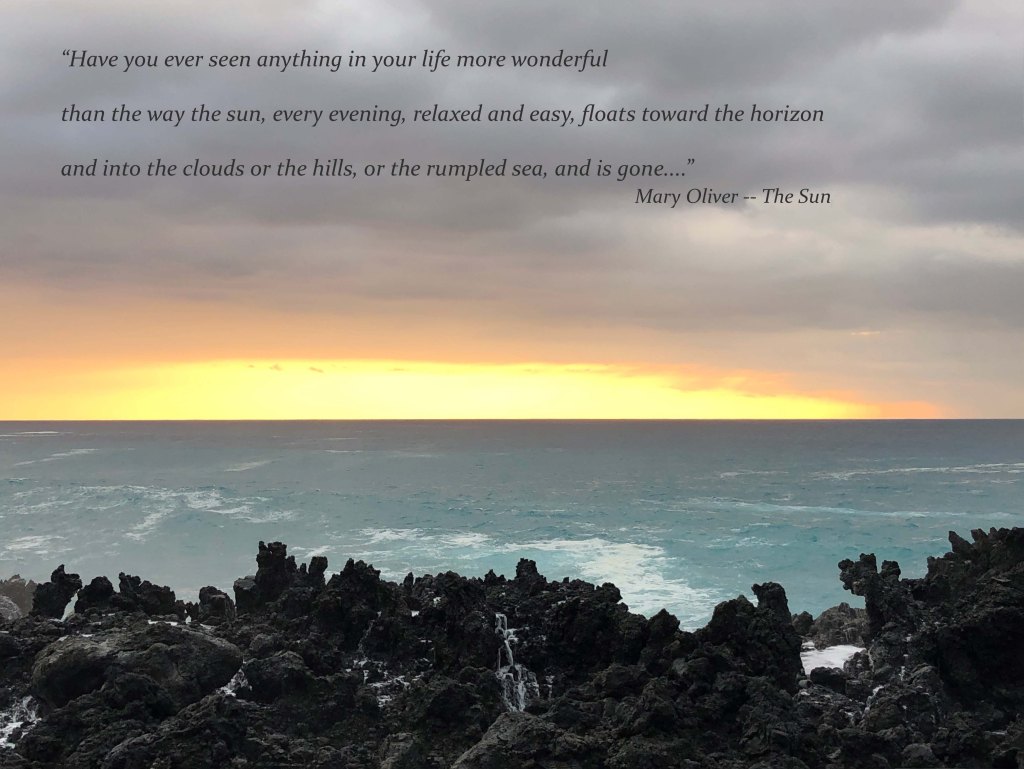
More from Mary Oliver’s The Sun:

Riding my bike along Seawall in Galveston today I heard an exasperated parent use this line with one of his kids. I am sure I used it long ago with my kids, but the absurdity of the line (its hubris and illogic, among other points) hit me today as I heard it.
Photo is just a filtered black background.
Much to think about today in Mary Oliver’s October, including this tricky little question:
“What does the world mean to you if you can’t trust it to go on shining when you’re not there?”
On the one hand I have the ability to think that the world will do just fine without me. (There is, after all, empirical proof of that since it did okay for a few years before me, and I have seen it continue to function as some depart.) On the other hand (there always seems to be another) I worry about how the hell things can possibly function without me. (Okay, hubris and hyperbole, but still, I think you get the point. I worry.)
Of course the world with “go on shining” when I am not. All the more reason, as if one needed it, to focus less on “me” and more on “the world.”
Photo taken in Kona early this year. Poem excerpt from Mary Oliver.
In one of those situations where the writing is both tongue-in-cheek and viciously pointed, Howard Thurman takes on Self-Righteousness Anonymous.
“It is an organization without structure, without form, without location, and without offices. Every person who belongs to it holds all the offices at one and the same time, for each member is the organization. It is a very old group, as old as the first mistake.”
I’ve heard about this organization [throat clear]. How does one identify members? Anonymous:
“In every discussion their word must be taken at its face value. Others may have to prove what they say, make a clear case for their position; not so with S. R. Anonymous. When he speaks, Truth has spoken. When he is tolerant, it is a benevolent toleration, the kind that a German police dog may have for a poodle pup. To be sure, mistakes may occur…but they are always due to extenuating circumstances for which someone else is responsible.”
Thurman rightfully notes that all of us are candidates for membership in Self-Righteousness Anonymous, benevolently omitting the suggestion that some may have attained a lifetime membership, but at the same time Thurman kindly suggests how one can easily cancel one’s membership: “One of the sure results of self-examination in the light of the Highest is an immediate humility and a canceling of one’s membership in Self-Righteousness Anonymous.” There it is again! That recognition that the world does not, in fact, revolve around me always shakes things up.
 It occurs to me...