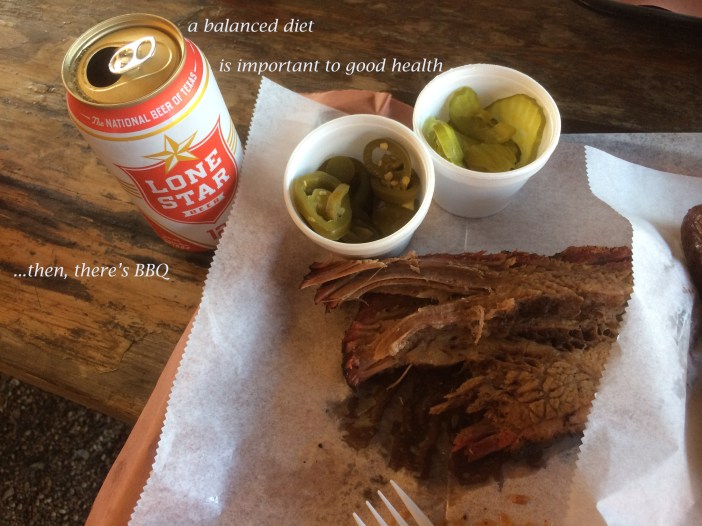
 Just like it is difficult to choose between brisket and sausage, it was difficult for me to choose a text — so I choose both. Photo taken at Snow’s BBQ in Lexington, Texas this past week.
Haiku of the Whenever
Stuff
“[W]e brought nothing into this world, and we can take nothing out of it.” 1 Timothy 6:6
There it is as cold as truth can be. I come in with nothing and leave with nothing. My stuff is, well, just stuff. I ain’t taking it with me when I leave. Granted, it may become someone else’s stuff, but it won’t be mine any more, only something that used to be mine. So if life ain’t about the stuff….
Dreaming and Doing
Dreaming and Doing
Today Oswald Chambers writes of dreaming and doing. “Dreaming about a thing in order to do it is right; but dreaming about it when we should be doing it is wrong.” A perfectly thought out plan is of little use to anyone unless and until it is put into action. Well, the plan may impress me, and I may take some pride in my being able to come up with such a clever plan, but that is about all one can squeeze out of it. The juice is in the execution of the plan. Suppose, on seeing a drowning man, I think quickly and devise a foolproof plan on saving him. The plan is of little use unless and until it is executed. Which takes us to Chambers’ punchline – [A]lways beware of giving over to mere dreaming when once God has spoken. Leave Him to be the source of all your dreams and joys and delights, and go out and obey what He has said…. Dreaming after God has spoken is an indication we do not trust Him.”
What plans do I have sitting on the shelf that God has led me to, helped me devise? Perhaps it is time to check the expiration date on them.
Desiderata 2
“Speak your truth quietly and clearly; and listen to others, even the dull and ignorant; they too have their story. Avoid loud and aggressive persons, they are vexations to the spirit.” Desiderata, Max Ehrmann
When I read this I always note the duality that runs throughout. We are to speak AND listen. When we speak (implying that we are to make rational choices regarding WHEN to speak) we tell our story “quietly and clearly.” Lots of duality there. Which in turn reminds me of the duality of Wilson Mizner’s quote: “A good listener is not only popular everywhere, but after a while he knows something.”
Everyone has a story — Everyone. We are called to speak ours, and called to listen to others’. It is in speaking and listening that we connect our stories. The speaking and the listening are the thread and the needle that help us bind our scraps of cloth together to make this patchwork quilt we call humanity.
More Love
On this Valentine’s Day, these song lyrics comes to mind, and if I am lucky, they will stay there:
From Darrell Scott and Tim O’Brien:
“More love, I can hear our hearts cryin’, more love, I know that’s all we need, more love, to flow in between us, to take us and hold us and lift us above, if there’s ever an answer it’s more love”
From Kate Wolf:
“Give yourself to love, if love is what you’re after. Open up your hearts to the tears and laughter. Just give yourself to love. Give yourself to love.”
From Burt Bacharach and Hal David:
“What the world needs now, is love, sweet love. It’s the only thing, that there’s just too little of.”
The Joy of Finding
The Joy of Finding
At the recommendation of a friend I read a New Yorker article recently – When Things, Go Missing, by Kathryn Schulz. http://www.newyorker.com/magazine/2017/02/13/when-things-go-missing Give it a read. In it the author writes on two kinds of loss, loss of things (misplaced keys, jewelry, etc.) and loss of people (death). While both are, in our language, considered a loss, in this article, the former, loss of things, is labeled as “disappearance,” while the latter, the loss of people, is labeled as “loss.” The distinction makes both physical and metaphysical sense. While my keys are “lost” in the sense that I can’t find them, they still exist and are fully functional. If someone else finds them they can use them to start and drive off in my truck. My lost cell phone did not vaporize, it exists, I just don’t know WHERE it exists. If someone finds the $20 bill I dropped, it spends for them as well as it would have for me. Schulz puts it better than I can:
“With objects, loss implies the possibility of recovery; in theory, at least, nearly every missing possession can be restored to its owner. That’s why the defining emotion of losing things isn’t frustration or panic or sadness but, paradoxically, hope. With people, by contrast, loss is not a transitional state but a terminal one. Outside of an afterlife, for those who believe in one, it leaves us with nothing to hope for and nothing to do. Death is loss without the possibility of being found.” [To set theological arguments aside here, I’ll simply add “…on this earth” after “found” here.]
In the end, and though it would be impossible to do so while I am in the midst of looking for/mourning the “disappearance” of my keys, lost phone, or that $20 bill, Schulz convinces me that “disappearances” can, if I let them, be a blessing, because they can remind me of the transience of life. These “disappearances” along the way can prepare me for and help diminish (though not prevent) the sting of real “loss.” The key, she notes, if to recognize that the blessing is in the finding:
“[W]e will lose everything we love in the end. But why should that matter so much? By definition, we do not live in the end: we live all along the way. The smitten lovers who marvel every day at the miracle of having met each other are right; it is finding that is astonishing. You meet a stranger passing through your town and know within days you will marry her. You lose your job at fifty-five and shock yourself by finding a new calling ten years later. You have a thought and find the words. You face a crisis and find your courage.”
Indeed, “it is the finding that is astonishing.” Schulz notes that if I let it, disappearance reminds me to notice the world around me, to count my blessings. These “disappearances” can “serve as a kind of external conscience, urging us to make better use of our finite days.” Schulz closes with these beautiful words: “[O]ur brief crossing is best spent attending to all that we see: honoring what we find noble, denouncing what we cannot abide, recognizing that we are inseparably connected to all of it, including what is not yet upon us, including what is already gone. We are here to keep watch, not to keep “ Amen.
Desiderata 1
I keep having this recurring thought that we in the United States seem to have a lot of collective angst right now. It is as if everyone is leaning forward, listening intently, ready, waiting, and perhaps in a strange way, relishing the next opportunity to pounce on someone, something, something done or said. Maybe I overstate this. Maybe I am just imposing my own thoughts and feelings on the rest of my fellow Americans. But in any event, that comes to mind as I read the beginning of Max Ehrmann’s Desidrata this morning.
“Go placidly among the noise and haste, and remember what peace there may be in silence. As far as possible, be on good terms with all persons.”
That opening line “go placidly among the noise and haste,” is such a great line to start off with. There is always, it seems, “noise and haste” to “go placidly” through if one chose to react that way, but it seems that these days I share with many others the inclination to jump into the fray and add to the din. Here, Ehrmann posits that perhaps the better response is to hold the comment, the criticism, the sarcasm I have in my head and on the tip of my tongue, and choose instead to “be on good terms” with those around me. It is not like Ehrmann is suggesting saint-like effort on my part – he gives me the “as far as possible” out. It occurs to me that much in my life and in my relationships is governed how far “as far as possible” is at any given moment.
Be the Candle
I have seen it enough times that it ought to be (pun intended) burned into my mind, but each time I see it I am amazed and inspired all over again. You have been there. A bunch of people in a darkened room, everyone holds a candle but there is only one lit candle. Another candle is lit from that one, then another from that one, until the whole room is well lit by all the candles. That process is usually accompanied by music. But whatever music is playing I always hear Pass It On by Kurt Kaiser:
“It only takes a spark, to get a fire going, and soon those all around can warm up to its glowing. That’s how it is with God’s love, once you experience it. You spread His love to everyone. You want to pass it on.”
Be the candle. Protect the flame. Pass it on.
Haiku or Whatever of the Whenever
Photo taken on Galveston beach a while back. Song in my head this morning.

 It occurs to me...