Photo taken while perusing the meat counter at the local grocery store.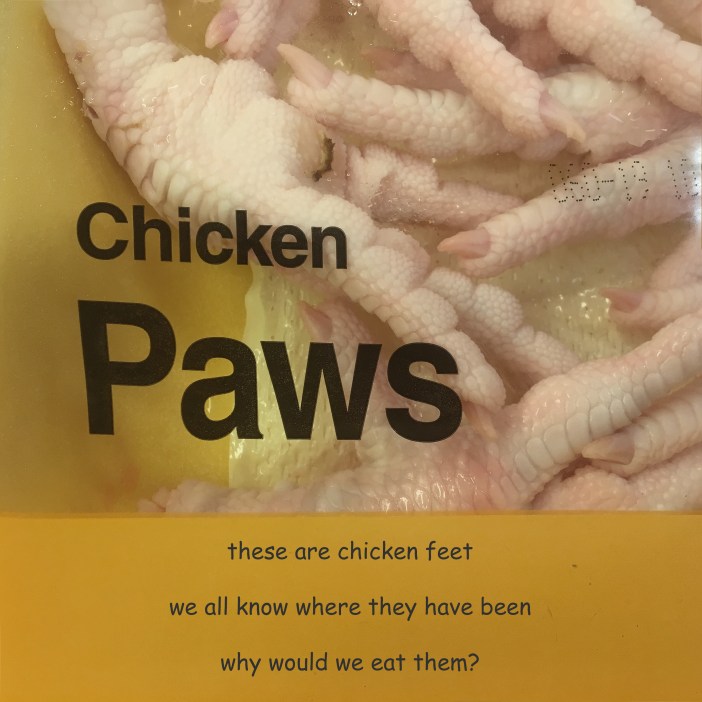
Author: itoccurstocp
Enjoy It In Peace
On “enough:”
For the sake of remaining ‘at the top of our game’ we maintain a system that continues to celebrate acquisitiveness at the expense of enjoyment.” Robert & Edward Sidelsky
There is, it seems, this compulsion to grow, to do better, to improve. I am not sure I can call it a “natural” or innate” compulsion as opposed to one ingrained in us by societal pressures. Nowhere is it more apparent than in the financial or corporate world, where there is a constant push to grow, do better, to improve. There is this push for economic growth. A $50,000,000,000 company should be striving to become a $100,000,000 company. A 1% growth needs to be a higher rate of growth. We can’t just maintain the status quo in a good economy (so we call that “stagnation” and attach the negative image of putrid, scum covered water) but must strive for “economic growth” (imaging flowers budding out in springtime). Indeed, the phrase” good enough” even if thought, is rarely uttered.
This all seems summed up in this from Pope Paul VI: “What is the meaning of this never-ending, breathless pursuit of a progress that always eludes one just when one believes one has conquered it all sufficiently in order to enjoy it in peace?”
To me, this conjures up the image of running or cycling, looking ahead while steadfastly climbing a hill, focused on getting to the top – only to find out when I get there that there is yet another hill in front, and another, and another. Or borrowing from one of my favorite sayings, the image of climbing the ladder of success only to find that it was leaning on the wrong wall.
The key phrase that gets glossed over in all this – “enjoy it in peace.” Onward!
A Life Roughly Right
Occasionally, things I am reading converge. This may be happenstance, but it seems to deserve some special attention in any event. Today’s convergence is, I guess, the equivalent of a hat trick:
Aristotle – “It is the mark of an educated person to look for precision in each kind of inquiry just to the extent that the nature of the subject allows it.”
John Maynard Keynes – “It is better to be roughly right than precisely wrong.”
We strive for perfection yet we celebrate our sports heroes for being good enough, not perfect. A 0.300 batting average, a 90% free throw average. But in our neurosurgeons, however, a higher “batting average” is expected, particularly if it is me they are operating on. Unless one considers the Aristotle quote, how confusing this might be for a neurosurgeon who moonlights as a baseball player (okay, who plays beer league softball on Wednesday nights).
Which leads to the hat trick — this from Rachel Remen: “Once we stop demanding of ourselves that we be on course all the time we might begin to look at our mistakes differently…. They will not prevent us from reaching our dreams nearly so much as wanting to be right will.”
Stated another way, it occurs to me that notwithstanding wishes to the contrary, the “nature of the subject” of life doesn’t lend itself to being precisely right so much as “roughly right.” But I could be dead wrong about that.
Guest House
From Coleman Banks, this translation of Rumi – The Guest House:
“This being human is a guest house. Every morning a new arrival…. Be grateful for whoever comes, because each has been sent as a guide from beyond.”
Such strong imagery, such a message. “Be grateful for whoever comes, because each has been sent as a guide from beyond.” A reminder that for all the efforts to prove otherwise, there is much I do not, cannot, know. This thought occurs to me today: Which is more important: a) what I do with what I do know, or b) what I do with what I don’t know?
Mystery
Answers and certainty, that’s what I like, what I want. Perhaps that is why I don’t care for the word “mystery.” At best it seems like a cop out, a deflection, a way not to answer the question, as in “It’s a mystery!” At its worst, “mystery” seems like an admission of failure, the shorter equivalent of “I don’t know” which can be understood as “I couldn’t/can’t figure it out.” And, damn it, shouldn’t I, in this Google-age, know or at least be able to figure it out, whatever “it” is?
In her essay on “Mystery” Rachel Remen approaches mystery from a different perspective:
“Perhaps real wisdom lies in not seeking answers at all. Any answer we find will not be true for long. Any answer is a place where we can fall asleep as life moves past us to its next question. After all these years I have begun to wonder if the secret of living well is not having all the answers but in pursuing unanswerable questions in good company.”
Elsewhere she notes: “Mystery requires that we relinquish an endless search for answers and become willing to not understand.”
In all this it occurs to me that if I can come up with answers for all of the questions I have, then I should consider asking some different questions. Knowledge may be found through the Google search engine, but not wisdom.
But I do like that thought, “pursuing unanswerable questions in good company.”
Great Is Thy Faithfulness II
An encore verse to yesterday’s Great Is Thy Faithfulness portion:
“Pardon for sin and a peace that endureth, Thine own dear presence to cheer and to guide. Strength for today and bright hope for tomorrow. Blessings all mine, with ten thousand beside. Great is Thy faithfulness. Great is Thy faithfulness. Morning by morning new mercies I see. All that I needed Thou hand hath provided. Great is Thy faithfulness Lord unto me.”
There’s a great bumper sticker: “Strength for today and bright hope for tomorrow.”
Great Is Thy Faithfulness
Today this popped into my mind. Always a welcome tune:
“Great is Thy faithfulness, Oh God my Father, there is no shadow of turning with thee. Thou changest not, Thy compassions they fail not. As Though hast been Thou forever shall be. Great is Thy faithfulness. Great is Thy faithfulness. Morning by morning new mercies I see. All that I needed Thou hand hath provided. Great is Thy faithfulness Lord unto me.”
Indeed. Great is Thy faithfulness!
The Purpose of Life
Reading more in Rachel Remen’s My Grandfather’s Blessings I had this thrown into my path: “Is it possible that there may be an unknowable purpose to life itself?” In the list of deep questions, that one may be among the deepest, right next to “What is the meaning of life?” –but still, it seems worth pondering even if it makes my head hurt. All that comes to mind now is the old Gospel tune:
Farther along we’ll know all about it
Farther along we’ll understand why
Cheer up my brother live in the sunshine
We’ll understand it all by and by…
Remen states it this way: “At the moment there was a great silence around that question. There is a great question around it still.”
Haiku of the Whenever
 Photo taken in Galveston recently.
Let All Mortal Flesh…
Now and again I get reintroduced to hold hymns. I say “reintroduced” because they are often hymns I heard as a kid, and while I am quite familiar with the tune, I never really paid any attention to the words, or no more attention than to be able to recite the opening line or the “tag line” for the song. So it was recently with this oldie that even predates me – it goes back to the second or third century:
Let all mortal flesh keep silent,
And with fear and trembling stand
Ponder nothing earthly minded,
For with blessing in his hand,
Christ our God to earth, descending,
Our full homage to demand.
This is one of those hymns where the music and lyrics are perfectly matched. Listening to the chant-like lyrics, the organ rattling the timbers, I can almost smell the incense, and hear the rustling of the nuns’ clothing as they make their way to my pew to force me to kneel erect (i.e. get my ass off the front edge of the pew.) Ah, memories…!
 It occurs to me...