Live each day assured by the certainty that the blessings are too many to count and the troubles too few to worry too much about.
Author: itoccurstocp
The Reluctant Innkeeper
These days I find myself going back a lot to The Guest House, the Coleman Barks translation of a writing by Rumi.
This being human is a guest house.
Every morning a new arrival.
A joy, a depression, a meanness,
some momentary awareness comes
as an unexpected visitor.
Welcome and entertain them all!
Even if they are a crowd of sorrows,
who violently sweep your house
empty of its furniture,
still, treat each guest honorably.
He may be clearing you out
for some new delight.
The dark thought, the shame, the malice.
meet them at the door laughing and invite them in.
Be grateful for whatever comes.
because each has been sent
as a guide from beyond.
It is difficult to think of myself as an innkeeper whose house/life is open to anyone, anything. After all, I am the owner; I’m in charge here, aren’t I? This is my place, my routine, my life. Don’t I get to pick my guests? It is more difficult to entertain the thought that I am to “welcome and entertain them all.” I mean it is bad enough that they (whoever or whatever “they” are) just showed up unannounced and uninvited, but now they are imposing on me and what I had planned. But most difficult of all is the thought that I am to be grateful for the interruption and inconvenience. Grateful?
But of course the twist here is that whether I recognize it or not I am a one of “them,” a “they.” And while you’d never know it from my incessant whining, I am a “guest” as much or more than I am the “homeowner.” I mean the population of this earth, with one trifling exception, is made up of others. What occurs to me here as somewhat of a sequel to The Guest House is this from Robert Louis Stevenson:
“Wherever we are, it is but a stage on the way to somewhere else, and whatever we do, however well we do it, it is only a preparation to do something else that shall be different.”
Which is of course where the “guests” come into play. They are my guides to the somewhere or something else — if I let them be.
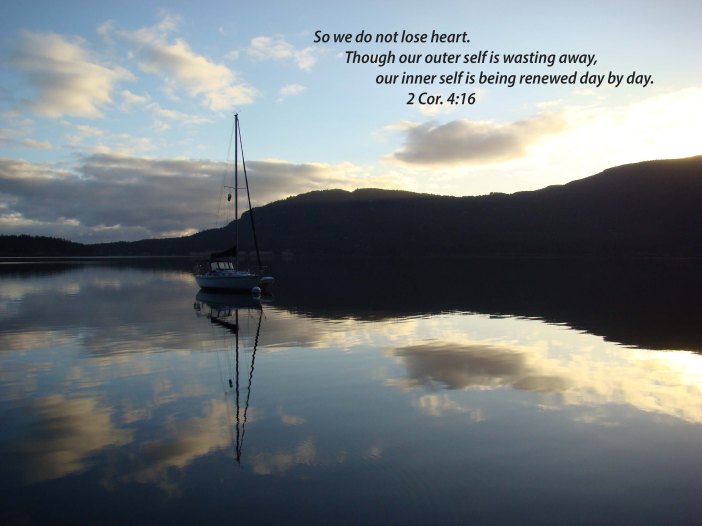
So we do not lose heart
Photo taken a few years back in the San Juan Islands. Timeless text.
Zoom, Communication & Connection
Zoom.* We think of language at this huge behemoth that changes at glacial speed, but it occurs to me today how quickly lexicon can change. A year ago, less for most, “zoom” meant to go fast or to focus in. Today, “Zoom” means to hold a videoconference. And as I have had more and more Zoom experiences in the past month the same question rises in my mind that occurs each time I witness (and in some cases, experience) the rise (and sometimes fall – remember MySpace?) of every such software program that comes along (think Facebook, Instagram Pinterest…) – these are indeed methods of communication, but are they ways we will, in a true sense, connect?
The answer, of course, is that “it depends.” It depends on the nature of the communication and whether it rises to the level that allows people to connect in something more than an electronic sense, more than a superficial, “drive by” sense. Two tin cans and a string provide a method of communication and can provide a connection between two (but only two, I guess) people. Zoom can facilitate communication among many more. I suppose the question of whether it facilitates connections between and among people is up to us.
* Note that on my first Zoom experience I was so impressed by the Zoom technology and its ability to facilitate business communication that I bought a membership and bought stock in the company. This post should not be interpreted to promote my financial self-interest — no way!
Renewed day by day
“So we do not lose heart. Though our outer self is wasting away, our inner self is being renewed day by day.” 2 Cor. 4:16
Indeed it is. It occurs to me that this renewal occurs organically, whether I want it to or not. My choices are whether I want to step in and help, if so, how.
Time
“[M]an can neither make nor retain one moment of time; it all comes to him by pure gift; he might as well regard the sun and moon as his chattels.” C. S. Lewis – The Screwtape Letters
Lewis is, of course, correct. I don’t own or control time – damn it!
Haiku of the Whenever
Photo taken on UT campus. I run by these from time to time.
O Lord
The word “hope” seems to be experiencing a revival these days. Thinking on that this morning these two quotes came to mind:
“So we do not lose heart. Though our outer self is wasting away, our inner self is being renewed day by day.” 2 Cor. 4:16
“This is another day, O Lord. I know not what it will bring forth, but make me ready, Lord, for whatever it may be.” In the Morning – Book of Common Prayer
I have always liked the Book of Common Prayer passage, particularly for the versatility of the “This is another day, O Lord” part. Some days I say the “O Lord” in a prayerful way; on other days it comes out more as a statement of exasperation and dread. – “Oh Lord!” It is particularly in those latter “O Lord!” days that I need to be reminded that while the “outer self” may, as I see it be “wasting away,” when it looks like things are really turning to (or already are) #%*!, I need that belief/hope that the “inner self is being renewed day by day.”
“So we do not lose heart.”
Morning Prayer
Photo of my home office desk.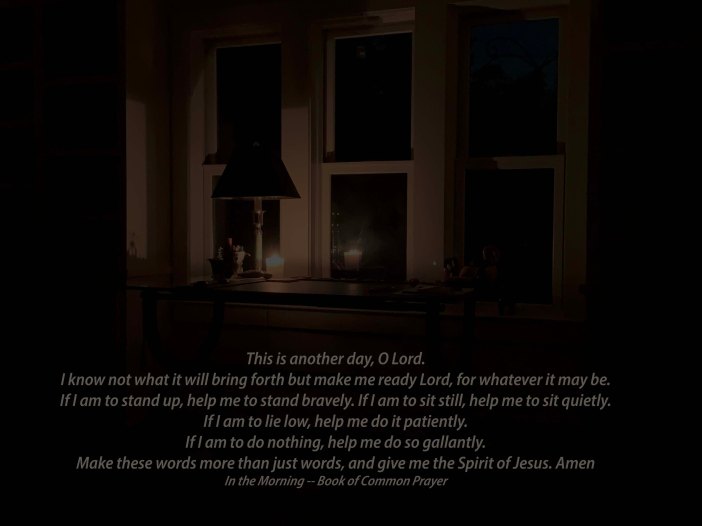
John Prine
Singer/songwriter John Prine died last night. I can’t really remember the first time I heard a John Prine song. I assume it was some time in my teens, but for at least fifty years, the answer to the question of when I last heard a John Prine song was likely today or, at most, yesterday. I am reminded of the old Wolf brand chili commercial and offer this take: Neighbor, how long has it been since you’ve been treated to a John Prine song? [Pregnant pause, and if Prine were saying it, he would clear his throat here.] Well, that’s too long.
Of course, his death will not lessen my listening experiences, will likely increase/enhance them, and he gave us a new album last year, so Prine and his music will remain mainstays in the jukebox that passes for my ears and head. Still, the promise of seeing him perform again is gone, and he will be sorely missed.
Roger Ebert, Kris Kristofferson, Bob Dylan, and countless others have written and attempted to describe Prine’s voice, his music, his appeal, so I won’t even try as I would fail, as would anyone, because his music was more a feeling than anything else. He didn’t appeal to everyone, but I doubt that bothered him a bit because he got to do what he loved doing, which was clear any time you saw him perform. That said, I am partial to an early comment by Kristofferson who is credited with “discovering” Prine. “No way somebody this young can be writing so heavy. We may have to break his thumbs.” Thankfully, his thumbs and that uniqueness remained in place for some fifty more years. And I think Ebert hit the nail on the head when he wrote this after seeing Prine for the first time in the 70s: “He sings rather quietly, and his guitar work is good, but he doesn’t show off. He starts slow, but after a song or two, event the drunks in the room begin to listen to his lyrics. And then he has you.”
Prine and his music had me for half a century, will continue to have me, and for that I am thankful.
“That’s the way that the world goes round, you’re up one day, the next you’re down. It’s a half an inch of water and you think you’re gonna drown. That’s the way that the world goes round.”
 It occurs to me...