Photo taken at moon rise over the park by our house. Text was in my reading for today and seemed to fit.
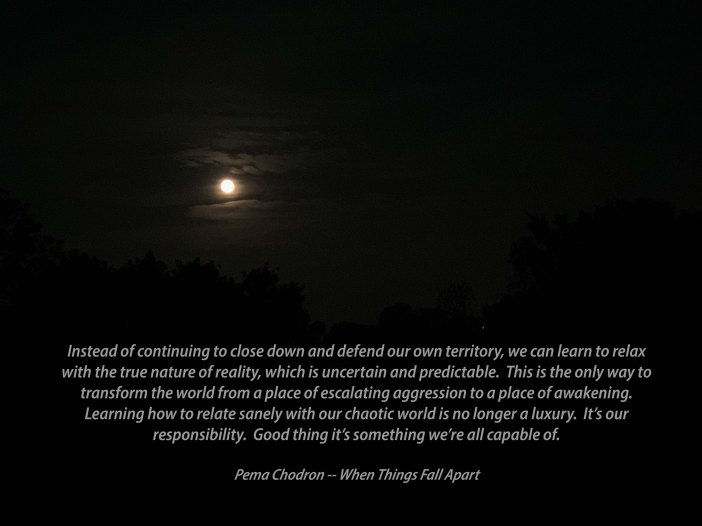
Photo taken at moon rise over the park by our house. Text was in my reading for today and seemed to fit.
In When Things Fall Apart, Pema Chodron writes on how our emotions control us (pleasure and pain, loss and gain, praise and blame, fame and disgrace), particularly when we undertake to eradicate (as opposed to rolling with) them. She writes:
“The human race is so predictable. A tiny thought arises, then escalates, and before we know what hits us, we’re caught up on hope and fear…. Before we know it, we’ve composed a novel on why someone is so wrong, or why we are so right, or why we must get such and such.”
I know I have a library full of those novels, even more short stories, and my head is full of drafts in progress. In not so many words, she suggests a book burning.
“Therefore, we do not lose heart. Though outwardly we are wasting away, yet inwardly we are being renewed day by day.” 2 Cor. 4:16
While true every day, this just seemed like a good thing to hear today.
From Pema Chodron in When Things Fall Apart, this on “refraining”:
“Refraining is one of those uptight words that sound repressive. Surely, alive, juicy, interesting people would not practice refraining. Maybe they would sometimes refrain, but not as a lifestyle…. It’s the quality of not grabbing for entertainment the minute we feel a slight edge of boredom coming in. It’s the practice of not immediately filling up spaces just because there’s a gap.”
I do that a lot, try to fill in the gaps. In conversation (no one likes that awkward silence), in my calendar (productivity, “the idle mind is the devil’s workshop,”…), the empty bookshelf shelf in my office that empty spot in my garden. A lot of time and effort is spent filling in the gaps, as if there is something inherently wrong with a gap. Yet it occurs to me (or perhaps I should say, it seems $%*#@ obvious on reflection) that the gaps are where the peace is. Chodron notes: “It’s a transformative experience to simply pause instead of immediately filling up the space.” Maybe the gap, the space, needs to be filled in, maybe not. Maybe someone else will handle it, or not. This is where the refraining comes in.
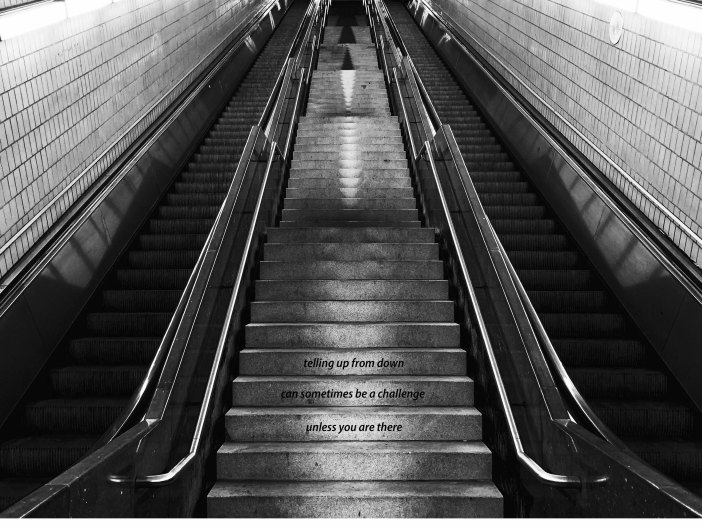
Photo taken at the MARTA Peachtree Center stop on my last travel — what seems long ago and far away. While I knew I was standing at the bottom and looking up, it was a bit disorienting, and looked like an M.C. Escher print. I should note that I did edit this a bit. In reality it is not quite so foreboding.
From Pema Chodron in When Things Fall Apart:
“[F]eelings like disappointment, embarrassment, irritation, resentment, anger, jealousy, and fear, instead of being bad news, are actually very clear moments that teach us where it is that we’re holding back. They teach us to perk up and lean in when we feel we’d rather collapse and back away. They’re like messengers that show us, with terrifying clarity, exactly where we’re stuck. This very moment is the perfect teacher, and, lucky for us, it’s with us wherever we are.”
Chodron goes on to explain that when (not “if”) we get to that place “where you have no choice except to embrace what’s happening or push it away” we are most genuinely in the moment, yet the moment is not so important — at least not as important as what follows, the “what next”, or as my friend Jim Mulford used to say, the “so what.” In those “what’s next” or “so what” moments do we awaken to the reality that “it takes death for there to be birth [or do] we just fight against the fear of death?”
Then comes the hard part:
“Reaching our limit is not some kind of punishment. It’s actually a sign of health that, when we meet the place where we are about to die, we feel fear and trembling. A further sign of health is that we don’t become undone by fear and trembling, but we take it as a message that it’s time to stop struggling and look directly at what’s threatening us. Things like disappointment and anxiety are messengers telling us that we’re about to go into unknown territory.”
Which of course sounds a lot like Paul’s exhortation in Philippians 2:12: “continue to work out your salvation with fear and trembling, for it is God who works in you to will and act according to his good purpose.”
The perfect teachers — fear and trembling!
From Oswald Chambers in today’s reading in My Utmost for His Highest:
“God answers prayer in the best way, not sometimes, but every time, although the immediate manifestation of the answer in the domain in which we want it may not always follow.”
From Mick Jagger:
“You can’t always what you want. You can’t always what you want. You can’t always what you want. But if you try sometimes, you just might find, you get what you need.”
I don’t know, maybe it’s just me, but the mere thought of Mick Jagger and Oswald Chambers being on the same page, heck, even in the same book, is enough to get me through the day with a smile on my face.
From When Things Fall Apart by Pema Chodron:
“When we think that something is going to bring us pleasure, we don’t know what’s really going to happen. When we think something is going to give us misery, we don’t know. Letting there be room for not knowing is the most important thing of all. We try to do what we think is going to help. But we don’t know. We never know if we are going to fall flat or sit up tall. When there’s a big disappointment, we don’t know if that’s the end of the story It may be just the beginning of a great adventure. “
It is, of course, the experience of life. Setting all hubris aside, looking back at our experiences, we don’t ever know.
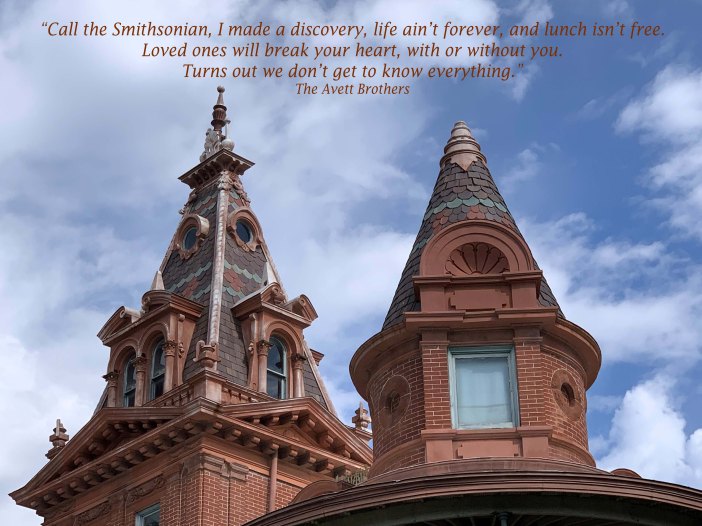
Photo of the Littlefield House (1893) on the UT campus, but it reminded me of the Smithsonian, which reminded me of this song.
No matter which of the four gospels we are talking about, the post-resurrection story is anticlimactic. They share that in common. I mean, how could it not be anti-climactic? Maybe that’s how it has flown under my radar so long – the seeming inconsistencies. Was Jesus recognizable after the resurrection or not?
Probably the most well-known post-resurrection story is that in Luke, the so-called Road to Emmaus story in Luke 24. You know the story. Jesus has died, but is now missing from the tomb. As “two of them” (whoever “them” is) are walking to Emmaus “Jesus himself came and walked along with them; but they are kept from recognizing him.” We aren’t given details on why “they” didn’t recognize him, only that they didn’t. And this is not a “didn’t recognize him” from across a room, in a brief glance, this is “they” didn’t recognize him in the 6 to 7 mile walk from Jerusalem to Emmaus. In a walk of about two hours, close enough to converse, “they” didn’t recognize Jesus. Those dudes need some glasses! It was not until they are eating later that day, after Jesus “took bread, gave thanks, broke it and began to give it to them” that “their eyes were opened and they recognized him.” We scratch our heads, of course, how would “they” not recognize him? It is almost enough to make us forget that the person they didn’t recognize had been dead and was alive again. Oh, that we understand – but how could “they” not recognize him”
Well, “they” are seemingly in good company. In John 20, when Mary Magdelene was standing outside the tomb, she has a conversation with Jesus but “did not realize that it was Jesus.” She tells him (you can hear the brave sternness in her voice): “Sir, if you have carried him away, well me where you put him and I will get him.” But the dialogue continues, and when Jesus answers her by name Mary Magdelene finally recognizes him. So seemingly, Mary Magdelene, though a little slow out of the gate, beats the “they” to the finish line in the race to recognition.
Compare “they” and Mary Madgelene to the story in Matthew, which is short on detail. The two Marys find an empty tomb and are running to tell the others: “Suddenly Jesus met them,” he greets them, and the two Marys recognize him, “clasped his feet and worshiped him.”
Finally, in Mark (in a section my Bible tells me was not in many of the early manuscripts) we see what is essentially a re-telling of the story from the other three Gospels, above – somewhat of a summary of those events.
It is easy (as it is always easy to be critical of others) to scratch our heads and wonder how “they” could have missed the obvious. The easy questions are there – Why do “they” and Mary Magdelene not recognize Jesus, at least not at first? And why do some come to recognition more quickly than others? What kept them from recognizing him immediately? Well, the answers that occurs to me, when I think on it, suggest that this all seems about right. My powers of recognition are about the same, or maybe not even that good. Sometimes I see Jesus immediately, but not generally. Not Jesus, himself, you understand, but Jesus in others. Sometimes it takes a while for the switch to flip and the light bulb to come on – if it indeed ever does. There are times, okay, many times, where Jesus has been right there in front of me and I missed him. I know that with surety because sometimes the clarity of that being in the presence of Jesus hits me well after the fact — a minute, an hour, a year, a decade later. Still, when the recognition comes it is powerful, even awesome.
I am, at best, “they.” At worst I am recognition-challenged, quick to see, slow to recognize. But the good news is that Jesus doesn’t give up easily. He kept walking with them on the Road to Emmaus despite the fact that “they” didn’t recognize him; he hung in there in dialogue with Mary Magdelene until the light bulb of recognition shone brightly. I do not/will not recognize from time to time, but it would be a shame to quit looking, quit trying to recognize Jesus just because I don’t always recognize Him immediately. In this I am reminded of one of my favorite quotes, from Justice Feliz Frankfurter: “Wisdom too often never comes, and so one ought not reject it merely because it comes too late.” If I just keep walking, keep looking, keep the dialogue open, the switch will flip on for me – it has and it will. And oh, what a glorious light when I finally realize he was/is there, right there beside me!
 It occurs to me...