Giving and Receiving

From the Not By Bread Alone Lenten devotional for today:

[C]an we view everything instead through a Gospel prism and realize once again, finally, that the light touches all of us…?  .”

I don’t think the writer meant that as a rhetorical question.

Partnership

I come into my own through God.  God comes into God’s own through me.  Same God, same deal.  That said, a lot of time and effort is made trying to come into my own by other means.  I like the analogy Anthony DeMello uses on this point.

“It’s like imagining that you change your handwriting by changing your pen.  Or that you change your capacity to think by changing your hat. That doesn’t change you really, but most people spend all their energies trying to rearrange their exterior world to suit their tastes.  Sometimes they succeed – for about five minutes – and they get a little respite, but they are tense even during that respite, because life is always flowing, life is always changing.”

There are two constants in the partnership.  One is a bit more steady than the other.

Reducing God To My Own Logic

A riff on my earlier note on Howard Thurman in Meditations of the Heart:

Thy shalt love:

              Thy God – “I shall not waste any effort trying to reduce God to my particular logic.”

Thy neighbor – “I shall study how I may be tender without being soft; gracious without being ingratiating; kind without being sentimental and understanding without being judgmental.”

Thyself – “I must have no attitude toward myself that contributes to my own delinquency.”

“I shall not waste any effort trying to reduce God to my particular logic.”  Boy, that’s the starting point of a lot of trouble, isn’t it – “reduc[ing] God to my particular logic.”  Underlying that thought, of course, are two thoughts – 1) that I can in fact understand God, 2) that I can understand how you understand God.  And those two conclusions somehow seem to lead to a third – having reduced God to my own logic and perceiving that I understand how you have reduced God to your own logic, I come (not surprisingly) to the conclusion that I am correct and you are wrong.  Wars have been fought on this. 

What comes to mind here is one of my favorite Anne Lamott quotes: “You can safely assume you’ve created God in your own image when it turns out that God hates all the same people you do.”  I do struggle a bit with the “waste of time” part.  Much can be learned from that effort.  But the problem is not in the effort so much as in the conclusion that I have in fact “cracked the nut” and have God all figured out. That’s when the trouble starts.
Thou Shalts

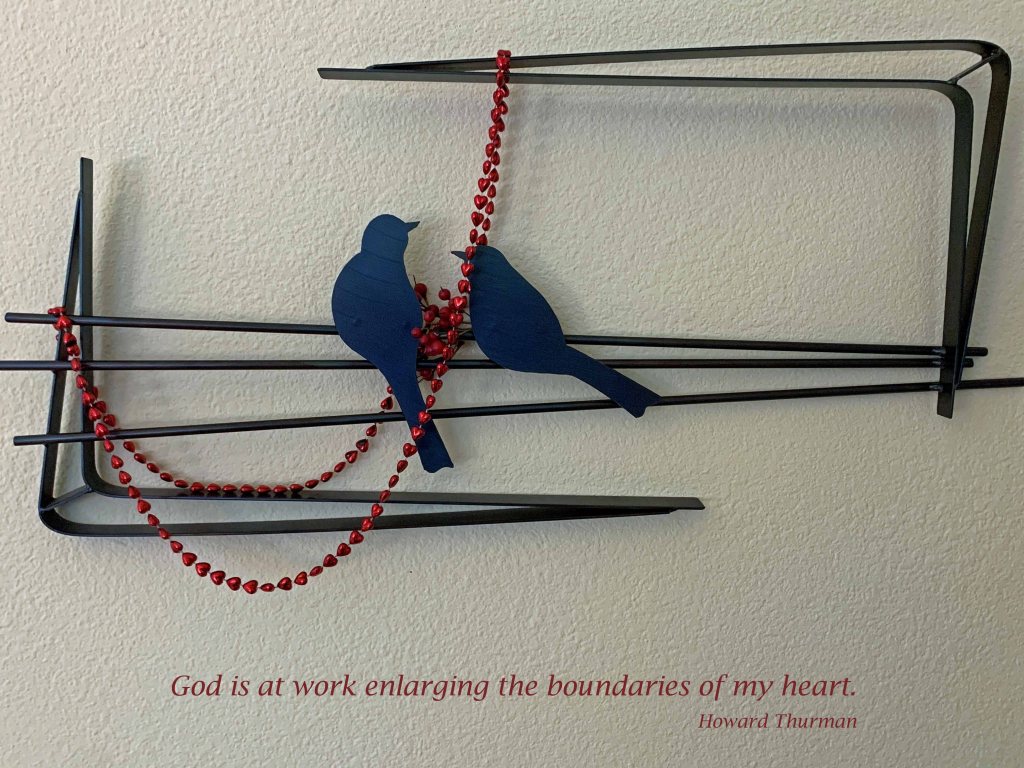
Such beautiful writing and wisdom from Howard Thurman in Meditations of the Heart, particularly in light of Valentine’s Day approaching:

Thy shalt love:

Thy God – “I shall not waste any effort trying to reduce God to my particular logic.”

Thy neighbor – “I shall study how I may be tender without being soft; gracious without being ingratiating; kind without being sentimental and understanding without being judgmental.”

Thyself – “I must have no attitude toward myself that contributes to my own delinquency.”

Seeing Things/People

Back today, thanks to Anthony DeMello in Awareness, to a recurring theme:

“We see people and things not as they are but as we are.  That is why when two people look at something or someone, you get two different reactions.  We see things and people not as they are, but as we are.”

Seems like infallible logic to me, particularly given that the principle is supported by the sage wisdom of Brad Paisley in I’m Still a Guy”

“When you see a deer you see Bambi, I see antlers up on a wall.

When you see a lake you think picnics and I see a largemouth up under that log….

When you see a classic French painting, I see a drunk, naked girl.

You think that ridin’ a wild bull sounds crazy, but I’d like to give it a whirl.”

Two people, two different perceptions/reactions.  That is not, of course, an inherent problem – people can and do see things differently.  However, conflict can arise when (hypothetically speaking, of course) when (not if, when) one person insists that his/her perception/reaction is the correct one, and in fact the only correct one (think “fake news” and “alternative facts”).  That is where the trouble starts, the trouble being directly proportional to the insistence.

The grace in all this hides in the problem itself.  If I see things as I am, it follows that when I change, it changes how I see things.  Or as DeMello puts it: “The day you are different, they will become different.  And you will see them differently too.”

Miraculously, it is the same for everyone. 

The “Great Exposure”

Howard Thurman writes today about “the nourishment of the Great Exposure.”  A nice phrase, no – the “Great Exposure.”

“We are surrounded every day by the exposure to sudden and devastating calamity. Despite all efforts to the contrary, there is no device by which we might get immunity from the ‘slings and arrows of outrageous misfortune.’”  Granted, some may seem to by and large escape the more outrageous misfortunes, some not, yet my experience is that I am not only a poor judge of my own misfortunes, and perhaps more so (if I perceive them at all) the misfortunes of others.  As Thurman puts it: “Life is vulnerable – always there is the exposed flank.”  This is where I hear Thurman offering the “good news/bad news” conundrum: “It is the way of life that it be nourished and sustained by the constant threat, the sudden rending.” 

I am reminded here of Coleman Bank’s translation of Rumi’s The Guest House:

A joy, a depression, a meanness

Some momentary awareness comes

As an unexpected visitor

Welcome and entertain them all

Even if they’re a crowd of sorrows,

who violently sweep your house

empty of its furniture,

still treat each guest honorably.

He may be cleaning you out for some new delight.