Now and then my camera creates an image on its own and reminds me…
Now and then my camera creates an image on its own and reminds me…
In today’s reading, Howard Thurman takes on “the primary question,” which he identifies as: “Is this a world with moral meaning at the center.” This is, he writes, a question that “must be answered before other questions can even be asked.” That was enough to get my attention.
At the outset. Thurman recognizes the difficulty of the task ahead – this “primary question…can never be answered with proof and finality, but some answer must be given on the level of faith.” Still, he notes, one cannot sidestep the question, for “to decide not to decide it to decide against.” Adding to the challenges, one can “make this affirmation with gusto and enthusiasm without really meaning it” not because of insincerity but “simply because there is evidence on either side. We see the sordid and tragic in life, we see the pain and suffering…. Then we see beauty, truth, love, and fulfillment.” This debate churns with us. As Thurman puts it, “the evidence is always straining within us. In consequence we may decide intellectually in favor of meaning, only to find our subconscious casting a dissenting ballot.”
At this point, however, Thurman makes a significant pivot away from the intellectual and emotional battle inside us and places the issue firmly before us and the rest of the world:
“Therefore, the great labor of life, after we have made the initial life affirmation, is to validate the decision in practice. After all, how can one believe that life has meaning if his own life does not have meaning. No words, no matter how eloquently and enthusiastically uttered, can replace the expressiveness of action. Indeed, words become true when they are lived, and they become untrue when the living of them is neglected. We shall always be ambivalent and our ‘Yes’ will never have the total assent of our total wills. Our great labor is simply to bring active affirmation as close as possible to the vocal affirmation. All else is subsidiary.”
Two points. First, I so love the “as close as possible” nod Thurman gives to recognize the difficulty of the task. A full match up of words and deeds would be great, but just get “as close as possible.” Whew! Second, provides insight as to Matthew 5:37 – “Let your “yes” be “yes” — not just in word, but in deed also.
Photo taken last week, fallen flower on pavement.

Photo taken on the beach last week
Driving around recently I saw a bumper sticker on a car and the word “gratitude” caught my eye. it seems to me that one doesn’t see that word on many bumper stickers. It was a small square bumper sticker with small print, and the road grime that covered it made it even more difficult to read. Luckily, we both caught a light, and so I had a chance to read the full message:
“Gratitude for all there is, and for all there isn’t.”
I am still pondering those ten words days later.
“Gratitude for all there is” — It occurs to me that gratitude for what there is is challenge enough. It is easy to take things, blessings if you will, for granted, and in my experience, though it seems counterintuitive, the more things and blessings I have, the more difficult it becomes to be grateful for them. That is, the easier it is to take them for granted.
“Gratitude for all there isn’t.” – Well, this is an even greater challenge, to be grateful for what we don’t have. Of course there are things we don’t have and don’t want, some problem, trouble or disease for instance. You’d think it would be easy to be grateful for their absence, though of course there is that schadenfreude thing to contend with. But even more challenging is to be grateful for things we want but don’t have, or that we want more of.
No answers here, but still savoring the thought:
“Gratitude for all there is and for all there isn’t.”
Photo taken yesterday in Kona, Hawaii, song is an old favorite.
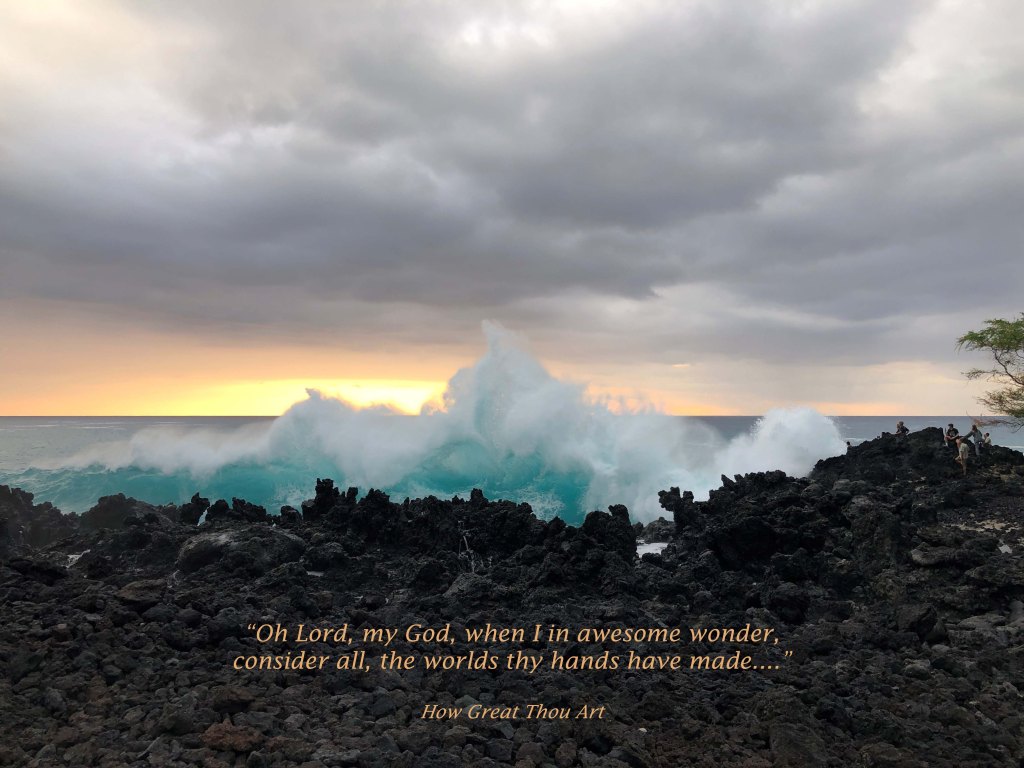
Photo taken in Galveston under the Pleasure Pier, which, apropos to the text, was previously the Flagship Hotel pier, until said hotel was seriously damaged by a hurricane and repurposed as an amusement park of sorts.
As to the quote, Bowler was speaking to the unsettling nature of the pandemic, which in many ways has “shuffled the deck” on our lives, or at least caused us to entertain the thought of looking at things differently.
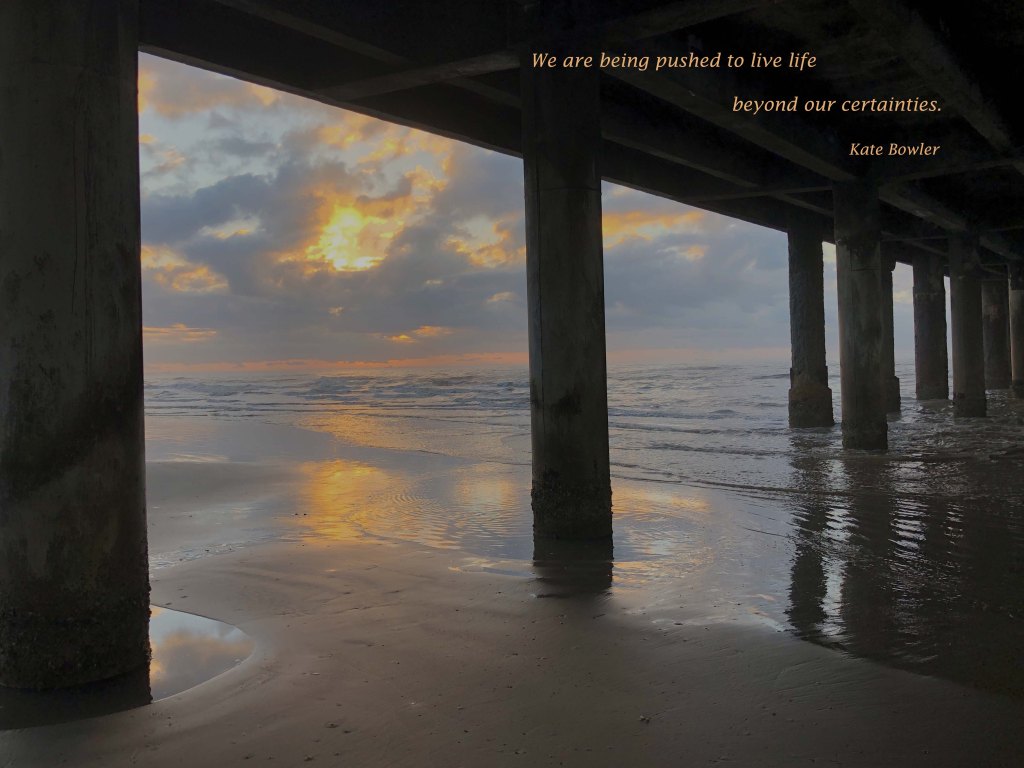
Listening on a recent run, I heard this quote from Kate Bowler on her Everything Happens podcast, commenting on pandemic life:
“We are being pushed to live beyond our certainties.”
Indeed we are, and it is quite uncomfortable at times, walking out with less than full knowledge and understanding. But then came the epiphany realized in the next mile — “full knowledge and understanding” was never really a thing, it just felt more like a thing then that it does now. It occurs to me that my certainties are, or at least in many cases, ought to be like the horizons (okay, hilltops) I focus on as I run – when I get there, I find there is more beyond.
From Anthony DeMello:
Student: “Master, what is the secret of your serenity?”
Master: “Wholehearted cooperation with the inevitable.”
From Howard Thurman:
“There is a general notion abroad that the wise man accepts the universe, accepts life. The notion is sound because it reveals a direct understanding of the most elementary fact of life, namely, that the universe is here and we are in it.”
I like those shorthand reminders – “cooperation with the inevitable” and “the universe is here and we are in it.”
To these I would add a third:
To carve an elephant, I need not create the block of wood.
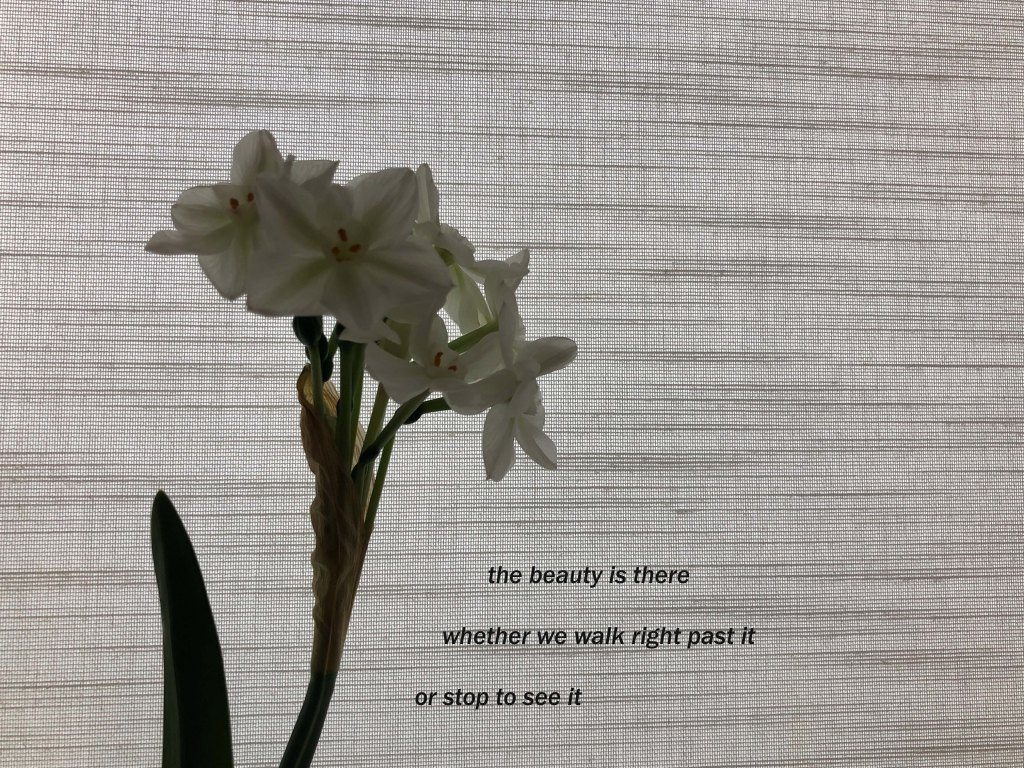
Photo taken of a paper white narcissus in our shaded kitchen window. (A Christmas tradition, but they are a bit late to the bloom this year. The window faces east so there is some nice morning light against it.
 It occurs to me...