Haiku Wednesday

Riding my bike along Seawall in Galveston today I heard an exasperated parent use this line with one of his kids. I am sure I used it long ago with my kids, but the absurdity of the line (its hubris and illogic, among other points) hit me today as I heard it.

Photo is just a filtered black background.

What does the world mean to you?

Much to think about today in Mary Oliver’s October, including this tricky little question:

“What does the world mean to you if you can’t trust it to go on shining when you’re not there?”

On the one hand I have the ability to think that the world will do just fine without me.  (There is, after all, empirical proof of that since it did okay for a few years before me, and I have seen it continue to function as some depart.)  On the other hand (there always seems to be another) I worry about how the hell things can possibly function without me. (Okay, hubris and hyperbole, but still, I think you get the point.  I worry.)

Of course the world with “go on shining” when I am not.  All the more reason, as if one needed it, to focus less on “me” and more on “the world.”

Self-Righteousness Anonymous

In one of those situations where the writing is both tongue-in-cheek and viciously pointed, Howard Thurman takes on Self-Righteousness Anonymous.

“It is an organization without structure, without form, without location, and without offices.  Every person who belongs to it holds all the offices at one and the same time, for each member is the organization.  It is a very old group, as old as the first mistake.”

I’ve heard about this organization [throat clear].  How does one identify members?   Anonymous:

“In every discussion their word must be taken at its face value.  Others may have to prove what they say, make a clear case for their position; not so with S. R. Anonymous.  When he speaks, Truth has spoken.  When he is tolerant, it is a benevolent toleration, the kind that a German police dog may have for a poodle pup.  To be sure, mistakes may occur…but they are always due to extenuating circumstances for which someone else is responsible.”

Thurman rightfully notes that all of us are candidates for membership in Self-Righteousness Anonymous, benevolently omitting the suggestion that some may have attained a lifetime membership, but at the same time Thurman kindly suggests how one can easily cancel one’s membership: “One of the sure results of self-examination in the light of the Highest is an immediate humility and a canceling of one’s membership in Self-Righteousness Anonymous.” There it is again! That recognition that the world does not, in fact, revolve around me always shakes things up.


Haiku Wednesday

I see a lot of pavement as I run, and continuously see hardware scattered along the road. Occasionally I’ll stoop over and stick a piece in my pocket. Which ultimately leads to this commentary on that reality, or on recent events, however one chooses to take it.

The Illusion of Completeness

Today from Howard Thurman – the illusion of completeness.

“There is something incomplete about coming to the end of anything….  The fact is, one never comes to the end of anything.  Something always remains, some deposit, some residue that mingles with the stream of one’s life forever.  In that sense there can never be an end to anything; something remains.”

It occurs to me that the sooner one accepts that, the “incompleteness,” the quicker peace settles in.  I am reminded of this from Kate Bowler:

“I have always thought that there was a there somewhere, and I just needed to get there.  [But] the point of life is not doneness.  I am letting myself off the hook for the feeling that there’s going to be a finished life for me.”

As Thurman notes — “There is something incomplete about coming to the end of anything….”

Photo and Text Sunday

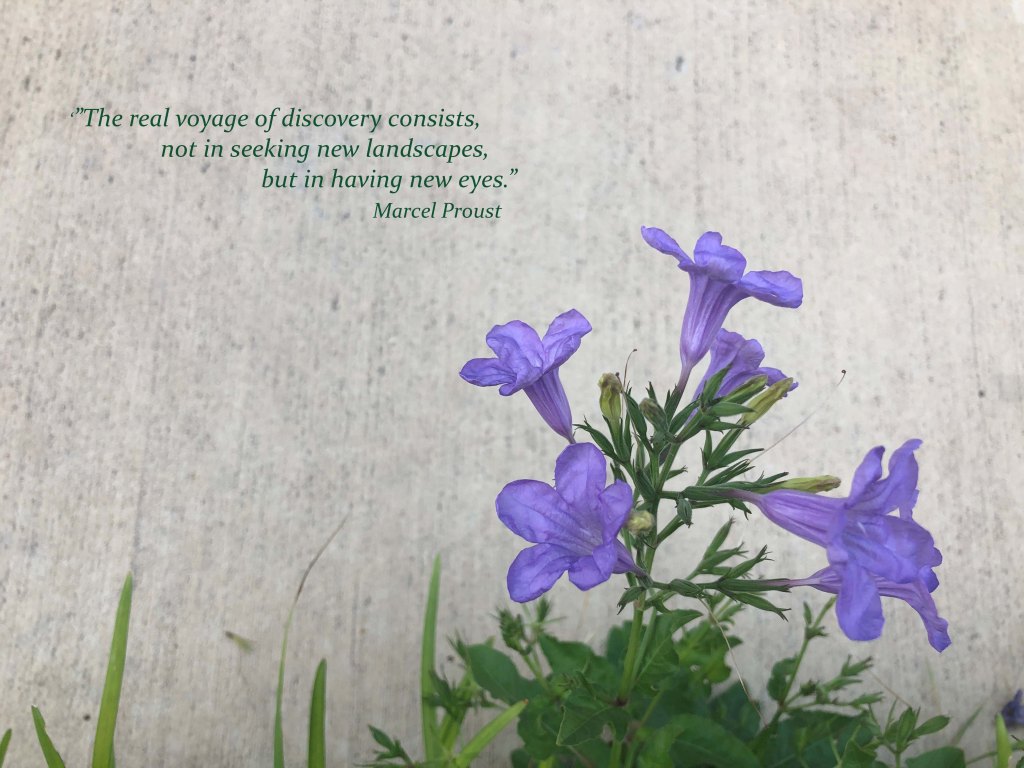
Today’s photo was taken of these purple flowers that grow wild around Austin, and l assume elsewhere. I generally don’t really notice them as they are plentiful and, well, I consider them to be weeds (a whole ‘nother lesson there), but on this day this bunch caught my eye on a run as it extended out over the sidewalk, giving me the opportunity of “having new eyes” as I looked at them — and to the point, gave me a photo for this quote I have had sitting on a post-it note on my desk.

Dingy Sleeves

Howard Thurman points out a paradox today, that as children we often strive to be more like grown ups, and grown ups we often strive to be more like children.  He notes that as adults we can easily feel we have seen it all and can arrive at a point in which we have “no response for surprises, for that which is breathlessly beautiful.” That is, we are at high risk for becoming world-weary (the German “weltschmerz”), or as Thurman puts it, “incapable of the tremor of sheer delight or the thill of intense awe and wonder.” Thurman’s encouragement is “to recapture the wonder of little children, to know once again the fresh feel of the unknown as we stand on the threshold of new adventure, this saves life from boredom and keeps it from growing dingy on our sleeve.”

And who wants life to become “dingy on our sleeve?

Quiet Faith of Man

This song, written by Bill Staines, song by Jerry Jeff Walked, bubbled up on my playlist today and hung around in m head. Songrwiting at its best, particularly the chorus:

You can trust the moon to move the mighty ocean

You can trust the sun to shine upon the land

You take the little that you know, and you do the best you can

And you see the rest as the quiet faith of man

Walker

https://www.google.com/search?gs_ssp=eJzj4tFP1zcsNjCtKClMKjFg9BIqLM1MLVFIS8wsyVDIT1PITcwDAL6cC0o&q=quiet+faith+of+man&rlz=1C1GCEA_enUS928US930&oq=quiet+faith+of+mman&aqs=chrome.1.69i57j46i13l2j0i13i30l2j0i5i13i30j0i390l3.6757j0j15&sourceid=chrome&ie=UTF-8

Staines