The Flowering of the Mood of Presence

From Howard Thurman, Deep Is The Hunger, on leisure:

“Time is of the essence in developing the inner life because, without a sense of leisure, the external world with its demands, emergencies, and crises, chokes the flowering of the mood of Presence.”

Boy, is there a lot there!    Those “demands, emergencies, and crises” can damn sure get me focused on the “external world” to the exclusion of “developing the inner life.”  Thurman, though, is ever the realist.  He is not reaching for the stars, trying to achieve leisure, but only “a sense of leisure.”  That is, as I read it, look up from those pressing demands of the external world from time to time and recognize the existence of and the need to nurture the “inner life.’  This is necessary to the  (I love this phrase) “flowering of the mood of Presence.”
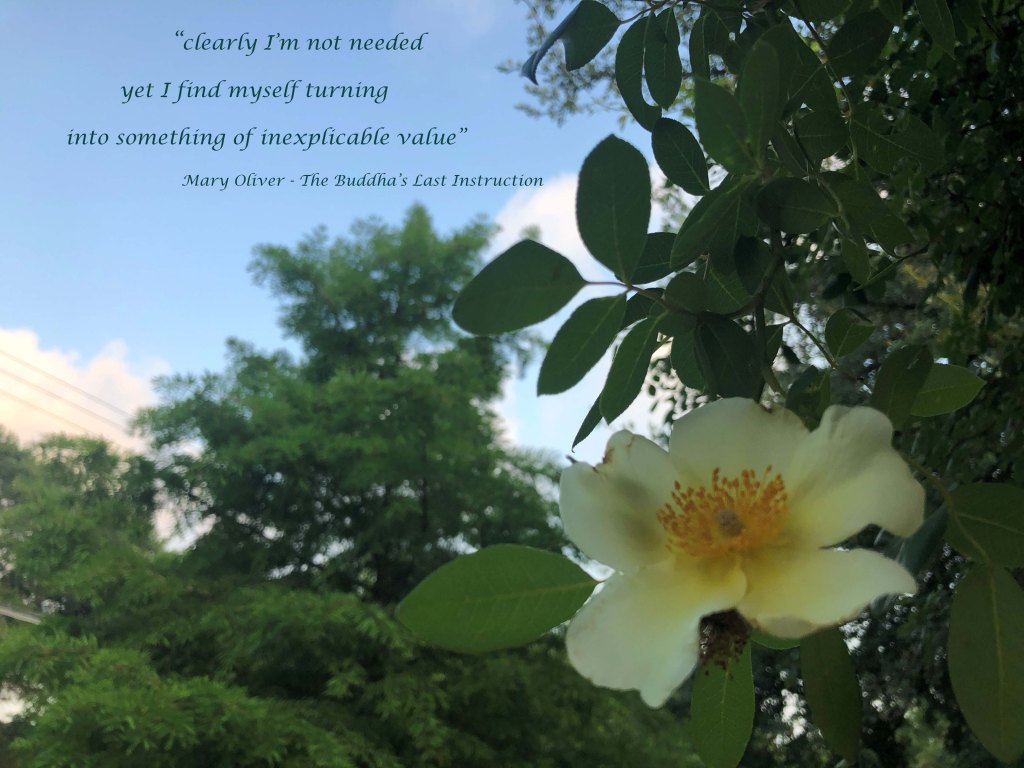
Photo and Text Sunday

Okay, I’ve never really cared for Leonard Cohen, or for this song (I find The Neville Brothers version of it better), but apparently a lot of people do like the song and the song (and a flashback to Hitchcock’s The Birds) is what made me take the photo — so here it is.

Namely, Myself

Today, one of my favorite passages from C. S. Lewis’ Mere Christianity:

“…hate the sin but not the sinner.  For a long time I used to think this a silly straw-splitting distinction: how could you have what a man did and not hate the man?  But years later it occurred to me that there was one man to whom I had been doing this all my life – namely myself.”

Indeed it is so.  The lesson here seems pretty straightforward.  If I can reconcile the sin/sinner conundrum with myself, well then, resolving it with that guy ought to be achievable.

Of Course!

Today, from Mary Oliver’s The Swan:

“Of course!  The path to heaven doesn’t lie down in flat miles.”

Of course it doesn’t — though not for my lack of trying to make it, wishing it were, so.

Choosing Attitude

Victor Frankl refers to the choosing of attitude as “the last of human freedoms.”  When all other freedoms are gone, that one remains.  Thankfully, though, we are allowed to exercise that choice at any point, not only when it is all that remains.