Author: itoccurstocp
Quite Simple?
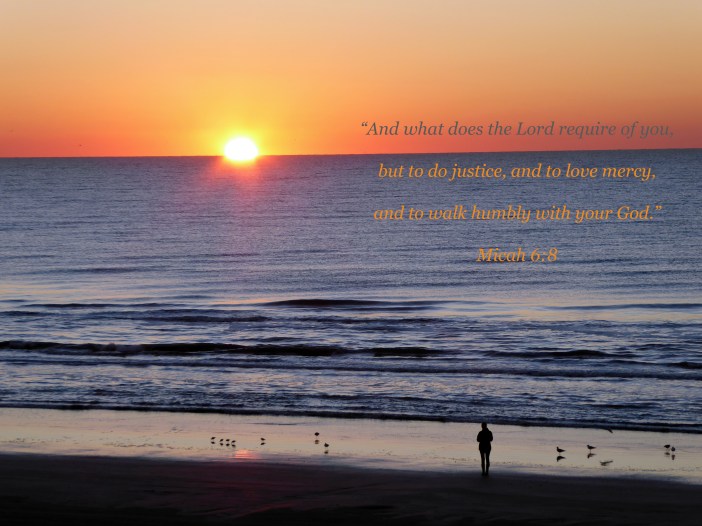
“And what does the Lord require of you, but to do justice, and to love mercy, and to walk humbly with your God.” Micah 6:8 (NIV)
I ran across this passage today and started looking up other translations and interpretations. Ultimately, I fell upon this one. I am no Greek scholar but this one from Eugene Peterson’s The Message felt right:
“But he’s already made it plain how to live, what to do, what God is looking for in men and women. It’s quite simple: Do what is fair and just to your neighbor, be compassionate and loyal in your love, and don’t take yourself too seriously — take God seriously.”
Indeed, the concept is “quite simple.” The application, well, that’s a bit more challenging.
Perfection/Perseverance
“It is not perfection that leads us to God; it is perseverance.” Joan Chittister
I read this and immediately thought of Matthew 5:48: “Be ye therefore perfect, even as your Father which is in heaven is perfect.” Of course, the aspiration for perfection in life is just that, an aspiration. Luckily, when I persevere, God fills in the gaps, the imperfections, with His grace and forgiveness.
Stuff Happens
“I have told you these things, so that in me you will have peace. In this world you will have trouble. But take heart! I have overcome the world.” John 16:33
If one wanted to put this passage on a bumper sticker, the “Shit Happens” bumper sticker would work nicely – though that might not fit nicely in the church bulletin announcing the lesson for the day. Commenting on this passage today, Oswald Chambers puts it a bit more appropriately: “An average view of the Christian life is that it means from trouble. It is deliverance in trouble, which is very different…. God does not give us overcoming life: He gives us life as we overcome.”
Intellectually, I understand this. Stuff happens. Still, it occurs to me that I go through life being upset when stuff (the stuff I know will happen) does happen. In this sense, I want the fruit without the tree, the juice without the squeeze. Stuff does happen. Stuff will happen. I assume that the Psalmist was thinking down this path when he wrote:
“God is our refuge and our strength, an ever-present help in times of trouble. Therefore we will not fear, though the earth gives way and the mountains fall into the heart of the sea, though its waters roar and foam and the mountains quake with their surging.” Psalm 46:1-3
Haiku of the Whenever – beautiful sunsets
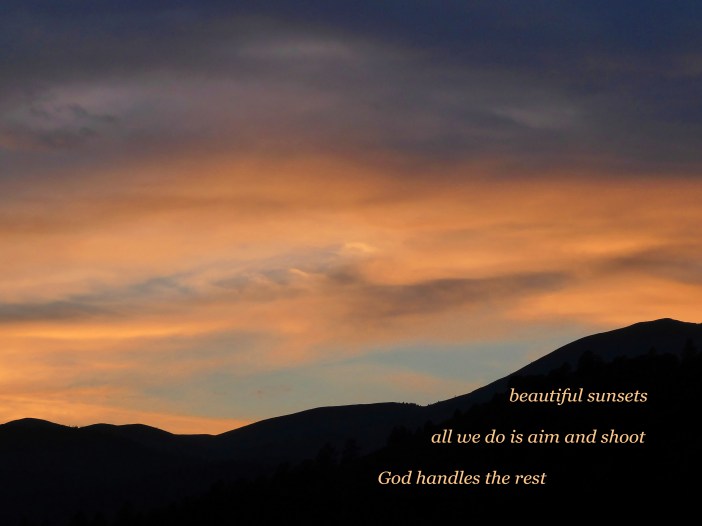
Photo taken from our patio in New Mexico tonight
It’s Happy Hour!

Photo shot at The Lodge in Cloudcroft, New Mexico. My wife, green chile wine, and the New Mexico sky. A Triple Crown for sure!
More on coming to faith
“My coming to faith did not start with a leap but rather a series of staggers from what seemed like one safe place to another. Like lily pads, round and green, these places summoned and then held me up while I grew. Each prepared me for the next leaf on which I would land, and in this way I moved across the swamp of doubt and fear. When I look back at these early resting places…I can see how flimsy and indirect a path they made. Yet each step brought me closer to the verdant path of faith on which I somehow stay afloat today.” Anne Lamott – Traveling Mercies
The imagery of the “lily pads” speaks so well as to the journey of faith, the “series of staggers from what seemed like one safe place to another. What is/seems at one point like solid footing, like a good resting place can, with a shift to a slightly different position or point of view, become shaky, necessitating a move to the next place to be held up, the next place to grow. Faith is not factual certainty. I need not take a “leap of faith” if there is the certainty of solid ground beneath my feet. I am no fan of change, but a walk of faith seemingly necessarily involves a “swamp of doubt and fear” in which beliefs are considered and/or reconsidered, are cast away or embraced more firmly.
Coming to faith
Having recently finished one book, I perused my bookshelf looking for the next thing to read, or re-read. No matter how many times I read it I always identify with the opening paragraph from Anne Lamott’s Traveling Mercies. It is so chock-full of truths:
“My coming to faith did not start with a leap but rather a series of staggers from what seemed like one safe place to another. Like lily pads, round and green, these places summoned and then held me up while I grew. Each prepared me for the next leaf on which I would land, and in this way I moved across the swamp of doubt and fear. When I look back at these early resting places…I can see how flimsy and indirect a path they made. Yet each step brought me closer to the verdant path of faith on which I somehow stay afloat today.”
It occurs to me that “coming to faith” is, for many if not most, not so much as a “leap” as “a series of staggers.” “Leap” seemingly implies a purposeful path precisely from Point A to an intended, exact Point B. I suppose that happens with some people, but it has not been, is not, my experience. No, Lamott’s “series of staggers” seems more appropriate as it implies a meandering journey filled with somewhat equal parts well-intentioned purposefulness and pure dumb “luck” (or what was perceived as “luck”) seasoned heavily with grace and forgiveness. And then there is the “”what seemed like one safe place to another.” “Seemed like” is the key language there for me. As I “stagger” it is not always abundantly clear what is or is not a/the next “safe place.” Often I stand at the decision point fork long enough to feel like the traveler in Robert Frost’s poem The Road Not Taken, not quite sure which path to take – though I have not always taken the road less traveled.
I am thankful for patience
Find Me a Hammer
“Be perfect, therefore, as your heavenly Father is perfect.” Matthew 5:48
I ran into this passage again today, this time in C. S. Lewis’ Mere Christianity. Lewis, as he is inclined to do, takes it in an interesting direction with a parable. Suppose, he writes, I am living in a house and God comes to visit and help me do some work around the house. I may have in mind what needs to be done around the house — fix this and that, some new paint here and there, plant a few things outside. God, however, has different plans. He starts knocking down walls, adding on rooms or floors, adding gardens and courtyards. Once I invite God in, He plans on living here. As Lewis puts it:
“You thought you were going to be made into a decent little cottage: but He is building a palace. He intends to come live in it himself. The command “be ye perfect” is not idealistic gas. Nor is it a command to do the impossible. He is going to make us into creatures that can obey that command.”
I guess I best go find me a hammer.
 It occurs to me...